Credit unions run on trust their members can feel, which makes a badly handled delinquent account a different kind of risk than it is for a bank. Recover the balance the wrong way and you don’t just lose the receivable, you lose a member, their referrals, and a story that spreads through a tight-knit field of membership fast. Nexa Collections recovers past-due loans, overdraft balances, and charged-off accounts through a member-centric process built specifically for credit unions.
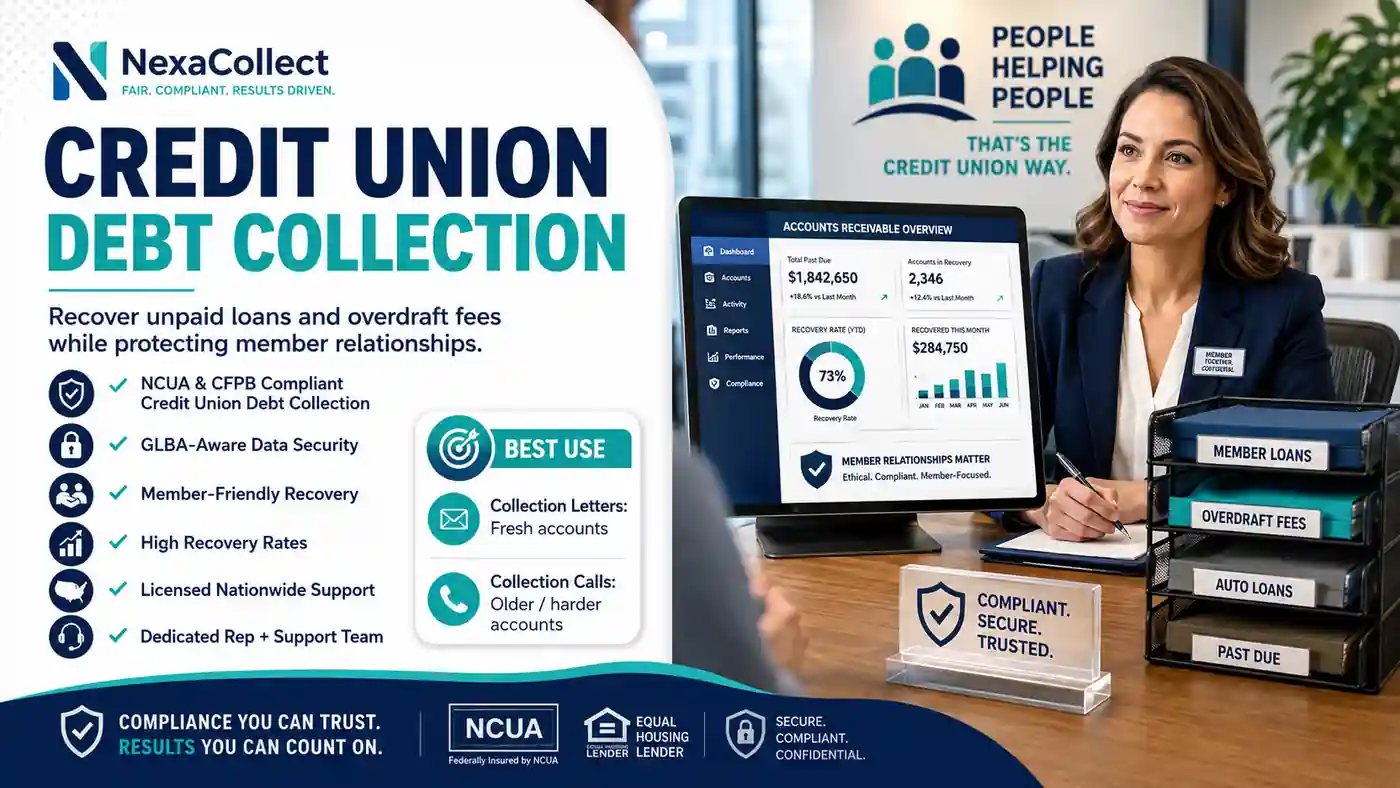
Quick Answer: Credit union debt recovery requires balancing NCUA and CFPB regulatory compliance with a member-centric approach that protects community trust. Nexa provides 50-state licensed, GLBA and SOC 2 Type II secured credit union debt collection starting at a $15 Fixed Fee Service per account. Backed by a 4.85/5 rating across 2,000+ reviews and a dedicated financial services support team, our soft Fixed Fee approach helps credit unions recover overdrawn share accounts, credit card defaults, personal loans, and auto deficiency balances while retaining 100% of recovered principal.
Nexa provides reputation-safe approach, equipped with all 50-state collections license, offering free credit reporting, free litigious debtor check, free bankruptcy scrub, and zero onboarding fees. Secure – SOC 2 Type II & HIPAA compliant. Over 2,000 online reviews rate us 4.85 out of 5. Every credit union is assigned a dedicated account executive, backed by a specialized financial services support team, not a general call queue.
Stop Losing Money. Get Paid Now
Credit unions now manage trillions in assets and a large, diverse loan book: auto, cards, HELOCs, personal loans, indirect paper, and small-business credit. With that growth has come more loans rolling into 60/90+ days past due, higher net charge-off ratios than in the low-rate years, rising delinquencies in auto and unsecured portfolios, and heavier exam focus on credit risk and third-party oversight. Inside many credit unions, a small team is juggling early-stage calls, repossessions, charge-offs, legal files, bankruptcies, and member service, it’s easy for late-stage, lower-priority accounts to fall through the cracks simply because there aren’t enough hours in the day.
AR Pain Points Credit Unions Struggle With
- Thin internal collections staff — A handful of collectors handling everything from reminder calls to legal files.
- Complex relationships — Co-borrowers, cross-collateralized loans, indirect portfolios, and members with multiple products.
- Overdrafts and fee-driven balances — Small but noisy accounts that can generate complaints and bad reviews.
- Reputation risk — One harsh collection experience can undo years of member goodwill and word-of-mouth.
- Compliance pressure — Examiners expect documented processes, secure data handling, and controlled use of third-party vendors.
These are the reasons many credit unions keep early-stage work in-house, and push tougher, late-stage or charged-off accounts to a specialized agency that understands their environment.
Our Pricing

Nexa $15 Fixed Fee Service. $15 flat fee per account, 0% commission, credit union retains 100% of recovered principal. Ideal for early-stage defaults and courtesy pay negative share accounts, typically under 120 days past due, where a formal third-party letter often gets attention and cures the balance.
Contingency Recovery (Late-Stage Defaults). Performance-based recovery for aged, uncontactable, or charged-off accounts. No fee is paid unless funds are recovered. Best for accounts over 120 days past due, broken promises, repeat delinquents, and charged-off balances your team doesn’t have time to chase. Legal action can be considered through a network attorney, with your approval, when the balance and circumstances justify it.
What $50,000 in Delinquent Share Accounts Actually Nets Your Credit Union
A simple static example, $50,000 in delinquent share account balances, an 80% eventual recovery rate ($40,000 collected):
| Nexa $15 Fixed Fee Service | Traditional 35% Contingency | |
|---|---|---|
| Amount recovered | $40,000 | $40,000 |
| Fee (50 accounts × $15) | $750 | $14,000 (35% of recovered) |
| Credit union keeps | $39,250 (98.1%) | $26,000 (65%) |
Specialized Credit Union Product Portfolio Expertise
Negative Share / Courtesy Pay Defaults. Soft recovery for overdrawn checking and savings accounts before charge-off, the small, noisy balances that generate a disproportionate share of member complaints if mishandled.
Credit Card & Unsecured Personal Loans. Diplomatic outreach for past-due unsecured member credit lines.
Auto Loan Deficiency Balances. Recovering the remaining balance after collateral repossession and liquidation, or after an indirect loan default.
Indirect Lending Delinquencies. Managing defaults from dealer-originated credit union loans, where the member relationship began at the dealership rather than the branch.
Compliance That Protects Your Charter, Not Just Your Recovery Rate
Credit union collections carry a regulatory layer general collection agencies don’t always understand.
- NCUA guidelines. Examiners expect documented third-party vendor oversight, and a collection partner should be built to satisfy that review, not just pass a sales conversation.
- GLBA (Gramm-Leach-Bliley Act). Financial privacy standards governing how member data is stored, transmitted, and disposed of.
- CFPB Regulation F, FDCPA, TCPA. Federal rules governing communication frequency, required disclosures, and prohibited practices.
- SCRA (Servicemembers Civil Relief Act). Given how many credit unions serve military-affiliated fields of membership, this is routine due diligence, not an edge case. Before pursuing a servicemember’s account: interest on debt incurred before active duty began can be capped at 6% upon the member’s written request and supporting documentation; repossessing property financed before active duty generally requires a court order if the servicemember made a deposit or payment before entering service; and before any default judgment is entered against a non-responsive member, active-duty status must be verified against the Department of Defense’s database, entering judgment without that check is itself a violation.
In-House Collections vs. Traditional Aggressive Agency vs. Nexa’s $15 Fixed Fee Service
| Factor | In-House Collections | Traditional Aggressive Agency | Nexa’s $15 Fixed Fee Service |
|---|---|---|---|
| Upfront cost | Staff time, no direct cash outlay | Often 35-50% contingency regardless of account age | $15 flat fee, credit union keeps 100% of what’s recovered |
| Member retention & community reputation | Depends entirely on staff tone and training | Low, aggressive scripts risk complaints and word-of-mouth damage | Higher, diplomatic outreach designed to preserve the member relationship |
| Regulatory compliance (NCUA/Reg F/GLBA/SCRA) | Depends on internal training and documentation discipline | Varies, generic scripts may miss financial-institution-specific rules entirely | Built around NCUA vendor-oversight expectations, GLBA, and SCRA from account intake |
| Account management | Whoever’s available, often inconsistent | Often a standard call center | Dedicated account executive backed by a specialized financial services support team |
What a Good Credit Union Collection Partner Looks Like
When you send accounts to an outside firm, you’re not just outsourcing phone calls, you’re trusting them with member relationships. You should expect bank-level security and privacy (GLBA mindset, secure file exchange, access controls), strong regulatory alignment with FDCPA, FCRA, Reg F, TCPA, and state rules, a member-friendly tone that’s firm but respectful and aligned with your brand and culture, omnichannel outreach (letters, calls, email, text where allowed, with proper consent), and actionable reporting, recovery by product, delinquency bucket, and campaign, so you can show results to leadership and examiners. A good partner feels like an extension of your AR team, not a black box you hope is doing the right thing.
Serving Credit Unions NationwideNeed a Collection Agency? Contact UsHigh Recovery rate. Referrals of existing Credit Union clients can be provided if requested. |
Internal Moves That Lower Delinquencies
External collections work best on top of solid internal practices. High-performing credit unions usually monitor portfolios frequently rather than just at month-end, reach out early at 15–29 days past due, offer realistic, time-bound workout options for short-term hardship, educate members about autopay, due dates, and the impact of missed payments, and segment high-risk groups (indirect auto, higher-risk tiers, repeat delinquents) to decide earlier when to move them to third-party collections. Your collection partner can help refine these strategies so you’re not relying on manual lists, scattered notes, and overloaded staff.
How a Specialized Agency Works With Your Credit Union
For late-stage and charged-off accounts, a credit-union-savvy agency can take over outbound campaigns on older auto, card, and unsecured loans, handle repossession deficiencies, judgments, and post-charge-off recovery, use skip-tracing and other tools within legal limits to locate harder-to-reach members, and recommend legal action only when it makes economic sense and fits your risk appetite. The tone matters: the goal is to recover what’s owed, explore realistic arrangements where possible, and avoid burning bridges with members you may want to keep in the long run.
Recent Recovery Results
Regional Federal Credit Union — Overdrawn Negative Share Accounts:
A regional credit union placed 210 charged-off negative share accounts totaling $126,000. Using Nexa’s $15 Fixed Fee Service, the credit union recovered $88,200 within 40 days while keeping 100% of recovered principal for under $3,200 in total fixed fees.
Community Credit Union — Unsecured Personal Lines & Credit Cards:
A community credit union faced $94,000 in defaulted unsecured personal lines of credit across 32 member accounts. Nexa’s soft Fixed Fee diplomatic outreach resolved 24 of the accounts in under 45 days, recovering $70,500 without a single CFPB complaint or damaged member relationship.
Credit Union Account Escalation Framework
When and how to transition delinquent member accounts to Nexa to maximize cash flow while protecting community trust.
Internal Member Outreach
Courtesy reminders, automated TCPA/SCRA pre-scrubbing, and soft phone calls prior to charge-off evaluation.
$15 Fixed Fee Service
Diplomatic outreach for overdrawn share accounts, personal LOCs, and auto deficiencies. 100% principal retained.
Contingency Recovery Drive
Advanced skip-tracing, credit bureau reporting, asset verification, and legal escalation for uncontactable debtors.
Case Study: Overdrawn Negative Share Portfolio Recovery
Nexa $15 Fixed Fee Service Net
Based on submitting 210 overdrawn share accounts ($126,000 total balance) and recovering 70% diplomatically. Total fee: $3,150 ($15/account) while retaining 100% of recovered principal.
Traditional 35% Contingency Agency
35% commission consumes $30,870 out of your credit union’s recovered funds.
+$27,720 Saved
Launch $15 Member Recovery Drive
*NCUA, CFPB Reg F, TCPA, SCRA & GLBA Compliant. Active 50-State Licensing with SOC 2 Type II Security.
Frequently Asked Questions
How does Nexa maintain NCUA compliance and GLBA data privacy standards when collecting member accounts?
Every account is handled with the documented processes and vendor oversight NCUA examiners expect, secure file exchange, role-restricted access, and audit-ready reporting, alongside GLBA-aligned data privacy standards for how member financial information is stored, transmitted, and disposed of.
Can a $15 Fixed Fee Service help recover overdrawn negative share (courtesy pay) accounts before charge-off?
Yes, and this is exactly the account type it’s built for. Fixed-fee letter campaigns work well on fresh, small-balance negative share accounts, where a formal third-party notice often resolves the balance before it reaches charge-off, without the credit union paying a percentage of a balance that’s often modest to begin with.
How do you perform mandatory Servicemembers Civil Relief Act (SCRA) and TCPA checks prior to contacting members?
Active-duty status is checked against the Department of Defense’s database before any account involving a potential servicemember proceeds toward legal action, since a default judgment entered without that verification is itself a violation. TCPA compliance is handled through documented consent tracking for any autodialed or text communication, particularly relevant for reaching members on cell phones.
How does Nexa handle auto loan deficiency balances after collateral repossession and liquidation?
The deficiency, the gap between what the vehicle sold for at auction and what was actually owed, is pursued as a standard unsecured balance once the repossession and sale process is complete, following the same diplomatic, documented approach used for other credit union accounts.
Will using an outside agency trigger negative member feedback or CFPB complaints against our credit union?
Not with a member-centric process. Nexa’s diplomatic, firm-but-respectful approach is specifically designed to resolve balances without generating the kind of aggressive interaction that leads to complaints, protecting the credit union’s standing with both members and regulators.