Restoration companies aren’t struggling because of lack of work. They’re struggling because cash flow, claims delays, and operational pressure are all hitting at the same time.
The restoration industry isn’t short on demand. It’s short on liquidity, and those are two very different problems with two very different fixes. A growing market, a widening insurance-payment gap, and a construction-wide labor shortfall are all landing on restoration companies at the same time, and none of the underlying data suggests any of it is easing.
The Market Is Growing, But the Number Depends on What You’re Counting
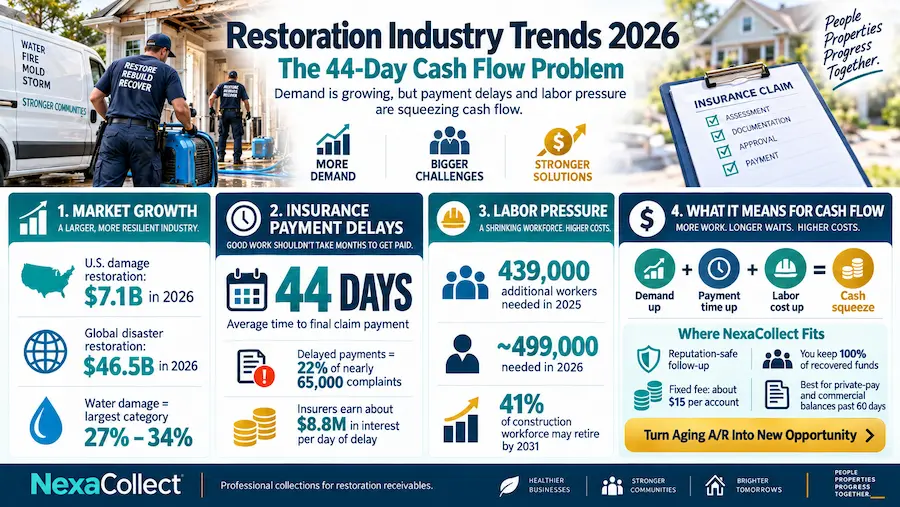
Restoration industry “market size” gets cited constantly, and the figures genuinely don’t agree, because different reports measure different things. IBISWorld’s narrower US-specific “damage restoration services” category puts the 2026 market at roughly $7.1 billion, growing modestly at under 2% annually. Broader “global disaster restoration services” market reports, which fold in a wider range of remediation, reconstruction, and international activity, put the figure considerably higher: Mordor Intelligence estimates $46.5 billion in 2026, growing at a 5.36% CAGR toward $60.4 billion by 2031; Fact.MR estimates $48.9 billion in 2026, projecting $89.1 billion by 2036. The gap between these numbers isn’t a data error, it’s a scope difference, and it’s worth knowing which one a given statistic is actually describing before repeating it.
What all of the reports agree on: water damage remains the largest single service category, generally cited between 27% and 34% of revenue depending on the source, and demand is climate-driven and not slowing down. The January 2025 Los Angeles wildfires alone caused an estimated $61.2 billion in damage, a scale of single-event demand that illustrates how concentrated and sudden restoration workload can become, and how quickly that workload can outstrip a local market’s capacity to get paid promptly for it.
Insurance Payment Delays Are Measurable, and the Number Is Getting Attention
This is the part of the cash-flow problem with the clearest, most current data behind it.
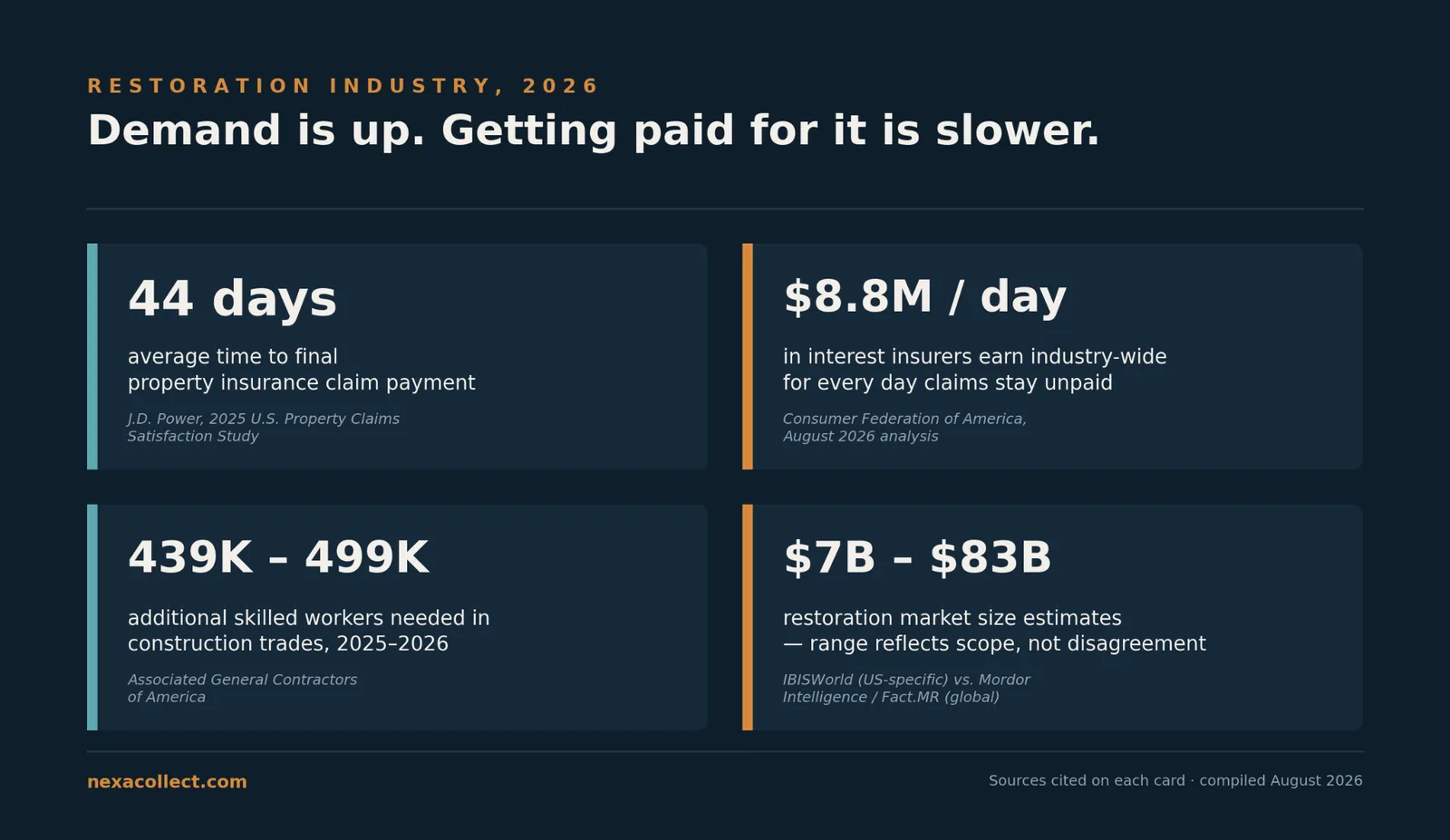
J.D. Power’s 2025 U.S. Property Claims Satisfaction Study found an average of 44 days to final claim payment. For a restoration company that’s already completed the work, that’s over six weeks between finishing a job and actually being made whole on it, assuming nothing complicates the claim further.
The scale of the underlying problem is bigger than any one company’s experience. The Consumer Federation of America published an analysis in August 2026 estimating that the homeowner insurance industry earns roughly $8.8 million in interest for every single day claim payments are delayed industry-wide, money sitting in insurer accounts rather than moving to policyholders and the contractors waiting to be paid. CFA also notes that delayed claim payments represent the single largest complaint category in the National Association of Insurance Commissioners’ database, accounting for 22% of the nearly 65,000 complaints state insurance commissioners received in 2025.
The pattern isn’t abstract. California’s own Department of Insurance reviewed a sample of 220 State Farm claims stemming from the 2025 LA wildfires and found 27 instances where the insurer failed to pay within the required 30-day window after agreeing to pay. That’s over 12% of a sampled batch missing a hard regulatory deadline, on claims tied to exactly the kind of large-scale disaster event that drives restoration demand in the first place.
Separately, homeowners are absorbing real cost increases alongside these delays: deductibles have risen an average of roughly 22%, and premiums around 8.5%, tightening the private-pay side of the equation at the same time the insurance-funded side is slowing down.
The Labor Market Restoration Draws From Is Genuinely Short-Staffed
Restoration technicians, water mitigation specialists, and reconstruction crews draw heavily from the same skilled-trades labor pool as general construction, and that pool is measurably strained. The Associated General Contractors of America estimated the industry needed 439,000 additional workers in 2025, climbing to roughly 499,000 for 2026 as construction spending continues rising. The demographic driver is structural, not cyclical: NCCER projects that approximately 41% of the current construction workforce will retire by 2031, a retirement wave the current pipeline of new entrants isn’t replacing at pace.
The practical effect on a restoration company’s cost structure is straightforward: wages for skilled trades have been rising faster than the broader labor market (construction wages grew roughly 4.2% year-over-year through mid-2025, ahead of the national average), while overtime, subcontractor premiums, and time-to-hire all move in the wrong direction for a company trying to protect margin on jobs that are already waiting weeks for insurance payment.
What This Actually Means for a Restoration Company’s Cash Position
Put the three trends together and the shape of the problem is clear: demand is genuinely up, but the time and cost required to get paid for meeting that demand is up too, and those two things are moving in the same direction at the same time. A company can be running at full capacity, completing quality work, and still be cash-constrained, not because the work wasn’t earned, but because a 44-day average claim cycle, a real chance of missed insurer deadlines, and rising labor costs are all compressing the same window.
For most restoration companies, this plays out as three distinct receivables problems layered on top of each other: insurance-pending balances waiting on a carrier that’s statistically likely to take over a month, private-pay and deductible balances that are smaller individually but growing as a share of total revenue, and aged commercial or property-management accounts that stretch terms because they can.
The first category is mostly a documentation and follow-up problem, tracking approvals like a project milestone rather than an afterthought, and pushing back on delays using the same regulatory deadlines regulators themselves are now scrutinizing. The second and third categories are where a structured, professional follow-up process, distinct from chasing the insurance carrier, tends to matter most, since these are the balances most likely to simply age past the point where internal staff have time to work them.
This is also where a low-cost, reputation-safe collection option earns its place, not as a first response to every slow payment, but as the tool for the specific slice of receivables that internal follow-up genuinely can’t reach: private-pay and commercial balances that have gone quiet after the standard 30-60-90 day sequence. Nexa’s fixed-fee model, roughly $15 per account with the company keeping 100% of what’s recovered, is built for exactly this stage, professional, low-pressure follow-up on accounts that are still fresh enough to resolve without an aggressive push, rather than a last resort used only once a balance is already effectively written off. See how the pricing structure works for accounts at different stages of aging.
|
Frequently Asked Questions
How long does it actually take to get paid on an insurance-funded restoration job?

According to J.D. Power’s 2025 U.S. Property Claims Satisfaction Study, the average time to final claim payment across the property insurance industry is 44 days. That’s an average, not a ceiling, and delays tied to large-scale events like wildfires or major storms can run considerably longer, which is part of why documentation and approval tracking matter more on catastrophe-driven jobs than routine ones.
Is the restoration industry actually growing, or is that overstated?
It depends on which market figure is being cited, since “restoration industry” gets measured differently across reports. Narrower US-specific figures put the market at roughly $7 billion with modest single-digit growth, while broader global “disaster restoration services” figures run into the tens of billions with growth rates around 5% annually. Both are accurate for what they’re measuring; the confusion comes from treating them as the same number.
Why are insurance claim payments taking longer than they used to?
Several forces are compounding at once: rising claim complexity, documentation and review cycles that haven’t kept pace with claim volume, and, according to a 2026 Consumer Federation of America analysis, a financial incentive problem, insurers earn meaningful interest income on funds they haven’t yet paid out. Regulatory scrutiny is increasing in response, including state investigations into insurers missing required payment windows after major disaster events.
How does the construction labor shortage actually affect restoration companies specifically?
Restoration technicians and reconstruction crews are drawn from largely the same skilled-trades labor pool as general construction, so the same shortage driving up wages and hiring timelines in construction affects restoration staffing and cost structure directly. Industry estimates put the construction labor gap at roughly 440,000 to 500,000 workers annually, with a significant share of the existing workforce projected to retire by 2031.
At what point should a restoration company consider professional collections instead of continuing internal follow-up?
Generally once an account has gone through a structured internal sequence, typically 60 to 90 days of documented reminders and follow-up, without resolution, and internal staff no longer have realistic bandwidth to keep pursuing it without pulling attention from active jobs. This is usually most relevant for private-pay and commercial accounts rather than insurance-pending balances, which are better addressed through documentation and carrier escalation.
Does using a collection agency risk the customer relationship or a bad review?
Not if the approach is diplomatic and professional rather than aggressive. A calm, formal notice resolves most balances without generating the kind of confrontation that leads to a negative review, and for a restoration company specifically, reputation carries outsized weight given how often referrals and repeat relationships (property managers, insurance adjusters, past customers) drive future work.