San Francisco Bay Area — A Local Collection Agency That Protects Your Brand
San Francisco doesn’t run on generic California collections math. The city’s local minimum wage sits well above the state’s, and California’s own garnishment formula explicitly sales with local wage rates, not just the statewide figure. That means a straightforward-looking judgment against a San Francisco debtor can behave differently, in the debtor’s favor, than the same judgment would against someone earning identical pay in a lower-wage part of the state. A collections partner that doesn’t know this is running the wrong math on every SF account it touches.
Quick answer: San Francisco and Bay Area collections require California-specific compliance (a 4-year statute of limitations for written contracts, 2 years for oral agreements, and a wage garnishment cap that scales with local minimum wage, meaningfully higher in San Francisco than the state baseline) alongside real familiarity with the city’s tech, medical, and professional-services economy. Nexa recovers SF and Bay Area accounts starting at a $15 fixed fee per account, with contingency options for older balances, built around this specific mix of high-value commercial accounts and California’s protective consumer framework.
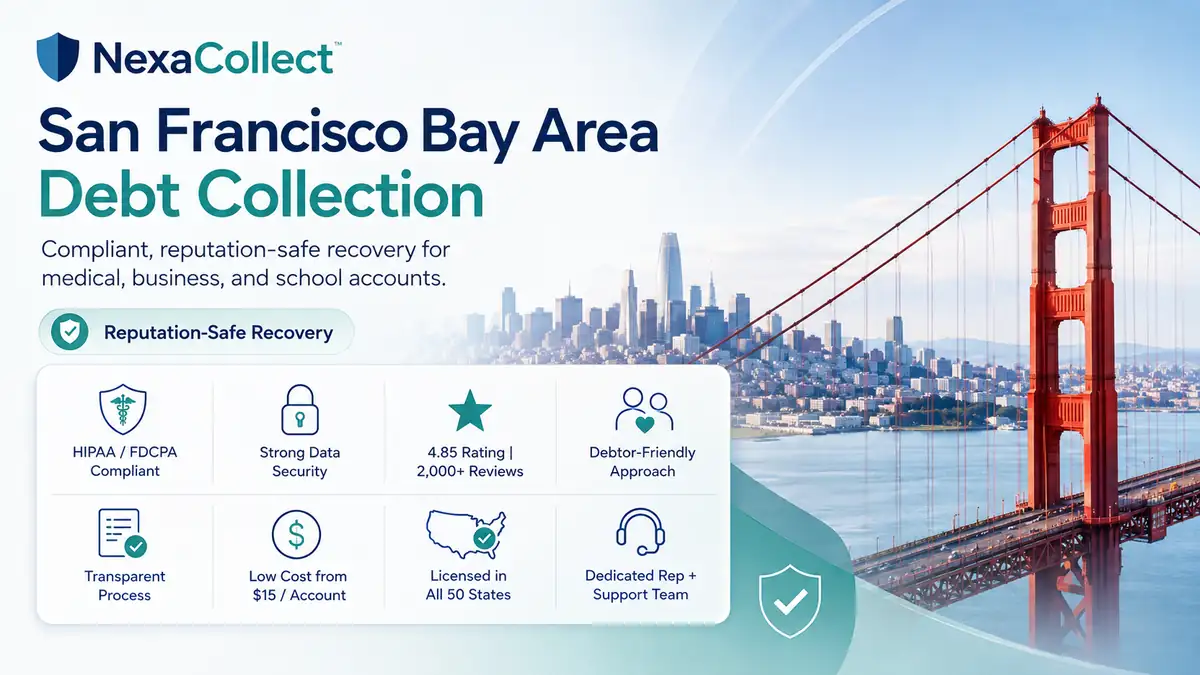
Nexa provides a reputation-safe approach, equipped with all 50-state collections license, offering free credit reporting, free litigious debtor check, free bankruptcy scrub, and zero onboarding fees. Secure – SOC 2 Type II & HIPAA compliant. Over 2,000 online reviews rate us 4.85 out of 5.
Need help with an account that needs legal escalation? Contact us
Why San Francisco’s Garnishment Math Is Genuinely Different
The local minimum wage isn’t a footnote here, it changes the calculation. Under Cal. Code Civ. Proc. § 706.050, wage garnishment on an ordinary judgment is capped at the lesser of 25% of a debtor’s disposable earnings, or 50% of the amount by which weekly disposable earnings exceed 40 times the applicable minimum hourly wage. The statute is explicit that where a debtor’s local minimum wage exceeds the state minimum, the local rate governs that calculation. San Francisco’s local minimum wage runs well above California’s state figure, which pushes the protected-income floor higher here than it would be for an identical earner in a lower-wage California city. For a creditor evaluating whether garnishment is worth pursuing against an SF-based debtor, this is a real number to run before assuming a judgment translates into collectable wages.
A new procedural step creditors need to know about. As of 2025, AB 2837 requires a judgment creditor pursuing garnishment on a consumer debt to include an Address Verification Declaration confirming the debtor’s last known address, submitted to the levying officer separately from the court filing. Omitting it invalidates the levy. It’s a small requirement with a real consequence if missed.
San Francisco’s commercial base has its own texture. Beyond the household tech names, the city’s economy runs on a dense layer of professional services, law firms, CPAs, managed service providers, SaaS companies, and healthcare systems, alongside a startup ecosystem where well-funded companies do sometimes wind down entirely. Chasing a balance from a company that’s quietly dissolved requires different tools (successor-liability checks, asset tracing) than chasing a slow-paying but still-operating client, and knowing which situation you’re actually in before spending on collection effort matters more here than in a more stable, slower-churning commercial market.
The California Legal Landscape
| Statute of Limitations (written contracts) | 4 years — Cal. Code Civ. Proc. § 337 |
| Statute of Limitations (oral agreements) | 2 years — Cal. Code Civ. Proc. § 339 |
| Wage Garnishment | Lesser of 25% of disposable earnings, or 50% of earnings above 40x local minimum wage — Cal. Code Civ. Proc. § 706.050 |
| Garnishment Procedure (new) | Address Verification Declaration required as of 2025 — AB 2837 |
| Debt Buyer & Collector Licensing | California Debt Collection Licensing Act, administered by the DFPI |
| Validation Notice | 30-day dispute window required before continued collection |
Medical debt reporting is genuinely tighter here than the national default, and the specifics shift, confirm current options before assuming a given approach is available on any particular account rather than relying on a general national rule.
What This Costs
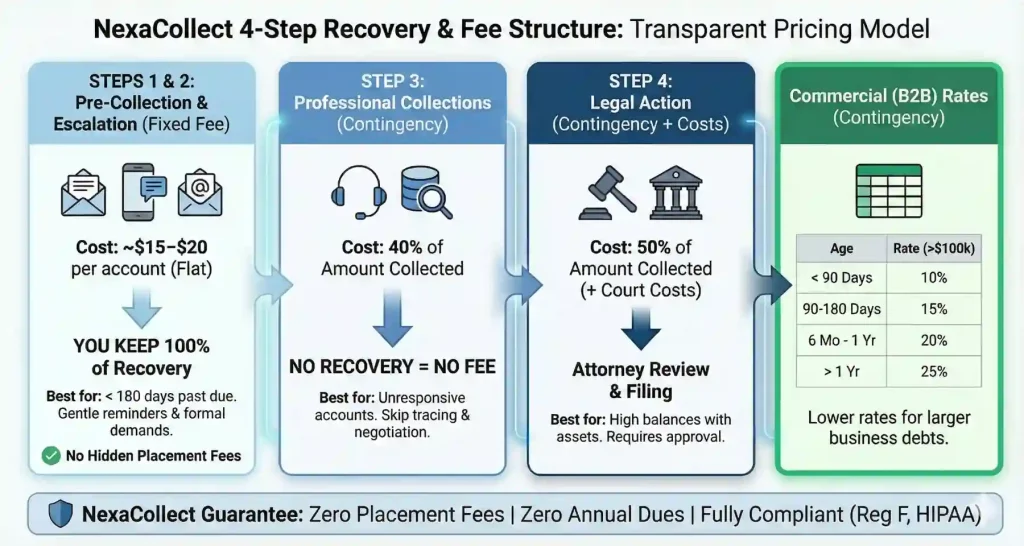
Step 1 & 2: Fixed-Fee Recovery (~$15/account). Professional demand sequences for accounts under roughly 60 days. Payments come directly to you. See the full pricing breakdown.
Step 3: Contingency Collection (~40%). For older or unresponsive accounts, no recovery, no fee.
Step 4: Legal Referral (client-approved, ~50%). Only where the balance and circumstances justify it, filing fees reimbursed from the first recovery.
Who We Collect For Across the Bay Area
- Medical & Dental: HIPAA-compliant patient balance recovery for practices around Van Ness, Pacific Heights, and across the peninsula.
- Tech & Professional Services: B2B and commercial receivables for SaaS companies, law firms, and consultancies concentrated in FiDi and SoMa, sized appropriately for both established firms and newer companies still finding their footing.
- Fitness & Membership Businesses: Recurring billing recovery for the city’s boutique studios and gyms.
- Schools & Education: Tuition and program fee recovery for the Bay Area’s private schools and training programs.
- Home Services & Contractors: Recovery for contractors serving the city’s dense residential and commercial renovation market. Restoration companies, security alarm companies and waste management companies.
- Utilities: Utility account recovery across the wider Bay Area service territory.
Frequently Asked Questions
Does San Francisco’s local minimum wage actually change how much can be garnished from a debtor’s wages?
Yes, and this is specific to how California’s garnishment formula is written. Under Cal. Code Civ. Proc. § 706.050, the garnishment cap is the lesser of 25% of disposable earnings or 50% of earnings above 40 times the applicable minimum wage, and the statute explicitly uses the local minimum wage where it exceeds the state figure. Since San Francisco’s local minimum wage runs well above California’s state minimum, the protected-income floor is meaningfully higher for a debtor working in San Francisco than for the same earner elsewhere in the state.
What’s new about California’s wage garnishment procedure as of 2025?
AB 2837 now requires a judgment creditor pursuing wage garnishment on a consumer debt to submit an Address Verification Declaration confirming the debtor’s last known address, delivered to the levying officer separately from the court filing itself. Missing this step invalidates the levy, making it a small but consequential procedural requirement to get right.
How long does a San Francisco business have to collect on an unpaid account?
Generally four years for claims based on a written contract under Cal. Code Civ. Proc. § 337, and two years for an oral agreement under § 339. Recovery odds decline well before either legal deadline arrives, so waiting until an account nears the statutory limit significantly reduces the realistic chance of collecting it at all.
Does a collection agency need to be licensed to operate in California?
Yes, generally. California’s Debt Collection Licensing Act requires debt collectors and certain debt buyers to be licensed through the Department of Financial Protection and Innovation. Creditors placing California accounts should confirm an agency’s licensing status before placement.
How does chasing a dissolved SF startup differ from chasing a normal slow-paying client?
Meaningfully. A company that’s genuinely wound down requires successor-liability checks and asset tracing, since the entity that owed the debt may no longer exist in any collectible form, while a still-operating but slow-paying client is a more conventional collections situation. Knowing which case an account actually is, before spending on collection effort, matters more in a market with San Francisco’s startup churn than in a more stable commercial environment.
Will pursuing an unpaid balance put a debtor’s home at risk in San Francisco?
Generally not through wage garnishment alone, and California maintains real homestead-style protections separate from the garnishment framework described above. Given the city’s income levels, the local-minimum-wage-adjusted garnishment floor described here often means a diplomatic, negotiated resolution is more productive than assuming aggressive enforcement is straightforward.