The Sacramento Partner for Compliant, Cost-Effective, Reputation Safe Recovery
Sacramento runs on more than government—and unpaid accounts show up in every corner of its economy. From healthcare groups and professional firms in Midtown and Downtown to schools, contractors, senior living providers, agricultural suppliers, food businesses, and companies across Elk Grove, Folsom, Roseville, and the Greater Sacramento region, overdue receivables can quietly tie up money needed for payroll, staffing, and growth.
Nexa helps Sacramento organizations turn those aging balances into recovered revenue without making every account a confrontation. Our approach combines professional follow-up, practical payment solutions, skip tracing, and appropriate escalation, with strategies tailored to whether the account belongs to a patient, customer, parent, tenant, or another business. Local knowledge matters in Sacramento because healthcare, education, government-adjacent businesses, agriculture, and professional services do not create the same collection challenges.
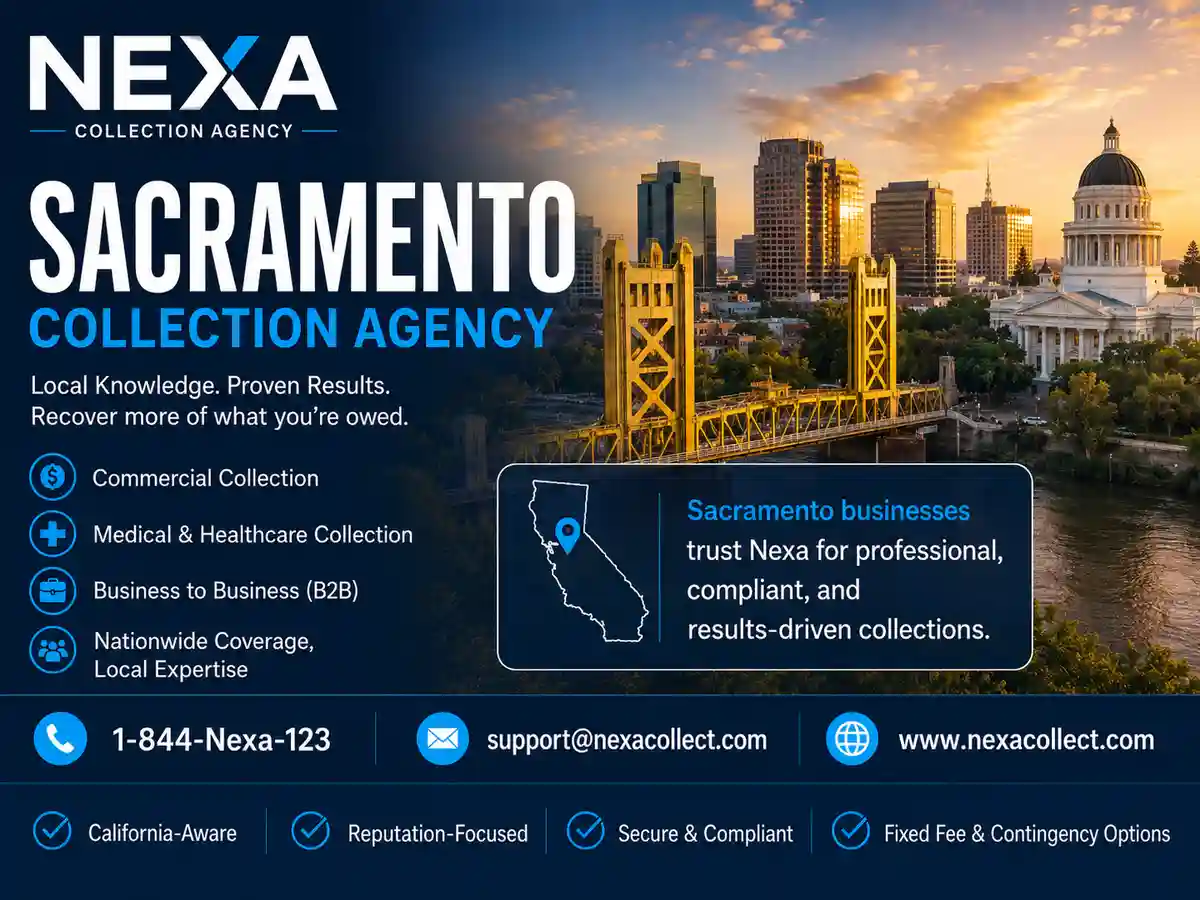
Nexa provides a reputation-safe approach, equipped with all 50-state collections license, offering free credit reporting, free litigious debtor check, free bankruptcy scrub, and zero onboarding fees. Secure – SOC 2 Type II & HIPAA compliant. Over 2,000 online reviews rate us 4.85 out of 5.
Need a Collection Agency? Contact us
What This Costs
Step 1 & 2: Fixed-Fee Recovery (~$15/account). Professional demand sequences for accounts under roughly 60-90 days. Payments go directly to you. See the full pricing breakdown.
Step 3: Contingency Collection (~40%). For older or unresponsive accounts, no recovery, no fee.
Step 4: Legal Referral (client-approved, ~50%). Including Prompt Payment Act penalty calculation on eligible state agency accounts, filing fees reimbursed from the first recovery.

Who We Collect For Across Sacramento
- State Government Vendors & Contractors: B2B and commercial receivables for businesses contracting with California state agencies, with Prompt Payment Act penalty screening built into intake.
- Medical & Dental: HIPAA-compliant patient balance recovery for practices across the metro.
- Professional Services & Government Affairs: Commercial receivables for the consulting, lobbying, and government-affairs firms concentrated around the Capitol.
- Schools & Education: Tuition and program fee recovery for the region’s private schools and training programs.
- Property Management: Move-out and lease-end balance recovery across the metro.
- Utilities: Utility account recovery across the Sacramento service territory.
Real Results in Your Area
- A Midtown professional services firm recovered $18,000 in 60 days using our Step 2 fixed-fee demands for their 90-day-past-due invoices.
- A major dental group near the American River uses our Step 1 (First-Party) reminders to reduce delinquencies by 40% before they even need collections.
- A large property manager with units across the region cut their write-offs by 52% after switching to our Step 3 contingency program.
California’s Prompt Payment Act
A vendor invoices a California state agency, the payment runs late, and most businesses simply wait it out, assuming a late government check is just how things work. It isn’t supposed to be. California’s Prompt Payment Act requires state agencies to pay undisputed invoices within 45 days, and when they don’t, the agency itself is obligated to calculate and pay a penalty automatically, no lawsuit required. Almost nobody claims it.
Quick answer: Sacramento’s position as California’s state capital creates a genuinely distinct commercial landscape: state agency vendors are entitled to automatic penalty interest under the California Prompt Payment Act (Gov. Code § 927 et seq.) whenever a properly submitted, undisputed invoice goes unpaid past 45 days, a right built into the statute rather than something a creditor has to sue to obtain. Beyond that, Sacramento operates under California’s standard framework, a 4-year statute of limitations for written contracts, 2 years for oral agreements, and DFPI-licensed debt collection requirements. Nexa recovers Sacramento accounts starting at a $15 fixed fee per account, with contingency options for older balances.
The State Capital Creates a Genuinely Different Commercial Landscape
State agency vendors are owed penalty interest automatically, and most never collect it.
Under California’s Prompt Payment Act, a state agency that acquires property or services under contract must pay a properly submitted, undisputed invoice within 45 calendar days, or automatically owe a late payment penalty. This isn’t a remedy a vendor has to litigate into existence, it’s a statutory obligation running directly against the agency. The penalty rate depends on vendor type: for certified small businesses, nonprofits, and Medi-Cal providers, it’s tied to the U.S. Prime Rate plus 10%; for other vendors, a state investment benchmark plus 1%, both accruing from the day after payment was originally due. For Sacramento’s dense population of state contractors, vendors, and service providers, this is real, unclaimed money sitting on the table in a way that simply doesn’t exist for a business in a city without this kind of state-government concentration.
The obligation applies broadly, well beyond a narrow set of contract types.
The Prompt Payment Act’s language is broad enough to reach most businesses contracting with state departments, not just large construction or IT vendors. A consulting firm, a printing company, a facilities services provider, any vendor with an undisputed invoice sitting unpaid past 45 days has a real claim to penalty interest that most simply never pursue, either because they don’t know the right exists or assume pursuing it would jeopardize future state business.
Standard California rules apply on top of this.
Cal. Code Civ. Proc. §§ 337 and 339 set the general 4-year written / 2-year oral statute of limitations. Wage garnishment on consumer judgments follows § 706.050’s standard formula, and AB 2837 requires an Address Verification Declaration before garnishment proceeds. Debt collectors operating in California generally need to be licensed through the DFPI under the state’s Debt Collection Licensing Act.
The California Legal Landscape
| State Agency Prompt Payment Deadline | 45 calendar days from undisputed invoice receipt — Gov. Code § 927 et seq. |
| Late Payment Penalty (small business/nonprofit/Medi-Cal) | U.S. Prime Rate + 10%, automatic |
| Late Payment Penalty (other vendors) | State investment benchmark rate + 1%, automatic |
| Statute of Limitations (written contracts) | 4 years — Cal. Code Civ. Proc. § 337 |
| Statute of Limitations (oral agreements) | 2 years — Cal. Code Civ. Proc. § 339 |
| Wage Garnishment | Lesser of 25% of disposable earnings, or 50% above 40x applicable minimum wage — § 706.050 |
| Debt Collector Licensing | California Debt Collection Licensing Act, DFPI-administered |
Frequently Asked Questions
What is the California Prompt Payment Act, and does it actually apply to our business?
It’s a state law (Gov. Code § 927 et seq.) requiring state agencies to pay a properly submitted, undisputed invoice within 45 calendar days, or automatically owe a late payment penalty. It applies broadly to most businesses contracting with state departments, not just large construction or technology vendors, a consulting firm, a supplier, or a services provider with an unpaid, undisputed state invoice past 45 days generally has a valid claim to this penalty.
Do we need to sue to collect the Prompt Payment Act penalty, or does the state calculate it automatically?
The obligation to calculate and pay the penalty runs against the state agency by statute, it isn’t something a vendor has to litigate to establish. In practice, many vendors never claim it simply because they don’t request it or aren’t aware the right exists, not because it requires a lawsuit.
How is the Prompt Payment Act penalty rate calculated?
It depends on the vendor type. Certified small businesses, nonprofit organizations, and Medi-Cal providers generally receive a rate tied to the U.S. Prime Rate plus 10%. Other vendors generally receive a rate tied to a state investment benchmark plus 1%. Both accrue from the day after the payment was originally due.
How long does a Sacramento business have to collect on an unpaid account generally?
Generally four years for a written contract under Cal. Code Civ. Proc. § 337, and two years for an oral agreement under § 339, the same statewide periods that apply throughout California.
Does a collection agency need to be licensed to operate in California?
Yes, generally. California’s Debt Collection Licensing Act requires debt collectors and certain debt buyers to be licensed through the Department of Financial Protection and Innovation.
Does Sacramento’s state government concentration change commercial collections strategy in other ways?
Yes, beyond the Prompt Payment Act specifically. A meaningful share of the metro’s commercial base, consulting firms, government-affairs practices, facilities and services vendors, deals primarily or exclusively with public-sector clients, which means understanding procurement cycles, budget-year payment timing, and the specific documentation state contracts require matters more here than in a metro with a more conventional private-sector commercial base.
Get Started Today
Stop wasting internal resources on accounts that won’t pay. Let us show you a better, safer, and more profitable way.