Garland is a manufacturing city, so an unpaid invoice often comes with more than a past-due date. It may come with a receiving report, a quality complaint, a disputed deduction, or a purchasing department saying the paperwork was never completed.
That matters in a city with 300+ manufacturers and a deep industrial base spanning food production, metals, coatings, packaging, automotive components and advanced manufacturing.
Garland businesses deserve better than “send it to collections and hope”
Nexa helps Garland companies figure out what actually stopped the payment before deciding how to recover it. A fresher balance may only need the $15 fixed-fee approach. A documented commercial dispute may need deeper review. Older or tougher accounts can move to contingency recovery, while healthcare accounts require a more reputation-sensitive workflow.
For Garland businesses, better collections often start with better evidence—not louder demands.
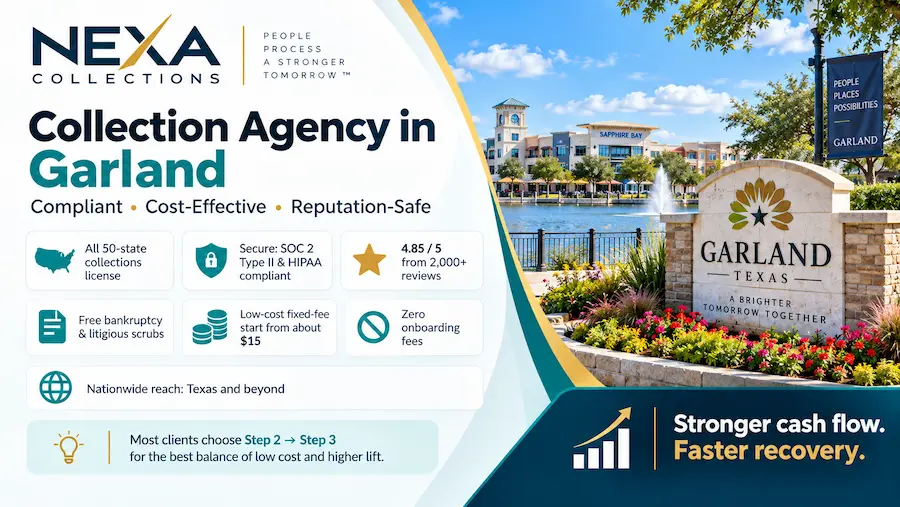
Nexa provides a reputation-safe approach, equipped with all 50-state collections license, offering free credit reporting, free litigious debtor check, free bankruptcy scrub, and zero onboarding fees. Secure – SOC 2 Type II & HIPAA compliant. Over 2,000 online reviews rate us 4.85 out of 5.
Need a Garland Collection Agency? Contact us
Recent Recovery Results
CPA & Advisory Firm — Fixed-Fee | 95% Recovered
A Garland professional-services firm placed $6,400 in fresher client invoices. Fixed-fee follow-up recovered $6,080 — 95%.
Commercial Collection Services
Packaging Manufacturer — Contingency | 86% Recovered
A Garland-area supplier assigned $41,000 in aging wholesale balances involving receiving and deduction disputes. Recovery produced $35,260 — 86%.
Restoration Company — Contingency | 72% Recovered
A Dallas County restoration company placed $22,500 in older completed-job balances. Documentation-led recovery returned $16,200 — 72%.
Restoration Collection Services
Need a Local Collection Agency? Contact us
Our 4-step recovery model built for Garland’s mix of industries

We work as an extension of your office, not a black box. Our model is transparent, flexible, and designed so you can start small and scale up.
Step 1 – First-Party Service ($15 per account)
Gentle, professional reminder contacts made in your name. Ideal when you want a nudge that still feels like it’s coming from your own team.
Step 2 – Third-Party Demands ($15 per account)
Firm but professional notices and follow-ups from us as an outside partner. This is where most Garland clients start: low cost, fast deployment, and excellent for batch placements.
Step 3 – Contingency Service (40%)
No recovery, no fee. We invest more time and effort into the harder accounts—skips, chronic late payers, and older balances—so your team doesn’t have to.
Step 4 – Legal (50%)
When it makes business sense to pursue legal action, we coordinate with experienced attorneys who understand Texas procedures and the cost-benefit realities of suing on a debt.
Model in practice:
Most Garland businesses use Step 2 for the bulk of their placements, and then upgrade selected files to Step 3 if earlier efforts don’t resolve the balance.
Why switch to us if you already have someone “handling collections”?
If your current partner is just going through the motions, staying put is more expensive than changing.
Reasons Garland businesses move over to us:
-
Recover more with the same staff. Stretch your internal A/R team further without hiring extra collectors.
-
Protect your name in the community. We’re careful with tone and timing so your Google reviews and local reputation stay strong—even when conversations get difficult.
-
Keep legal risk low. We respect Texas and federal regulations, and we build our process to avoid the complaints and regulatory issues that come with pushy tactics.
-
Straightforward pricing. You always know what you’re paying:
-
Step 1: $15
-
Step 2: $15
-
Step 3: 40% contingency
-
Step 4: 50% on legal recoveries
-
-
Nationwide reach. Many Garland companies serve customers across the U.S. We can pursue accounts in all 50 states, so your process stays consistent even when your customers are scattered.
Think of it this way: don’t let your cash flow back up like traffic on the President George Bush Turnpike. A better lane is available.
Texas collection basics every Garland business should know
You don’t need to be a legal expert—but you do need a partner who respects the rules.
-
Four-year statute of limitations (most debts). In Texas, most lawsuits for unpaid debts must be filed within 4 years of default. After that, the debt may still exist, but it’s generally “time-barred” for lawsuits.
-
Homestead and wage protections. For most consumer debts, Texas law strongly protects primary residences declared as homesteads and generally doesn’t allow wage garnishment for ordinary unsecured debts.
-
Commercial vs. consumer accounts. Some consumer protections don’t apply to corporate or LLC debtors, which changes strategy on business-to-business files.
We factor these rules into our recommendations so you don’t waste money chasing accounts that are legally weak—or take unnecessary risks on accounts that need a more careful approach.
Who we help in Garland and across the Metroplex
We work with a wide range of organizations in and around Garland, including:
-
Medical, dental, and specialty healthcare practices
-
Trades and home services (HVAC, electrical, landscaping, contractors)
-
Property managers and HOAs
-
Manufacturers and suppliers tied to Garland’s strong industrial base
-
Professional services (CPAs, law firms, consultants)
-
Education and training providers
Whether your office is near Firewheel Town Center, close to Lake Ray Hubbard, or in one of Garland’s industrial corridors, we build a recovery plan that fits your customer base and payment culture.
FAQs – Garland, TX
A Garland manufacturer delivered the goods, but the buyer later says they were defective. Does the buyer still have to pay?
Acceptance matters under Texas commercial law.
A buyer that has accepted goods generally must pay the contract rate for those goods. Acceptance does not eliminate every warranty or defect claim, but the buyer generally must notify the seller of a breach within a reasonable time after discovering it.
Texas law also limits when acceptance can later be revoked. Revocation generally requires a nonconformity that substantially impairs the goods’ value and must occur within a reasonable time, with notice to the seller.
For Garland manufacturers, keep the purchase order, specifications, inspection records, receiving documents, proof of delivery, rejection notices, RMA records and communications showing whether the goods were accepted or used.
Commercial B2B Collection Services
Can a Garland medical practice still collect a patient bill if it was not billed until nearly a year after treatment?
Texas has a specific timely-billing rule for healthcare providers.
A healthcare provider generally must bill the patient or other responsible person no later than the first day of the 11th month after the service date, subject to separate rules when insurance or another third-party payer must be billed.
If the provider fails to comply, Texas law can bar recovery of amounts the patient would otherwise have been reimbursed for—or would not have owed if timely billing had occurred. Beginning September 1, 2025, a provider treating a represented personal-injury patient can also satisfy the rule in qualifying cases by timely sending the bill to the patient’s attorney.
This is a useful pre-collection check before an older Garland medical balance is placed.
Industries We Serve
Medical & Dental, Hospitals, Schools, Small Businesses, CPA & Professional Services, Manufacturing, Commercial B2B, Contractors, Restoration, Property Management, Security & Alarm, Utilities, Government, Gyms & Fitness.
The owner approved a Garland construction invoice. How long can payment normally be held on a private project?
Texas has prompt-payment rules for many private construction projects.
When an owner receives a qualifying written payment request for properly performed work or appropriate materials, the owner generally must pay the contractor within 35 days.
Once the contractor receives payment from the owner, the contractor generally has seven days to pay the subcontractor the portion attributable to that subcontractor’s work. Good-faith disputes can permit withholding under specific circumstances.
That means a contractor saying “the owner has not paid me yet” and a contractor that has already been paid are two very different collection situations.
Contractor Collection Services
A Garland utility customer has fallen behind but is already on a payment arrangement. Should that account be treated like an ordinary delinquency?
Not without checking the arrangement first.
Garland’s utility system serves electricity through Garland Power & Light, along with municipal water, sanitation and stormwater billing. The City currently offers qualifying customers payment arrangements that can extend a bill’s due date and also operates a Customer Assistance Program for temporary financial hardship.
For any utility recovery program, accounts should clearly show whether the customer has:
- An active payment arrangement
- Pending assistance
- A disputed bill
- A final disconnected account
- Deposit credits
- A verified remaining balance
That helps distinguish a customer actively resolving a balance from one that has simply stopped paying.
Garland ISD provides student devices. Can damaged or unreturned Chromebooks become a separate receivable?
Yes. Technology charges are separate from ordinary cafeteria balances.
Garland ISD states that when negligent care results in device damage, students can be responsible for the full replacement cost. Current Chromebook replacement costs listed by the district range from approximately $259 to $317 depending on the model, and a replacement fee may be required before a replacement device is issued.
For education receivables, keep the device assignment record, serial number, damage report, replacement-cost schedule, notices to the parent or responsible party and payments together.
This type of balance should not simply be grouped with tuition, meal accounts or other student charges.
Can a Garland business automatically add attorney’s fees to an unpaid invoice once the account goes to collections?
No. Attorney’s fees are not simply an automatic collection surcharge.
Texas law allows reasonable attorney’s fees in certain successful claims, including claims for rendered services, labor, furnished materials, freight-related claims, sworn accounts, and oral or written contracts.
But Chapter 38 also imposes procedural requirements. Among other things, the claimant generally must be represented by an attorney, must present the claim to the opposing party or authorized agent, and the just amount owed must remain unpaid for at least 30 days after presentation.
For Garland businesses, collection fees, contractual late fees and potentially recoverable legal fees should therefore be documented and treated as separate concepts rather than automatically added together.
Commercial Collection Services
Ready to see better results from your past-due accounts in Garland?
Contact us