An unpaid equipment rental account is rarely just a billing problem. Somewhere on a job site, or in a driveway, or behind a locked gate, there’s a piece of equipment that still belongs to you, and the renter has both your money and your asset. Ordinary collections content treats this like any other unpaid invoice. It isn’t. Equipment leases carry legal remedies most receivables never touch.
Quick answer: Equipment rental debt is governed by UCC Article 2A, which gives lessors tools beyond an ordinary unpaid invoice: self-help repossession without a court order (limited by “breach of peace”), replevin as a court-ordered alternative, and a damages formula based on market rent differential rather than just the unpaid balance. Nexa recovers equipment rental accounts starting at a $15 fixed fee per account, with contingency options for older balances, alongside guidance on when repossession or replevin is the faster path to getting the actual equipment back.
Need a Collection Agency for Your Equipment Rental Business? Contact us
Why Equipment Rental Debt Isn’t an Ordinary Receivable
You may have a right to the equipment itself, not just the money.
Under UCC Article 2A, a “substantial default” (non-payment, wrongful rejection, repudiation, or anything that substantially impairs the value of the lease to you) generally triggers a lessor’s statutory remedies, which can include recovering the equipment directly rather than only pursuing payment. Whether repossession is realistic depends heavily on where the equipment actually is and whether it can be recovered without confrontation.
Self-help repossession has a hard limit: no breach of peace.
Where your lease agreement and state law permit it, equipment can often be recovered without going to court first, but only if it can be done without force, threats, or entering a locked or secured location without permission. Equipment sitting on an active job site behind a locked gate is a materially different situation than equipment parked in an open lot.
Replevin is the court-ordered fallback.
When self-help repossession isn’t safe or the renter is actively obstructing recovery, replevin is the legal action to obtain a court order compelling return of the specific equipment. It’s slower than self-help repossession but doesn’t carry the same breach-of-peace risk.
Damages aren’t just “what’s owed on the invoice.”
Article 2A’s default damages formula for a lessor is the present value of market rent for the remaining lease term, minus the present value of the original contracted rent for that same term, plus incidental and consequential damages, minus expenses saved because of the default. On a long-term equipment lease with meaningful time remaining, this can represent real value beyond the simple unpaid balance, worth factoring in before deciding an account isn’t worth pursuing.
What This Costs
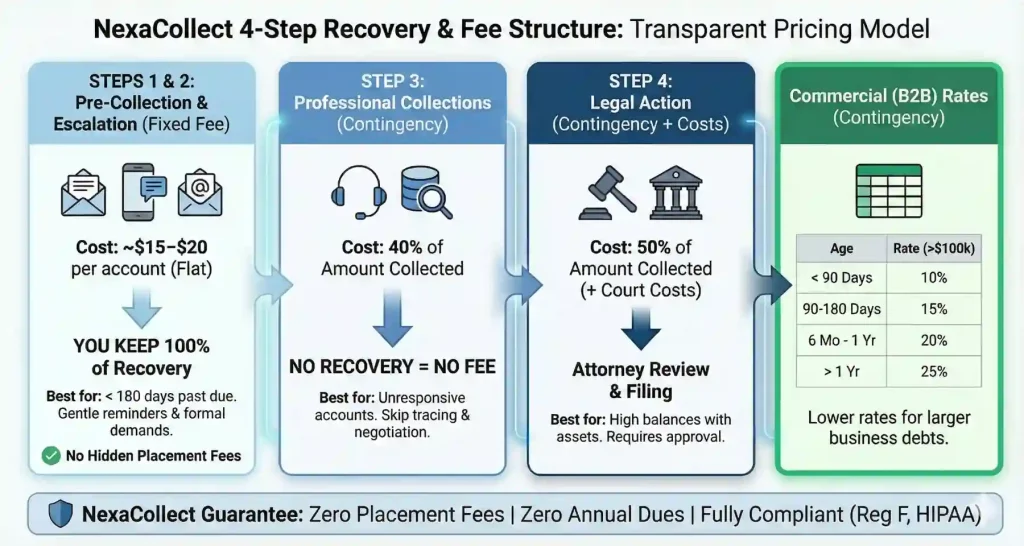
Step 1 & 2: Fixed-Fee Recovery (~$15/account). Professional demand sequences for accounts under roughly 60 days. Payments go directly to you. See the full pricing breakdown.
Step 3: Contingency Collection (20-40%). For older or unresponsive accounts, no recovery, no fee.
Step 4: Legal Referral (client-approved, ~50%). For accounts where repossession, replevin, or a lawsuit for damages is genuinely warranted, filing fees reimbursed from the first recovery.
Nexa provides a reputation-safe approach, equipped with all 50-state collections license, offering free credit reporting, free litigious debtor check, free bankruptcy scrub, and zero onboarding fees. Secure – SOC 2 Type II & FDCPA compliant. Over 2,000 online reviews rate us 4.85 out of 5.
Need a Collection Agency? Contact us
Common Billing Disputes in Equipment Rental (And How to Prevent Them)
Most equipment rental billing disputes fall into a handful of recurring categories:
- Incorrect Billing. Wrong rental rates, wrong equipment details, or billing for a longer period than actually rented. Keep meticulous records and review invoices carefully before sending.
- Late Fees and Penalties. A renter unaware of late-return fees is a common source of disputes. State these terms clearly in the rental agreement itself, not just verbally.
- Damage Charges. Disputes over equipment damage are common and often avoidable. Inspect and document equipment condition at both rental and return.
- Unauthorized Charges. Additional charges not agreed upon in advance create friction. A detailed contract outlining all possible charges prevents this.
- Billing Cycle Confusion. Long-term rentals especially benefit from clearly specifying whether billing is weekly, monthly, or otherwise.
- Lost or Delayed Invoices. Electronic invoicing with retained copies reduces disputes over timeliness.
- Payment Terms Disputes. Due dates, grace periods, and accepted payment methods should be explicit in the agreement, not assumed.
- Fuel Charges. Disputes over fuel level at return are common; a clear, transparent fuel policy prevents most of them.
To minimize these issues: maintain a detailed rental agreement, keep accurate records, communicate clearly with customers, use electronic invoicing, and periodically review your billing process for recurring problems. Where disputes do arise, having a defined resolution process, and knowing when to involve legal counsel, keeps a disagreement from becoming a write-off.
For general commercial collection methodology beyond equipment-specific remedies, see Nexa’s commercial collections services.
Frequently Asked Questions
Can we take back our equipment if a renter stops paying, or do we have to sue first?
Often you can, without going to court first, but only within limits. Under UCC Article 2A, self-help repossession is generally permitted where it can be accomplished without “breach of peace,” meaning no force, threats, or entering a locked or secured location without permission. Equipment on an open, accessible site is a very different situation from equipment behind a locked gate on an active job site, where self-help repossession is far riskier and replevin, a court-ordered recovery action, may be the safer path.
What is replevin, and when do we need it instead of just repossessing the equipment ourselves?
Replevin is a court proceeding to obtain a legal order compelling the return of specific property that’s being wrongfully withheld. It’s the right tool when self-help repossession isn’t safe or legally permissible, the equipment is on secured or locked premises, the renter is actively obstructing recovery, or there’s a real dispute about whether a default has actually occurred. It’s slower than self-help repossession but avoids the breach-of-peace risk entirely.
Is the damages we can claim just the unpaid rental invoices, or is there more?
Often more. Under UCC Article 2A’s default damages framework, a lessor is generally entitled to the present value of market rent for the remaining lease term, minus the present value of the original contracted rent for that period, plus incidental and consequential damages, minus any expenses saved because of the default. On a longer-term lease with significant time remaining, this can represent meaningful value beyond the simple unpaid balance on the books.
What counts as a “substantial default” that lets us actually use these remedies?
Generally non-payment, wrongful rejection or attempted revocation of the equipment, repudiation of the lease agreement, or any other default that substantially impairs the value of the lease to the lessor. Your specific lease agreement may also define what counts as a substantial default in more detail; reviewing that language before assuming a general default standard applies is worth doing on higher-value accounts.
Does it matter whether our rental agreement is a “true lease” versus something else?
Yes, significantly. UCC Article 2A distinguishes a true lease, where you retain title and a residual interest in the equipment while the renter has possession and use, from a lease intended as a security interest, which is treated more like a secured sale. The available remedies differ between the two, so how your agreement is actually structured affects which recovery tools are available on a given account.
At what point should an aging equipment rental account move from internal follow-up to a collection agency?
Generally once internal reminders and calls have stalled without resolution, commonly in the 60 to 90 day range, and especially once it becomes clear that resolving the account may require formal escalation like repossession, replevin, or a damages claim beyond a simple payment reminder. Waiting longer generally reduces both the odds of a straightforward payment and the practical condition of the equipment itself if it’s still out with the renter.
Damage Waiver Disputes: How do you handle accounts where the debtor refuses to pay because they claim the equipment malfunctioned during the rental period?
These accounts turn on documentation, not on who argues more persistently. We review the pre-rental and return inspection records, any signed damage waiver or condition acknowledgment, and maintenance logs before treating the claim as anything other than genuine, since a malfunction complaint that surfaces only after a payment demand looks very different from one raised at the time of return. Where the equipment was demonstrably in working condition at handoff and properly maintained, this documentation typically resolves the dispute quickly. Where records are thin, we flag that gap early so you know whether the account is a strong candidate for continued pursuit or better resolved through negotiation.
Insurance Subrogation: If a rented asset was lost or stolen, can Nexa help pursue payment through the debtor’s insurance?
Yes, where the rental agreement or applicable coverage makes this a realistic path. If a renter carried their own insurance, a loss damage waiver, or equipment-in-care-custody-control coverage, a lost or stolen asset may be recoverable through a claim against that policy rather than, or alongside, pursuing the renter directly. We help identify whether this option exists on a given account and coordinate the demand accordingly, which can be faster and less contentious than pursuing an individual renter who may not have the funds to pay for a lost asset outright.