A veterinary collection agency helps practices recover unpaid treatment bills while protecting the trust they have built with pet owners. Because many veterinary debts arise during stressful or emotional situations, collections should be empathetic, compliant, and reputation-safe—not aggressive.
Nexa helps veterinary practices recover past-due balances through pet-owner-friendly communication, flexible payment options, and a structured recovery process designed to protect both cash flow and long-term client relationships.
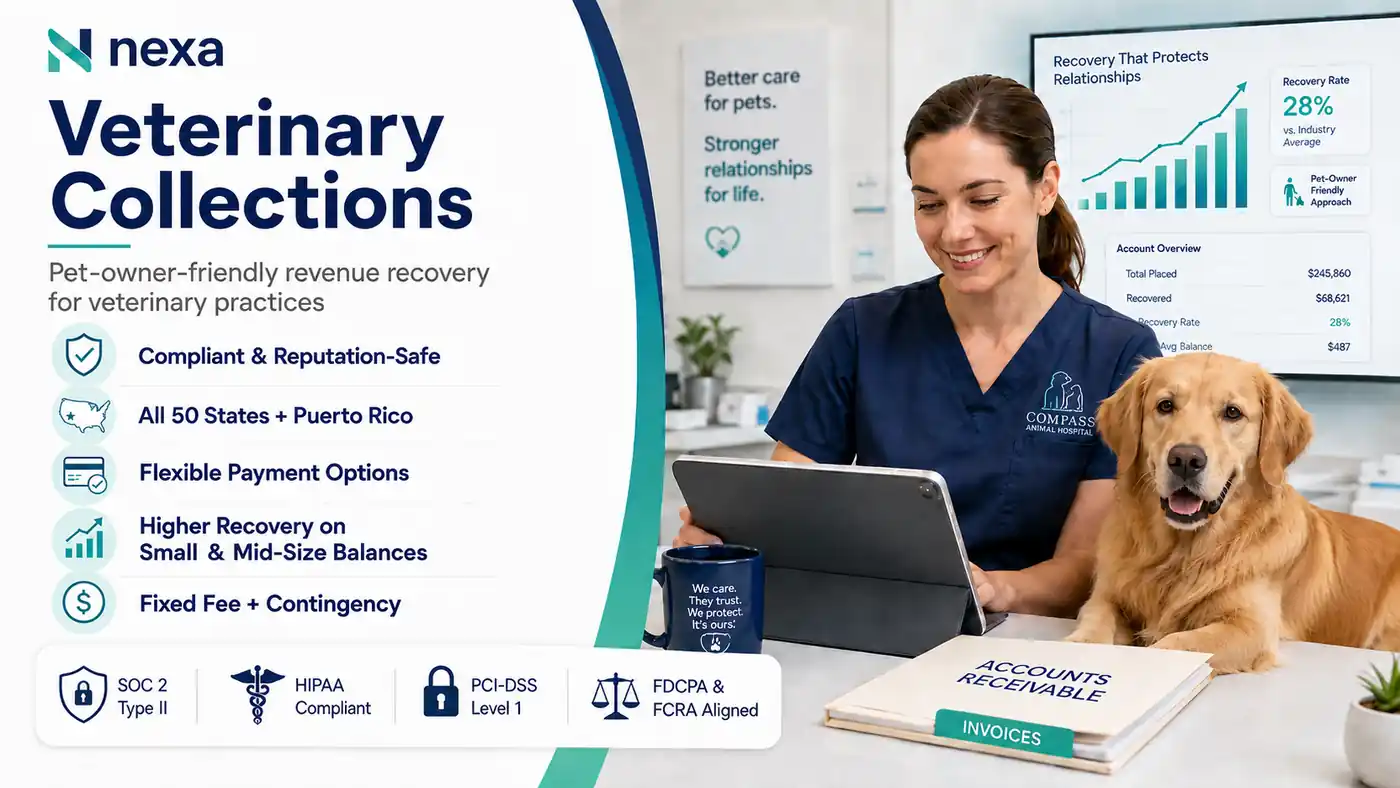
Quick answer: Veterinary collections differ from medical or dental collections in two important ways: HIPAA does not apply to animal records at all, so confidentiality runs through state veterinary board rules instead, and many states grant veterinarians a possessory lien allowing an unpaid animal to be legally retained as security for the bill. Nexa recovers unpaid veterinary balances starting at a $15 fixed fee per account, with contingency options for older or harder accounts, using outreach built specifically around this industry’s reputation sensitivity.
Need a Veterinary Collection Agency? Contact us
Why Veterinary Debt Is Different?
Emotional stakes are structurally higher.
A patient disputing a medical bill is usually annoyed. A pet owner disputing a vet bill was often terrified for an animal they consider family a few hours earlier. Outreach that would be perfectly normal for a commercial account reads as callous here, and callous reads as a screenshot on social media.
No HIPAA, but real confidentiality obligations exist anyway.
Pet owners frequently assume “medical practice” means HIPAA applies. It doesn’t, animals aren’t covered individuals under the law. What does apply: most states have their own veterinary record confidentiality statutes, and every state veterinary board has professional conduct rules governing client information. Collection outreach discusses the balance owed, not the animal’s diagnosis or treatment history, the same discretion HIPAA would require if it applied, achieved through the actual rules that do.
The lien question comes up constantly, and the answer is more specific than “yes” or “no.”
Where state law grants veterinarians a lien, a practice can generally retain an animal until the bill is paid, and in some states eventually sell it after a required notice period, though euthanasia is never a permitted route to resolving unpaid fees. Not every state has this law, and the ones that do vary on notice periods and procedure, so this is confirmed against the specific state before it’s ever positioned as an option.
What This Costs

Fixed-Fee Recovery ($15/account). A sequence of professional demand letters for earlier-stage balances. The client pays your practice directly, so you keep 100% of what’s recovered. See the full pricing breakdown.
Contingency Recovery (40%). For older, unresponsive, or higher-balance accounts, no recovery, no fee.
Where Veterinary A/R Actually Comes From
Emergency and after-hours care.
The highest-dollar, highest-emotion balances, often authorized verbally in the middle of a crisis, with payment discussion happening after the fact rather than before.
Boarding and kennel balances.
A different animal entirely from a medical bill: no treatment was rendered, just care over time, and disputes here tend to be about length of stay or condition on pickup rather than clinical judgment.
Elective and wellness balances.
Routine vaccinations, spay/neuter, and dental cleanings, generally the least disputed and best suited to fast, low-cost fixed-fee recovery.
End-of-life and euthanasia-adjacent balances.
Genuinely the most sensitive category in this entire industry. A grieving client with an unpaid balance is not a candidate for standard collections language, and how this is handled affects the practice’s reputation more than any other account type it will ever place.
How We Handle It Differently
- Reputation-first outreach. Diplomatic, professional letters that read as a billing follow-up, not a threat, since a single aggressive interaction with a pet owner is disproportionately likely to end up as a public review.
- State-specific compliance. Every account is handled against the confidentiality and collection rules that actually apply, state veterinary board requirements and general FDCPA standards, not a borrowed HIPAA framework that doesn’t fit.
- Category-aware handling. A boarding dispute, a declined-treatment-plan balance, and an end-of-life account are not the same conversation, and our outreach reflects that rather than using one script for all of them.
- Dedicated account support, not a rotating call queue, so your practice deals with one point of contact who understands the account.
Nexa provides reputation-safe, equipped with all 50-state collections license, offering free credit reporting, free litigious debtor check, free bankruptcy scrub, and zero onboarding fees. Secure – SOC 2 Type II & FDCPA compliant. Over 2,000 online reviews rate us 4.85 out of 5.
Need an Vet Collection Agency? Contact us
Frequently Asked Questions
Does HIPAA apply to veterinary clinics and pet medical records?
No. HIPAA protects human health information handled by specific covered entities, and animals are not considered “individuals” under the law, so veterinary records fall entirely outside its scope. Confidentiality is instead governed by state veterinary record laws, roughly 35 states have their own statutes, and by each state veterinary board’s professional conduct rules, which serve a similar practical purpose without being HIPAA itself.
Can a veterinarian legally keep a pet until the bill is paid?
In many states, yes, through what’s called a veterinarian’s lien, a legal right to retain an animal as security for an unpaid bill, similar in concept to a mechanic’s lien on a vehicle. Some states also allow the animal to be sold after a required notice period, typically 10 to 20 days, if the bill remains unpaid, though euthanasia is never a legally permitted way to resolve the debt. This right doesn’t exist in every state, so it needs to be confirmed against the specific state’s law rather than assumed.
How long does a veterinary practice have to collect on an unpaid bill?
The applicable statute of limitations depends on the state and whether the balance is backed by a signed agreement or an open account, generally ranging from about three to six years for most states. Recovery odds decline well before that legal deadline, though, so waiting until an account nears the statutory limit is not a viable collection strategy on its own.
Should a veterinary clinic pursue collections on a euthanasia or end-of-life balance?
Often yes, but the approach has to change, not the decision to collect. These balances are frequently the most emotionally difficult in the entire practice, and outreach here should lead with genuine empathy and flexible payment options rather than standard collection language, since a heavy-handed approach on this specific category carries outsized reputational risk relative to the balance involved.
What’s the difference between collecting a boarding bill versus a medical treatment bill?
A boarding or kennel balance is a service-over-time dispute, usually about length of stay, add-on services, or the animal’s condition at pickup, while a medical treatment balance is typically a straightforward billed-service dispute tied to a specific visit or procedure. The two require different documentation to resolve cleanly: boarding logs and daily records for one, treatment plans and itemized invoices for the other.
How does Nexa protect a veterinary practice’s local reputation while collecting on unpaid bills?
By treating every account as reputation-sensitive by default, not just the obviously delicate ones, since veterinary clients are unusually likely to post a public review after any interaction they perceive as harsh. Outreach is professional and calm rather than aggressive, which resolves most balances without ever becoming a Google or Yelp post, protecting the referral relationships a local practice depends on.
Recovering Money for Vets Nationwide |