Collection agencies work a lot like seeing a police car while you’re driving. You suddenly check your speed, make sure your seat belt is on, and start following every rule more carefully. Debtors usually react the same way when a professional collection agency gets involved. An unpaid bill that was easy to ignore suddenly feels serious and requires attention. That change in urgency is one of the biggest reasons collection agencies can be so effective at recovering past-due accounts. Debtors are more likely to dig deeper, explore their options, and make a genuine effort to get the account resolved.
Yes, collection agencies are extremely effective when used the right way.
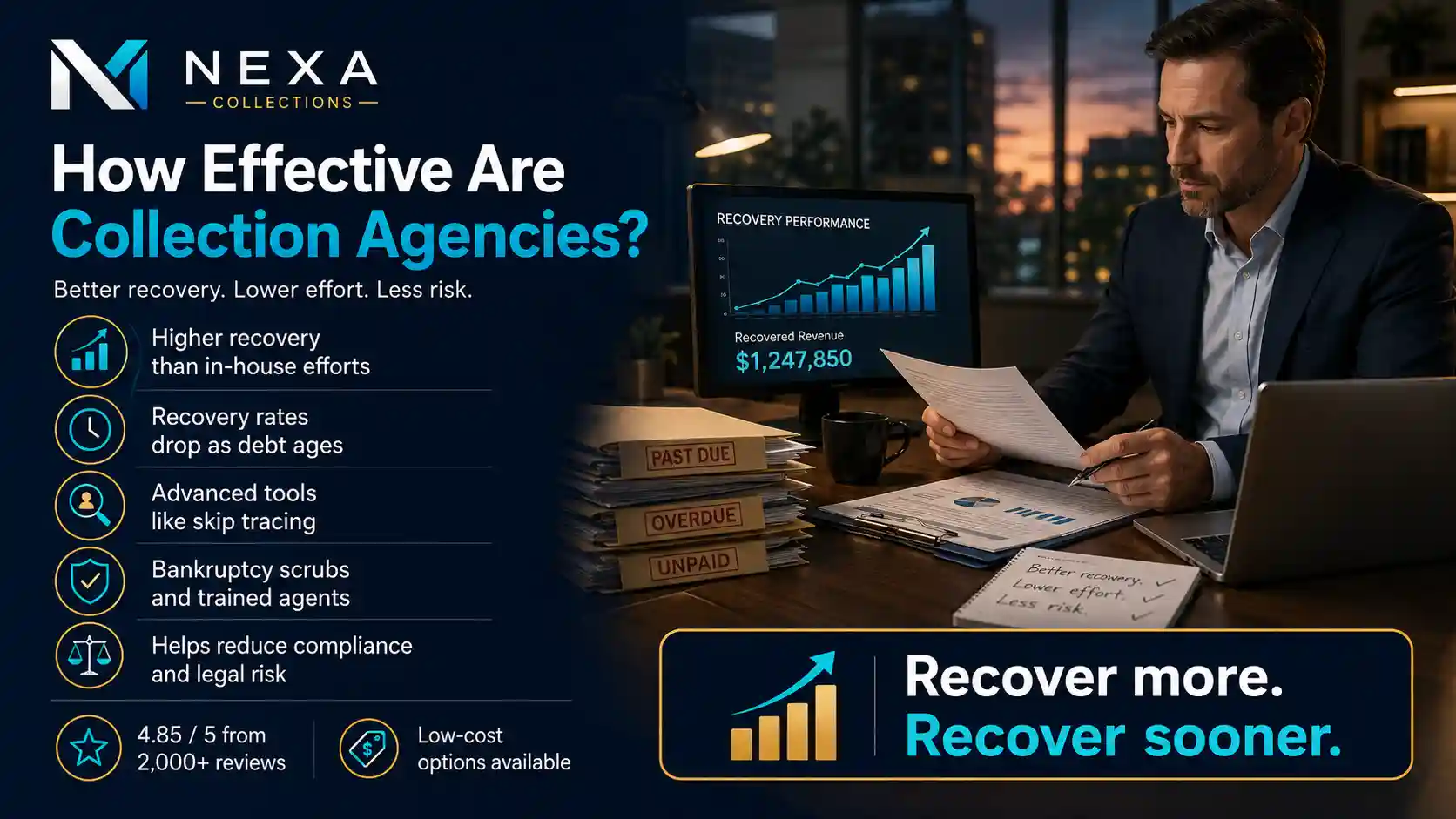
In short: Yes, quality collection agencies are genuinely worth their fee, but the right way to measure that isn’t the fee percentage alone, it’s net recovery after accounting for what your own staff’s time is actually worth. Debtors also treat a collection agency’s demand differently than the original creditor’s, moving an account to a third party changes the psychology of the situation and tends to produce faster, more complete resolution. Debts also become measurably harder to collect the longer they sit, so timing the handoff matters as much as choosing the right agency.
Cost-Effectiveness: The Nexa Advantage
-
Fixed-Fee Recovery ($15/account): Ideal for early-stage accounts. Debtors pay 100% directly to you. No commissions taken.
-
Contingency Service (20%–40%): Our “No Recovery, No Fee” model. We take the risk; you get the results.

Nexa provides reputation-safe, equipped with all 50-state collections license, offering free credit reporting, free litigation/bankruptcy scrubs, and zero onboarding fees. Secure – SOC 2 Type II & HIPAA compliant. Easy to use and each client is assigned a dedicated account representative backed by a responsive client support team
Need a Kansas Collection Agency? Contact us
Collecting outstanding debt isn’t an easy process. If a consumer has allowed their obligations to go into delinquency they’re usually either experiencing significant financial difficulty, they’re grossly irresponsible, or they have no intention of paying. None of these situations are amenable to fast debt recovery.
Companies will generally try to collect on their outstanding accounts internally before passing their most egregious cases on to an external debt collection agency. But how wise is this? Are collection agencies effective enough to warrant their fees?
Absolutely. Collection agencies are experts in debt recovery. The most effective agencies have perfected a proven process for their agents to follow that dramatically increases the chances of collecting a debt. Even after their fees, a collection agency is typically able to recover a lot more money than the client can do by themself. Plus they take away all the troubles that your staff has to undergo while chasing your unpaid bills.
Not only should companies trust collection agencies to handle their debt recovery, but they should also pass the debt on to the agency sooner than they do in many cases. That’s because debt collection success is a factor of time, skill, and reputation, all of which favor collection agencies.
The Real Cost-Effectiveness Question
Most businesses compare collection agencies by looking at one number: the fee percentage. That’s the wrong comparison. A lower-priced agency that recovers very little can cost you more, in real terms, than a higher-fee agency that recovers substantially more. The number that actually matters is net recovery, what lands in your account after fees, not the fee rate itself.
There’s a second cost most businesses don’t count at all: staff time. Every hour an employee spends making collection calls, sending statements, documenting disputes, or chasing an account is an hour not spent on their actual job. When that time is priced honestly, “handling it in-house for free” almost never is.
This is also why a single pricing model rarely fits every account. Fresh, lower-dollar balances are often better suited to fixed-fee collection, a predictable per-account cost with the creditor keeping 100% of what’s recovered. Older, disputed, or hard-to-locate accounts are often better suited to contingency, where the fee only applies to money actually collected. A cost-effective strategy generally uses both, starting inexpensively and escalating only the accounts that genuinely need more intensive work.
Collection Rates Drop As Debts Age
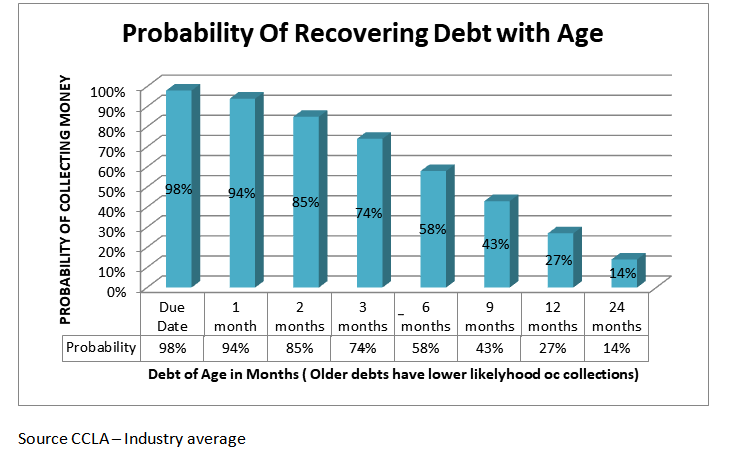
The longer an account remains delinquent, the less likely it is to be recoverable. Industry data from the Commercial Law League of America puts this in concrete terms: roughly 73% of a debt is typically still recoverable at 90 days past due, dropping to about 50% at 180 days, and down to around 25% by the one-year mark. Contact information changes, documentation gets harder to locate, and financial circumstances can deteriorate the longer an account sits untouched.
Internal collections departments, without the tools and specialization of a dedicated agency, generally fare even worse against this same aging curve. It’s better not to wait too long to pass outstanding debts on to a professional, and this is also why collection agencies commonly charge higher rates for older accounts than for fresh ones: the older account is genuinely harder work.
Collection Agencies Have Advanced Tools and Training
Debt collection is their business, after all. It’s how they make a living. This means collection agencies have just as much of an incentive to collect your debt as you do. It’s rare to find this sort of win-win relationship in business.
Agencies offer their agents rigorous training and access to advanced tools like skip tracing and bankruptcy scrub to improve the accuracy of their collections.
Skip tracing techniques allow agents to track down debtors that have “skipped” out on their debts and are no longer reachable. Bankruptcy scrubs alert agents when a bankruptcy filing occurs so they can move quickly to avail themselves of the proceedings as efficiently as possible.
These and other techniques aren’t always available to internal collections teams, reducing the effectiveness of their efforts.
Debtors Take a Collection Agency’s Demand More Seriously
When a debt passes from the original creditor to a collection agency, this escalation genuinely changes how a debtor responds. There’s an implied seriousness when an agency gets involved that a familiar in-house voice doesn’t carry, even when the underlying request is identical. People experiencing financial difficulty, or those who’ve simply been putting it off, will often string an original creditor along in a way they’re less willing to do once a specialist agency is involved.
This isn’t just a plausible story, the behavior shift shows up in how accounts actually resolve. Industry data shows lump-sum settlement is the leading resolution in roughly 48% of third-party collection cases, compared to hardship-program negotiation leading in about 21% of first-party (original-creditor) cases. Once an account moves past the original creditor relationship, debtors tend to move toward resolving it fully rather than negotiating it down piece by piece.
Collection agencies also know how to speak with debtors to motivate payment. That doesn’t mean they threaten them, because they generally don’t. Instead, they use a sophisticated, compliant approach to communication that pushes people toward payment without confrontation.
As a third-party agent, they can have conversations with debtors that are difficult for the original creditor. They can act as an intermediary or position themselves as a helpful, structured path to resolution instead of an adversary. These are benefits not available to the original creditor asking on their own behalf.
Collection Agencies Mitigate Legal Risks
Every state has laws governing how debts can be collected. Most creditors are unaware of these. And because they aren’t consistent, businesses that operate in multiple locations may have to follow different regulations depending on the customer.
Collection agencies are intimately familiar with all of these legal frameworks and operate within them daily. Using an agency can shield you from running afoul of these laws.
Collection Agencies Are The Most Effective Option
Quality agencies enjoy a higher success rate than original creditors, are more affordable than lawyers and legal proceedings, and use diplomatic techniques that allow companies to preserve their relationships with their customers.
You should undoubtedly attempt initial collection efforts, but once your delinquent accounts seem unrecoverable, you should trust a collection agency. Their fees might seem meaningful upfront, but recovering a substantial share of a debt you likely wouldn’t have collected otherwise is a genuine net positive. And with a contingency structure, if nothing is recovered, the service costs nothing. As stated earlier, it’s a win-win.
Frequently Asked Questions
Are collection agencies worth the cost?
Generally, yes, but the right measure is net money recovered, not simply the agency’s fee percentage. A lower-priced agency that recovers very little can cost you more than an agency with a higher fee but substantially better recovery. You should also factor in the hours your employees spend making calls, sending statements, documenting disputes, and chasing accounts instead of doing their primary jobs. The most cost-effective collection strategy is the one that puts the greatest net recovery back into your business.
Is it worth sending small balances to a collection agency?
Yes, if the pricing model fits the size and age of the debt. Traditional contingency collections can consume a large portion of a small recovery, which is why fixed-fee collections can make more sense for newer, lower-dollar accounts. Nexa’s early-stage programs start at approximately $15–$20 per account, and the creditor keeps 100% of the amount recovered during those fixed-fee stages. This can make accounts that businesses previously considered “too small to collect” economically worthwhile.
Is fixed-fee or contingency debt collection more cost-effective?
Neither is automatically better. Fixed-fee collection generally makes the most sense for fresh accounts and portfolios containing many smaller balances, because you pay a predictable amount per account and keep the recovery. Contingency collection is often better for older, difficult, disputed, or hard-to-locate accounts, because you pay the agency only when money is successfully recovered. A cost-effective strategy can use both, starting inexpensively and escalating only the accounts that need more intensive collection work.
What hidden fees should I look for when comparing collection agencies?
Don’t compare agencies using the contingency percentage alone. Ask about placement fees, setup or onboarding charges, annual membership fees, minimum-volume requirements, account-withdrawal penalties, skip-tracing charges, credit-reporting fees, and litigation or court costs. A seemingly inexpensive collection rate can become considerably more expensive once additional charges are added. Nexa currently charges no placement fees, annual dues, or hidden onboarding costs.
Why does waiting longer to send accounts to collections usually cost more?
As accounts age, they generally become more difficult to recover. Contact information changes, customers move or close businesses, documentation becomes harder to locate, and financial circumstances can deteriorate. Collection agencies therefore commonly charge higher contingency percentages for older accounts than for fresh accounts. Sending chronically past-due accounts earlier can improve both the economics and the available recovery options.
Can I add collection agency fees to what the customer owes?
Sometimes, but not automatically. For consumer debts covered by federal debt-collection law, a collector generally cannot collect an additional fee, charge, or expense unless it is expressly authorized by the agreement that created the debt or permitted by applicable law. State laws can impose additional restrictions. Businesses that want customers to be responsible for collection costs should have their contracts and collection-cost clauses reviewed for compliance before relying on them.