• Skip to main content
  • Skip to primary sidebar

Nexa Collections

  • Home
  • Serving
    • Medical
    • Dental
    • Small Business
    • Large Business
    • Commercial Collections
    • Government
    • Utilities
    • Fitness Clubs
    • Schools
    • Senior Care Facility
  • Contact Us
    • About us
    • Cost

Collection Agency Cost: What You Really Pay (and Why It Varies)

Why let overdue invoices drain your cash flow when NexaCollect can turn them into revenue for just pennies on the dollar.
 

Cash flow pressure has gone up sharply in the last few years. A large share of small businesses are owed money on unpaid invoices, with average outstanding balances in the five-figure range for many firms.

At the same time, the cost structure of collection agencies has become more transparent. Most agencies now use some mix of:

  • Flat / fixed-fee collections for fresher accounts

  • Contingency-fee collections for older or more difficult accounts

  • Legal collections when a lawsuit is justified

Typical market ranges today:

  • Flat-fee consumer placements often run about $12–$25 per account, with the creditor keeping 100% of what’s collected.

  • Contingency fees commonly fall in the 20%–40% (sometimes up to 50%) range, depending on age, balance, and difficulty.

  • Industry benchmarks often show average recovery rates around 20%–50% of principal, heavily influenced by how early accounts are placed.

Against that backdrop, the fee structure below is designed to sit within normal market ranges, while stressing compliance, reputation protection, and nationwide reach.


Key Things to Check Before You Compare Fees

Collection agency cost should never be your only selection criterion. Price without performance or compliance is expensive in the long run.

When evaluating any agency, look beyond the percentage and ask:

  • Compliance & regulations

    • Are they aligned with FDCPA, FCRA, TCPA, GLBA, HIPAA (for medical) and the CFPB’s Regulation F (including the “7-in-7” telephone contact rule, which presumes a violation if a collector calls more than seven times in seven days about a single debt)?

  • Licensing & coverage

    • Are they licensed or authorized to collect in all states where your customers live, and experienced with your industry (medical, dental, commercial, schools, utilities, etc.)?

  • Data security

    • Do they invest in encryption, secure portals, and cybersecurity, not just basic passwords?

  • Communication channels

    • Can they communicate via letters, phone, email, and text (with consent), and in multiple languages where needed?

  • Scrubs & research

    • Do they perform bankruptcy, deceased, litigious debtor, and change-of-address scrubs before they start?

  • Reporting & transparency

    • Will you have access to a real-time online portal to view placements, notes, payments, and to pause or recall accounts?

  • Reputation

    • What do online reviews, client references, and complaint records look like?

A slightly higher fee from a compliant, well-run agency is usually cheaper than a low fee from a vendor who exposes you to regulatory or reputational damage.


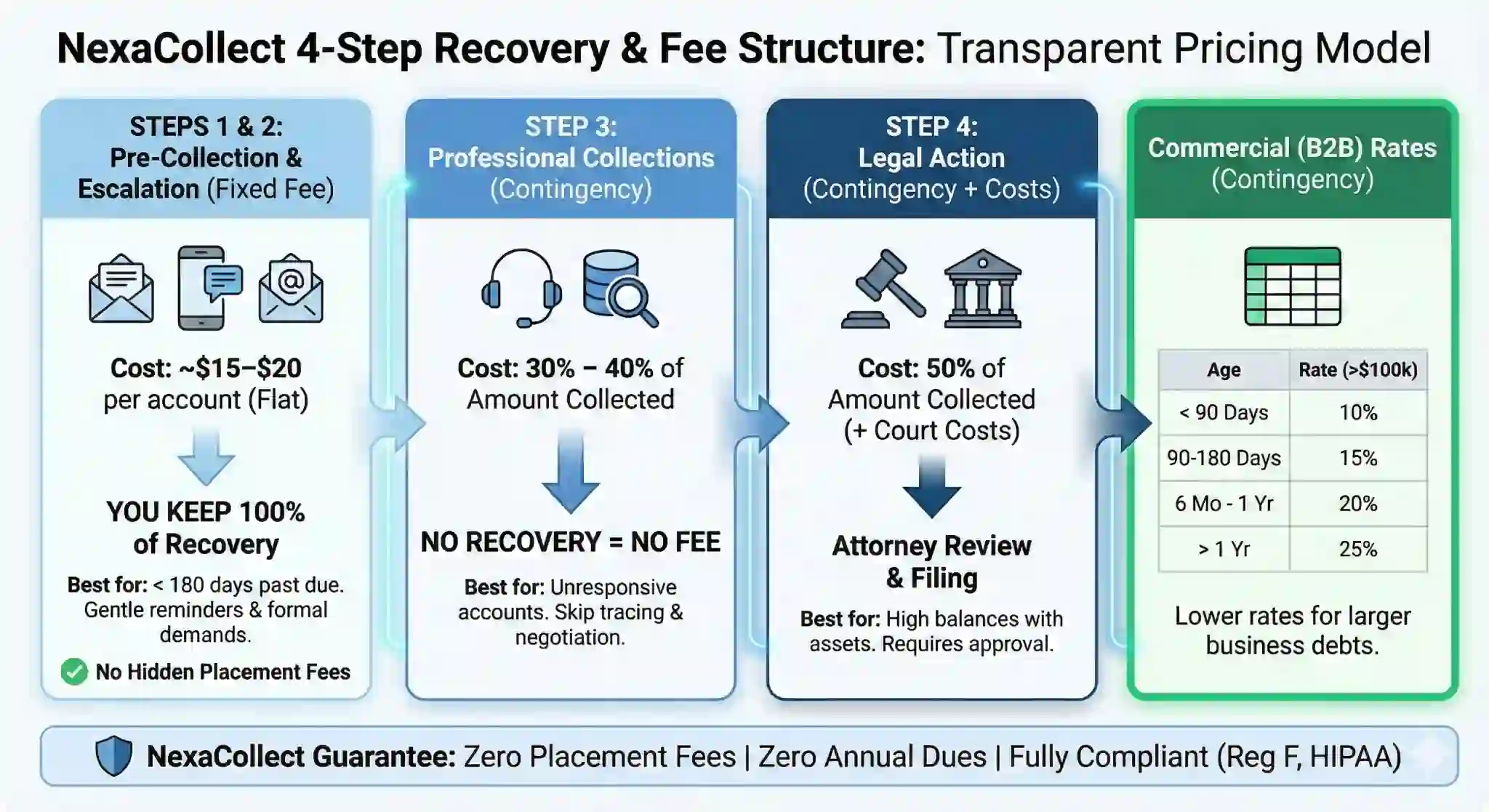
Consumer Collections Cost (B2C Recovery) – 4-Step Model

collection agency cost

The consumer (B2C) side is where flat-fee and contingency services blend together. The basic structure below remains the same; what has changed in recent years is the emphasis on compliance, data security, and omni-channel communication.

Important: The pricing and service structure below stays exactly as offered:
Step 1: ~$15, Step 2: ~$15, COMPLETE (Steps 1+2): ~$20, Step 3: ~40% contingency, Step 4: ~40–50% contingency (legal).

STEP 1: Pre-Collection (Fixed Fee Service – ~ $15 per account)

  • What it is
    A low-cost, early-stage reminder service that uses your company name.

  • What happens

    • Five contacts are made over roughly 30 days.

    • Debtors are instructed to pay you directly; the account is not yet “in collections” in the traditional sense.

  • Channel mix

    • Historically this service focused on 2 phone calls + 3 USPS letters.

    • Today, agencies also commonly layer in email and text (where permitted and consented) while still keeping the fixed fee structure.

  • Why use Step 1

    • Designed for accounts under 180 days past due, where a firm but polite nudge is often enough.

    • You keep 100% of the money collected; the only cost is the ~$15 flat fee per account.


STEP 2: Collection Demands (Fixed Fee Service – ~ $15 per account)

  • What it is
    A fixed-fee escalation where all contacts go out in the collection agency’s name, not yours.

  • What happens

    • Again, five structured contacts are sent, this time with a more serious tone.

    • In this step, communications are traditionally USPS mail–only, with increasing urgency in each letter.

  • Payments

    • Payments are still directed to you, not to the agency.

  • Why use Step 2

    • It’s an economical way to show debtors that the account has formally reached collections, without immediately jumping to a contingency fee.


COMPLETE Service: Step 1 + Step 2 (~ $20 for 10 Contacts)

  • Combining Step 1 and Step 2 gives you ten touches for about $20 total per account, instead of paying for them separately.

  • In practice, this creates a 30–60 day structured campaign: first in your name, then in the agency’s name.

  • You still keep 100% of what’s collected from the debtor.

For many businesses and medical practices, this COMPLETE fixed-fee path offers one of the best returns in the industry, especially when accounts are placed early.


STEP 3: Collection Calls (Contingency Fee – ~ 40% of Amount Recovered)

  • When to use
    For accounts that don’t respond to letters and reminders, or are already several months past due.

  • How it works

    • Professional collectors actively call the debtor to set up payment in full or a structured plan.

    • The tone is firm but compliant – no threats or harassment, consistent with Regulation F’s call frequency rules and the FDCPA.

  • Fees

    • Standard contingency fee is about 40% of what’s recovered.

    • You receive around 60% of the collected amount.

    • This is strictly “No Recovery – No Fee.”

  • Tools often used

    • Skip tracing to find updated contact information

    • Bankruptcy and deceased checks

    • Credit bureau reporting, where appropriate and authorized (note that for medical accounts, credit reporting has become much more limited due to voluntary industry changes and evolving rules).

Step 3 is typically where the heaviest lifting happens – and where the difference between an average and a top-tier agency really shows up.


STEP 4: Legal Suit (Contingency Fee – ~ 40%–50% of Amount Recovered)

  • When to use

    • The balance is large enough to justify attorney involvement.

    • The debtor appears to have assets or income worth pursuing.

    • Non-legal collections have been exhausted.

  • How it works

    • The collection agency and its network attorney assess your case.

    • If suit is recommended and you approve it, the attorney files in the appropriate court.

  • Fees

    • Contingency fee is usually in the 40%–50% range, depending on balance size, jurisdiction, and complexity.

    • You may also be responsible for court costs and filing fees, which are typically advanced by you and then added to the claim where allowed.

  • Why fees are higher

    • Legal collections involve more labor, more compliance checks, and more risk for everyone involved.

Legal action should be selective, focused on accounts where the probability of recovery justifies the cost.


Commercial Collections Cost (B2B Recovery)

Commercial (B2B) collections are different from consumer work:

  • Balances are usually higher.

  • Debtors are business entities, not individuals.

  • Negotiations often involve finance directors, controllers, or owners.

Because of this, B2B contingency fees tend to be lower than consumer contingency fees, even though the balances can be larger. Industry ranges of 10%–40% are normal, depending on age and amount.

Standard B2B Contingency Fee Grid

Commercial Contingency fee (Based on Account Age and Amount Assigned)
Age:
If > 1 year
40% 35% 30% 25%
180 days – 1 year 35% 30% 25% 20%
90-180 days 30% 25% 20% 15%
< 90 days 25% 20% 15% 10%
 Amount Assigned -> $500-
$5k
$5k-
$20k
$20k-
$100k
     $100K +

Need a good Collection Agency? Contact us 

Serving Nationwide

 
  • No Recovery = No Fee for these B2B contingency placements.

Older accounts and lower balances naturally carry higher percentage fees, because they are harder to collect and less profitable for an agency.


Why the “Cheapest” Collection Agency Often Costs You More

A lot of businesses still shop for a collection agency the way they shop for office supplies – by looking for the lowest price. That can be an expensive mistake.

Imagine you place $40,000 in unpaid accounts with two different agencies:

  • Agency A

    • Charges a contingency fee of 20%.

    • Obviously gives less time to each account. Recovers $6,000 (15% of your placements).

    • Your net after fees: $4,800.

  • Agency B

    • Charges a contingency fee of 30%.

    • Charges more, but also works a lot harder on each account. Recovers $16,000 (40% of your placements).

    • Your net after fees: $11,200.

Even though Agency B charges a higher fee percentage, you end up with more than double the money in your bank account. This gap gets even larger when you add:

  • Fewer write-offs

  • Better documentation and compliance

  • Less time your staff spend chasing the same accounts

In today’s environment—where average agency recovery rates are often in the 20–30% range and top performers can do significantly better—the real question isn’t “Who is cheapest?” but “Who can recover the most, safely?”


Recent Results

Below are fresh, sample scenarios that reflect what a modern fee structure can look like in practice. These are illustrative only, not guaranteed outcomes.

  • Dental practice in Ohio – Fixed fee COMPLETE service

    • $18,600 in early-stage patient balances placed under 150 days past due.

    • Used Step 1 + Step 2 (~$20 per account for 220 accounts).

    • Within 45 days, $10,900 was recovered directly by the practice (no contingency fee; only the flat fees paid).

  • HVAC contractor in Texas – B2C contingency (Step 3)

    • $62,000 in residential invoices, most between 6–12 months old.

    • Placed directly into Step 3 at ~40% contingency.

    • Over 6 months, $34,500 collected; the contractor received roughly $20,700 after agency fees.

  • Wholesale distributor in California – B2B contingency

    • $210,000 in past-due invoices, mostly 90–180 days with a few just over a year old.

    • Fee grid ranged from 15%–30% depending on balance and age.

    • Within 4 months, $88,000 recovered; net back to client after fees: approximately $69,000.

  • Multi-location medical group in Florida – mix of fixed fee and contingency

    • $75,000 in balances under 120 days placed on COMPLETE (Steps 1+2) plus $40,000 older than 180 days on Step 3.

    • Fixed-fee side: about $31,000 recovered directly to the practice.

    • Contingency side: $14,400 recovered, with roughly $8,600 net to the group after Step 3 fees.

  • Technology services firm in New York – B2B legal placements

    • Ten disputed invoices totaling $180,000, all over 1 year old.

    • After non-legal efforts, select cases moved to Step 4 (legal) at ~40–50% contingency, plus court costs advanced by the client.

    • Three cases produced judgments and settlements totaling $72,000, with approximately $36,000–$40,000 net back to the client after legal fees and costs.

These examples show how different fee structures (fixed vs. contingency vs. legal) can be combined to match your risk, account age, and business goals.


New Legal & Compliance Developments That Affect Fees and Strategy

In recent years, regulators and credit bureaus have made changes that directly affect how agencies operate and how you should think about fees:

  • CFPB Regulation F

    • Imposes the “7-in-7” call frequency standard (more than 7 calls in 7 days about a debt is presumed unlawful).

    • Sets clearer rules for voicemails, texts, and emails, and for validation notices and itemization of debt.

    • Agencies that invest in Regulation F–compliant systems may charge a bit more—but dramatically reduce your legal risk.

  • Medical debt credit-reporting changes

    • Credit bureaus have removed paid medical collections and many smaller medical collections, and generally wait longer before reporting new medical collections.

    • There have been efforts at the federal level to limit or ban medical debt on most credit reports, followed by court challenges, leaving a patchwork of rules and strong voluntary changes by the bureaus.

    • Practically, this means credit reporting is a weaker leverage tool for medical balances than it used to be; agencies now focus more on communication, payment plans, and financial counseling.

  • State-level activity and “junk fee” scrutiny

    • Several states have strengthened mini-CFDPA / mini-CFPB laws, increased penalties for unfair practices, and looked closely at extra fees added to consumer accounts.

    • Federal scrutiny of unreasonable and opaque fees has increased, signaling a broader push against confusing or excessive charges across financial services.

All of this reinforces one idea: the lowest advertised fee is meaningless if the agency is not fully compliant, transparent, and well-documented. A modern, reputable agency invests heavily in:

  • Compliance programs and training

  • Call recording and quality monitoring

  • Cybersecurity and data protection

  • Better analytics and workflows to improve recovery rates

Those investments show up in their pricing—but they also show up in your higher net recovery, fewer complaints, and far lower legal exposure.


Serving Nationwide – Focus on Value, Not Just the Percentage

The location of the agency matters far less than:

  • Their licensing footprint across all the states where your customers live

  • Their experience in your industry

  • Their recovery performance and compliance record

Rather than searching for the cheapest quote and stopping there, focus on:

  • Total dollars recovered after fees

  • Time saved for your staff

  • Protection of your brand and reputation

That is the real measure of collection agency cost—and the reason smart businesses, medical practices, and commercial creditors are willing to pay fair, transparent fees to agencies that actually deliver.

Filed Under: Debt Recovery

Primary Sidebar


accounts receivable

Need a Collection Agency?
Kindly fill this form.
We’ll get in touch with you

    Please prove you are human by selecting the house.

    Recent Posts

    • Federal Government Shutdown: Impact on Collections
    • 2025-2026 ROI & Opportunity Matrix for Collection Agencies
    • Collection Agency to Recover Timeshare Unpaid Bills
    • When Should I Send Dental Accounts to Collections? A Guide for a Healthy Practice
    • 10 Signs You Need to Hire a Medical Debt Collection Agency
    • Debt Collection for Telehealth Providers: Proven Strategies & Best Practices
    • The Rise of Mobile Payment Solutions in Debt Collection
    • Why Cybersecurity Matters for Collection Agencies

    Featured Posts

    • Government is Making Debt Recovery a lot Harder
    • Current Trends in the Restoration Industry
    • Urgent Care Clinics Billing Issues
    Directory of collection agencies
    Collections

    Featured Agencies

    • Global Credit Network – Debt Collection
    • Capital Credit & Collections – Debt Collection
    • Collection Agencies in Fenton, MO

    Copyright © 2025 NEXACOLLECT.COM | All information on this website is for general information only and is not an experts advice. We do not own any responsibility for correctness or authenticity of the information, or any loss or injury resulting from it. NexaCollect is not a collection agency.

    X
    Need a Collection Agency?
    Contact Us