From hotels and event vendors near International Drive and the Orange County Convention Center to medical practices, contractors, property managers, and B2B companies across Lake Nona, Downtown Orlando, and the I-4 corridor, overdue accounts can quietly drain cash flow. Nexa helps Orlando businesses recover past-due balances with persistent, Florida-compliant, reputation-safe collection strategies, so you get paid without damaging the customer relationships your business depends on.
Quick answer: Orlando collections run on Florida’s specific legal framework: a 5-year statute of limitations for written contracts, a Florida Consumer Collection Practices Act (FCCPA) that reaches original creditors as well as agencies, and a genuinely distinctive wage garnishment protection, Florida’s “Head of Family” exemption fully shields disposable earnings up to $750/week for anyone supporting a dependent, with earnings above that also protected unless a formally valid written waiver exists. Florida judgments last a notably long 20 years. Nexa recovers Orlando accounts starting at a $15 fixed fee per account, with contingency options for older balances, built around the tourism, hospitality, and convention economy that makes this city genuinely different to collect in.
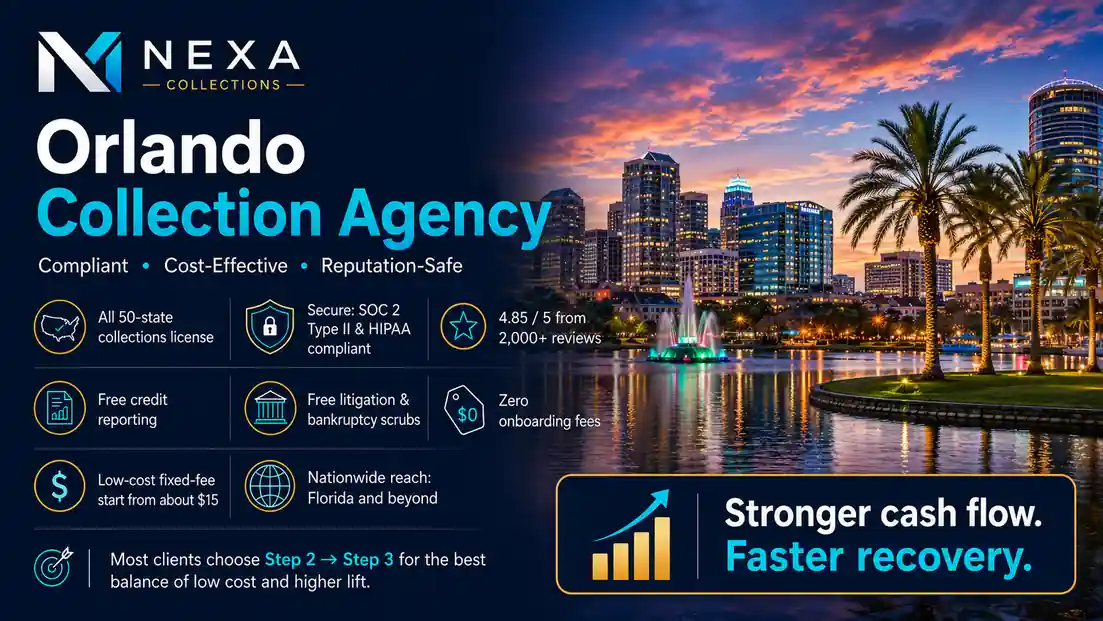
Nexa provides a reputation-safe approach, equipped with all 50-state collections license, offering free credit reporting, free litigious debtor check, free bankruptcy scrub, and zero onboarding fees. Secure – SOC 2 Type II & HIPAA compliant. Over 2,000 online reviews rate us 4.85 out of 5. Easy to use and a good support team.
Need an Orlando Collection Agency? Contact us
What Makes Orlando Collections Genuinely Different
The Head of Family exemption is the single most important thing to screen for before litigating.
Under Fla. Stat. § 222.11, a debtor who provides more than half the support for a child or other dependent gets disposable earnings up to $750/week fully exempt from garnishment, no exceptions. Earnings above that are also exempt unless the debtor signed a valid written waiver, and that waiver has real, strict formal requirements: it must be a separate document, in the same language as the underlying contract, printed in at least 14-point type, with specific statutory language included. A waiver buried in general contract boilerplate that doesn’t meet these formal requirements can be challenged and thrown out, which means a creditor who assumes a personal guaranty clause protects their garnishment rights may be wrong. Screening for this before spending on litigation avoids chasing wages that turn out to be exempt.
Florida judgments last unusually long.
A Florida money judgment is enforceable for 20 years, notably longer than most states. A real-property judgment lien lasts 10 years per recording and can be renewed once for another 10 years, though never beyond that 20-year judgment life. Post-judgment interest is set quarterly by the state, currently the Federal Reserve discount rate plus 400 basis points.
Florida’s debt collection law reaches your own billing team, not just outside agencies.
The Florida Consumer Collection Practices Act (§ 559.72) applies to original creditors collecting their own consumer debts, not only third-party collectors, the same pattern already confirmed in several other states. An Orlando business handling collections in-house is bound by the same conduct standards as an outside agency.
The Florida Legal Landscape
| Statute of Limitations (written contracts) | 5 years — Fla. Stat. § 95.11 |
| Statute of Limitations (non-written obligations) | Commonly 4 years |
| Head of Family Wage Exemption (≤$750/week) | Fully exempt, no exceptions — Fla. Stat. § 222.11 |
| Head of Family Wage Exemption (>$750/week) | Exempt unless a formally valid written waiver exists |
| Judgment Life | 20 years — Fla. Stat. §§ 95.11, 55.081 |
| Judgment Lien on Real Property | 10 years per recording, renewable once |
| Governing Consumer Law | Florida Consumer Collection Practices Act, reaches original creditors — Fla. Stat. § 559.72 |
| Construction Lien Notice to Owner | Generally required before work begins, or within 45 days of beginning to furnish labor/materials |
What This Costs
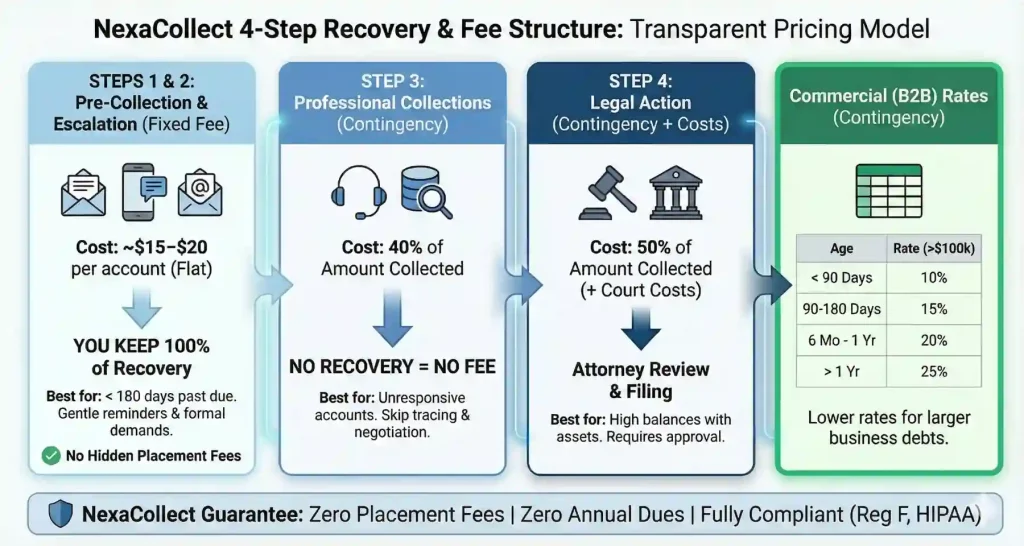
Step 1 & 2: Fixed-Fee Recovery (~$15/account). Professional demand sequences for accounts under roughly 60-90 days. Payments go directly to you. See the full pricing breakdown.
Step 3: Contingency Collection (~40%). For older or unresponsive accounts, no recovery, no fee.
Step 4: Legal Referral (client-approved, ~50%). With Head of Family collectibility screening built in before litigation, filing fees reimbursed from the first recovery.
Who We Collect For Across Orlando
- Agriculture & Manufacturing: B2B and commercial receivables for manufacturers and suppliers across the metro.
- Hospitals, Dental & Medical: HIPAA-compliant patient balance recovery for practices across the metro.
- Colleges & Universities: Tuition and fee recovery for the region’s higher education institutions.
- K-12 Private & Charter Schools: Tuition and activity fee recovery handled diplomatically, alongside meal and fee recovery for public districts.
- Accountants & CPA Firms: Commercial receivables for the professional services firms supporting Orlando’s tourism and corporate base.
- Banks & Credit Unions: Recovery for the region’s financial institutions and lending partners.
- Construction & Trades: B2B recovery with Florida’s 45-day Notice to Owner deadline flagged at intake for contractors and suppliers.
- B2B Commercial, Restoration & Waste Management: Commercial receivables for hotels, event vendors, caterers, transportation companies, and event-production firms around International Drive and the Orange County Convention Center, plus restoration contractors and waste management providers.
Frequently Asked Questions
A company held an event in Orlando and left without paying its final invoice. Can Nexa still collect after they return to another state?
Yes. This is a common challenge for Orlando hotels, convention suppliers, caterers, transportation companies, event-production firms, and other tourism businesses. The debtor does not become unreachable simply because its headquarters are in another state. Nexa can pursue qualifying accounts nationwide, using the event contract, purchase order, final invoice, service records, and correspondence to establish what is owed. This is particularly useful around the Orange County Convention Center, International Drive, Lake Buena Vista, and the I-4 tourism corridor.
What paperwork gives an Orlando hotel or event vendor the best chance of winning a disputed invoice?
The strongest file usually contains more than an invoice. For hospitality and convention accounts, provide the signed event or service agreement, purchase order, banquet or event order, cancellation terms, approved changes, delivery records, final invoice, emails approving additional charges, and payment history. A debtor saying “we dispute the bill” is much easier to address when every added service and charge has a clear paper trail.
If an Orlando contractor misses Florida’s mechanics-lien deadline, can the unpaid invoice still be sent to collections?
Potentially, yes. Losing lien rights does not necessarily erase the underlying debt. Florida has strict construction-lien requirements; for many subcontractors and suppliers who are not in direct contract with the owner, a Notice to Owner generally must be served before work begins or within 45 days after beginning to furnish labor or materials. Missing that deadline can defeat lien rights, but contractual collection options may still remain depending on the circumstances. Contractors should therefore pursue collection early rather than waiting for lien deadlines to expire.
Why should an Orlando creditor check whether a debtor is “Head of Family” before spending money on a lawsuit?
Because winning a judgment and collecting a judgment are two different things in Florida. Florida gives significant wage-garnishment protection to a person who provides more than half the support for a child or other dependent. A Head of Family earning $750 or less per week has disposable earnings protected from garnishment, and earnings above that level also receive substantial protection unless a valid written waiver exists. Screening collectibility before litigation can prevent a creditor from spending legal fees chasing wages that may be exempt.
Can an Orlando business create a collection-law problem before it ever hires a collection agency?
Yes. Florida’s Consumer Collection Practices Act (FCCPA) regulates prohibited conduct in collecting consumer debts and is broader in important respects than businesses sometimes assume. Problematic conduct can include improper threats, disclosing a debt to an employer in prohibited circumstances, or using abusive collection tactics. That means compliance should begin with your internal accounts-receivable team, not only after an account reaches a third-party agency.
How long can an Orlando business wait before an unpaid account becomes too old for a lawsuit?
Florida generally provides five years for actions based on a written contract or obligation founded on a written instrument. Many obligations not founded on a written instrument have shorter limitation periods, commonly four years. The exact deadline depends on the type of account and when the cause of action accrued, so businesses should not treat five years as a universal deadline. From a recovery standpoint, waiting anywhere near the legal limit is usually a poor strategy, accounts become harder to resolve as they age.