The Problem: Unpaid Invoices Are Stalling Your Business
Your business has a straightforward problem: you’ve done the work, but you haven’t been paid. When a prototype milestone, fabricated-parts order, patient balance, or contractor invoice goes unpaid, sending another statement rarely fixes the underlying problem.
The Solution: A Logical, Expert-Driven Process
Nexa helps Pittsburgh businesses, healthcare providers, manufacturers, technology companies, and contractors recover overdue B2B and consumer accounts with professional follow-up, payment negotiation, skip tracing, and appropriate escalation. The approach changes with the debt—because a restoration invoice dispute should never be handled like a patient balance or an ordinary unpaid invoice.
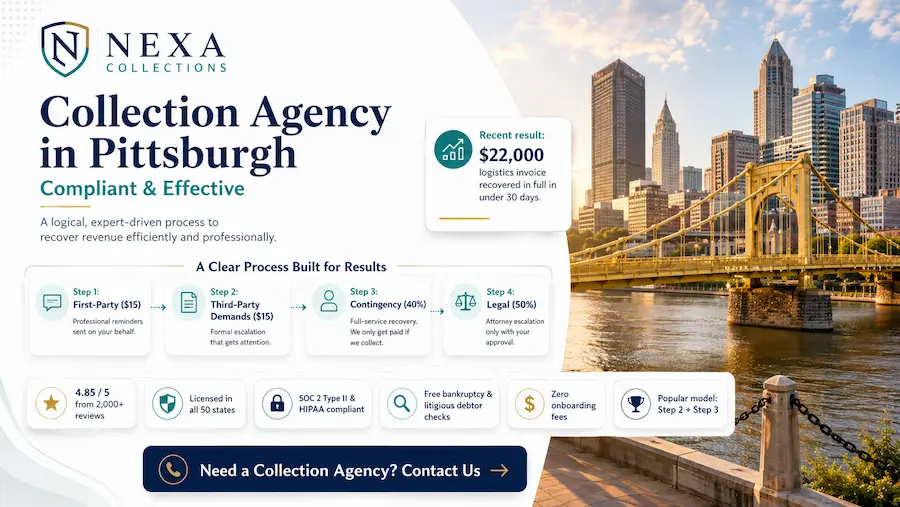
Nexa provides a reputation-safe approach, equipped with all 50-state collections license, offering free credit reporting, free litigious debtor check, free bankruptcy scrub, and zero onboarding fees. Secure – SOC 2 Type II & HIPAA compliant. Over 2,000 online reviews rate us 4.85 out of 5.
Need a Pittsburgh Collection Agency? Contact us
A Clear Process Built for Results
Our system is built on a simple, 4-step escalation. You are always in control.

- Step 1: First-Party ($15)Professional, persistent reminders sent on your behalf, preserving the client relationship.
- Step 2: Third-Party Demands ($15)We escalate, using our name and authority to send formal demands. This flat-fee step resolves a significant number of accounts.
- Step 3: Contingency (40%)If Steps 1 & 2 don’t secure payment, our expert team moves to full-service pursuit. We only get paid if we successfully collect.
- Step 4: Legal (50%)For the most difficult accounts, we can engage our attorney network, but only with your explicit approval.
Most of our clients use the Step 2 + Step 3 combination. It’s the most logical approach: you get the high-impact, low-cost attempt first, backed by the power of a full-service team if needed.
Recent Result
A Pittsburgh-based logistics firm was struggling with a $22,000 unpaid invoice from a national client. Their in-house efforts were ignored. They submitted the account to us, and our $15 Step 2 demand immediately got the debtor’s attention, opening a line of communication. When the debtor stalled, the account automatically rolled to our Step 3 team. Within two weeks, our specialists negotiated a payment-in-full. The client avoided a high-cost legal battle and recovered 100% of their principal in under 30 days.
The Logical Choice for Pittsburgh Businesses
-
Smarter Economics: Stop paying 40% on accounts that could be solved for $15. Our model is built to be cost-effective.
-
Total Compliance: We are licensed, bonded, and compliant in all 50 states. We navigate complex regulations (see below) so you don’t have to.
-
Reputation Shield: Your reputation, whether with clients at UPMC or partners in the Strip District, is your primary asset. We act as professionals, protecting your brand.
-
Instant Risk Assessment: Every account submitted receives a free bankruptcy and litigious client check. We stop you from wasting money on uncollectible or high-risk accounts.
-
Proven Trust: Our high Google reviews are not an accident. They are the result of a process that delivers results, transparently and effectively.
A Note on Pennsylvania (PA) Law
Pennsylvania requires any entity collecting on behalf of others to be properly licensed and bonded. Furthermore, the Pennsylvania Fair Credit Extension Uniformity Act (FCEUA) mirrors many of the federal FDCPA’s restrictions on harassment and unfair practices. Using an unlicensed or non-compliant partner is a direct financial risk. We are fully compliant with all PA regulations.
Frequently Asked Questions (FAQ)
1. Can a Pittsburgh medical or dental practice use skip tracing when a patient has moved?
Yes. HIPAA does not prevent a healthcare provider from using a collection agency to locate a patient and recover a legitimate balance. HHS specifically treats debt collection and obtaining location information as healthcare “payment” activities. When PHI is involved, the provider and collection agency still need the appropriate business-associate arrangement and must follow HIPAA’s minimum-necessary standard.
That distinction matters for Pittsburgh medical offices, dentists, surgery centers, imaging providers, urgent care clinics and specialty practices when statements are returned or a patient changes address. Before placement, preserve the patient ledger, EOBs, statements, contact history and documentation showing how the patient-responsibility balance was calculated.
See Nexa’s Medical Debt Collection service and Dental Collection service.
2. Can a Pittsburgh private school collect tuition after a student withdraws in the middle of the year?
Potentially, yes—but the signed enrollment agreement usually determines what remains due. A family withdrawing a student does not automatically erase an unpaid tuition obligation if the contract contains enforceable withdrawal, tuition, cancellation or payment-plan provisions.
Before referring an account, a Pittsburgh private school should preserve the signed enrollment agreement, withdrawal policy, tuition ledger, financial-aid adjustments, payment-plan records, notices and any credits applied after withdrawal. Pennsylvania generally provides a four-year limitation period for claims based on written contracts, so old tuition accounts should not sit indefinitely.
The same documentation-first approach can apply to legitimate activity fees, device charges, registration balances and other contractual school receivables.
See Nexa’s School Collection Agency service.
3. Can a Pittsburgh B2B creditor use a confession-of-judgment clause to collect faster?
Sometimes—and this is one of Pennsylvania’s more unusual commercial collection tools.
Pennsylvania procedure allows a judgment by confession when a signed note, lease or other instrument already contains a valid warrant authorizing confession of judgment. The procedure is specifically unavailable for a natural person in a consumer-credit transaction.
But the clause cannot simply be added after an invoice becomes delinquent. Pennsylvania courts construe warrants of attorney strictly, and the debtor’s signature must have the required relationship to the provision.
For Pittsburgh small businesses, equipment companies, wholesalers, commercial landlords, service firms and other B2B creditors, an attorney should review the original agreement before deciding whether confession of judgment is available.
See Nexa’s Commercial Collection Agency service.
4. Can a Pittsburgh restoration contractor collect an insurance-related balance after the work is finished?
Yes, when the customer is contractually responsible—but restoration files need stronger documentation than an ordinary unpaid invoice.
For residential work exceeding $500, Pennsylvania’s Home Improvement Consumer Protection Act generally requires a written, signed contract containing important details such as the scope of work, pricing, approximate start and completion dates and contractor information. Changes to the work should also be properly documented.
A strong restoration collection file can include the signed contract, Xactimate estimate, deductible acknowledgement, insurer estimate, Assignment of Benefits if applicable, supplements, change orders, completion documentation and records showing where an insurance payment was sent.
For qualifying private commercial construction, Pennsylvania’s Contractor and Subcontractor Payment Act can create additional leverage; absent different contract terms, overdue qualifying payments can accrue 1% interest per month.
See Nexa’s Restoration Company Collections service and Contractor Collection Agency service.
5. Are unpaid Pittsburgh gym memberships and security-alarm early-termination fees automatically collectible?
No. These are two good examples of why the underlying contract has to be checked before collection starts.
Under Pennsylvania’s Health Club Act, qualifying gym contracts lasting longer than three months generally give the buyer a three-business-day cancellation right. Other cancellation protections can apply when a club closes, and a contract that fails to comply with the Act can be voidable.
Residential security-system accounts can raise a different issue. Pennsylvania expressly includes security-system installation within its definition of home improvement when the qualifying residential project exceeds $500. That means the installation contract may need to satisfy Pennsylvania’s home-improvement contract requirements.
For either industry, Nexa should receive the signed agreement, cancellation provisions, payment history, equipment records and communications about cancellation or service termination before pursuing disputed charges.
See Nexa’s Gym & Fitness Collections service and Security & Alarm Collections service.
6. Can Pittsburgh municipal utility and government debts be collected like ordinary invoices?
Not always. Pennsylvania gives certain government and municipal receivables collection tools that private creditors do not have.
Pennsylvania’s Municipal Claim and Tax Lien Law includes claims arising from water rates, sewer rates, lighting rates, municipal services and certain work performed by municipal authorities. Qualifying claims can potentially become liens against the affected property rather than functioning solely as ordinary unsecured debt.
That makes a Pittsburgh municipal water balance fundamentally different from a private contractor’s invoice or gym membership. Government organizations should first determine whether an account belongs in a statutory lien process, internal administrative process or third-party collection workflow.
For public-sector collections, communication also matters: the person owing the balance may simultaneously be a resident, taxpayer, utility customer and voter.
See Nexa’s Government Collection Agency service.
Stop Chasing. Start Collecting.
Your time is too valuable to spend on accounts receivable. Hand the problem to the experts and get back to growing your business.
Contact Us Today to Get Your Revenue