Hmmm .. What is Hybrid Collection Service??
The “in-between” recovery program that fixes the biggest AR mistake: Waiting too long.
Most medical practices don’t lose money because patients never pay. They lose money because the account sits in limbo:
-
Your team keeps “following up”
-
The patient keeps “meaning to pay”
-
And then suddenly it’s 120+ days past due and hard collections is the only lever left,
Hybrid recovery was built for that exact gap.
It’s not a harsh collections program, and it’s not passive billing either. It’s a structured, time-based escalation that starts right when accounts begin to slip—at 75 days past due—so you don’t wait until the balance is stale.
What “Hybrid” actually means
Hybrid collection service blends two approaches into one predictable timeline:
-
A final, patient-friendly reminder letter that looks like it came from your practice
-
A controlled escalation into demand letters from the collection agency only if the patient still doesn’t respond
This is why it works: you get early action without instantly “turning the account over.”
The Hybrid timeline (simple and predictable)
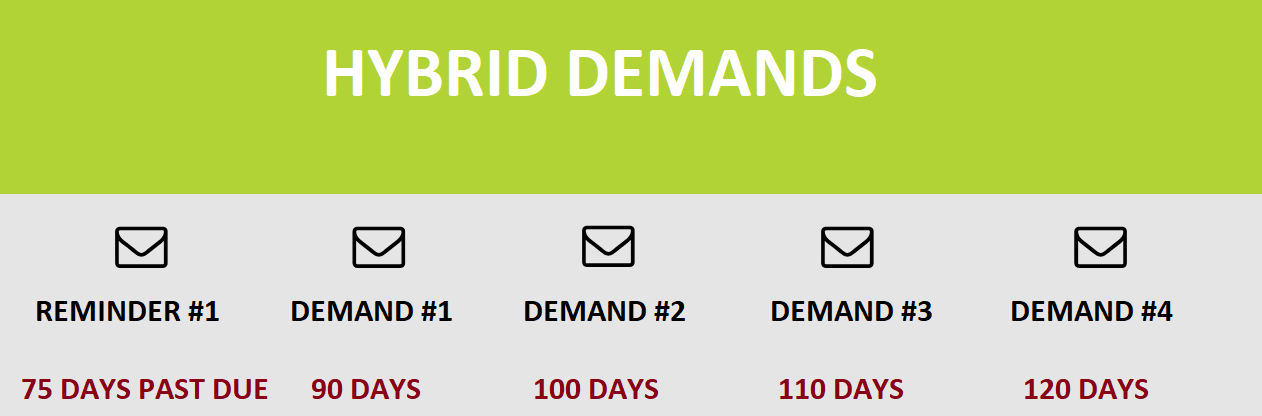
Once an account hits 75 days past due, it enters the Hybrid program.
Step 1: Day 76 – Final Reminder Letter (sent on your behalf)
On the 76th day, the collection agency sends a letter on your behalf to the patient.
-
This is the final REMINDER letter
-
No mention of the agency’s name
-
It reads like a firm, professional final notice from your office
This letter often triggers payment because it feels like the account is reaching a deadline—without creating fear or resentment.
Many practices see a large portion of Hybrid accounts pay directly back to the provider after this first step.
Step 2: Day 91 – 1st DEMAND Letter (from the collection agency)
Still no payment?
After 15 days, the 1st DEMAND letter goes out — this one is sent in the collection agency’s name and clearly demands payment.
This is where the urgency increases. The patient understands:
-
“This is no longer routine billing.”
-
“There will be consequences if I ignore this.”
At this point, the likelihood of payment typically increases sharply because the account has officially entered a more serious phase.
Step 3: Every 10 days – 2nd, 3rd, and 4th DEMAND letters
If the account remains unpaid, the collection agency sends the next demand letters every 10 days:
-
2nd Demand Letter (stronger tone)
-
3rd Demand Letter (clearer urgency and consequences)
-
4th Demand Letter (final escalation warning)
Each letter increases intensity in a controlled, compliant way—without jumping straight to “scorched earth” collections.
Why starting at 75 days matters
Hybrid service exists because timing is everything in patient receivables.
At around 75 days past due:
-
The patient still remembers the visit
-
Contact details are still fresh
-
The balance hasn’t aged into “ignore it forever” territory
-
Your team is usually feeling the drag (more calls, more excuses, more time burned)
Hybrid removes the ambiguity of “when should we send this to collections?” by making it a defined part of your internal AR workflow.
Instead of waiting until 90+ days to start soft collections, you start the process before the account gets cold.
What types of accounts Hybrid is best for
Hybrid is ideal for accounts that are:
-
Patient responsibility balances after insurance processing
-
Self-pay balances that have received multiple statements
-
Accounts that are not actively in a documented dispute
-
Accounts not already on a reliable payment plan
-
Accounts where your team is getting slow responses or broken promises
If the patient is genuinely engaged and paying, you don’t need Hybrid.
If the patient is silent, stalling, or repeatedly “forgetting,” Hybrid is the clean middle step before heavy collections.
Why patients respond to Hybrid (without trashing your reputation)
The Hybrid approach is built around a simple psychology:
Most patients don’t wake up wanting to dodge bills.
They procrastinate. They feel overwhelmed. They avoid calls. They don’t open statements.
Hybrid breaks the avoidance loop by creating:
-
A credible deadline (Day 76 final reminder)
-
A serious escalation signal (Day 91 demand letter)
-
A clear countdown (letters every 10 days)
It’s firm, consistent, and harder to ignore—without being abusive or aggressive.
Cost and ROI (what makes Hybrid attractive)
Hybrid is designed to be low-cost and scalable.
-
Average cost per account is typically around $15 per patient
-
Accounts can be purchased in advance
-
Or you may qualify for a pay-as-used version (often for a small additional cost per account)
The reason practices like it: you’re not paying contingency fees on a large batch of “still recoverable” balances. You’re using a predictable, low-cost program to keep your AR from aging out.
What happens after the Hybrid letters?
If an account remains unpaid after the sequence, it can be transferred for more intensive collections based on your policy.
At that point, you’re no longer guessing.
You’ve already given the patient:
-
A final reminder
-
Multiple escalating demand opportunities
-
Plenty of time to resolve it voluntarily
So if it needs stronger action, it’s justified—and documented.
The real benefit: Hybrid becomes part of your AR system
Hybrid works best when it’s treated as a standard operating procedure:
-
Every account hits 75 days → it enters Hybrid
-
Your team stops wasting hours chasing accounts that don’t respond
-
Your practice stays consistent and professional
-
Cash comes in earlier, with fewer “120+ day surprises”
Want to use the Hybrid program?
If you’re interested in Hybrid recovery, share a few details:
-
Your average patient balance size
-
How many accounts typically hit 75+ days per month
-
Your current follow-up process (statements, calls, texts)
-
Whether you want accounts to pay you directly first (preferred in Hybrid)
We’ll align the Hybrid timeline to your workflow so it feels like a natural extension of your billing process—not a sudden handoff.