Using eClinicalWorks alongside a collection agency means keeping your EHR and RCM tools exactly as they are for claims, billing, and reporting, while routing a specific slice of your aging report — the patient balances that have stopped responding to statements and reminders, typically 90-plus days out — to a dedicated collections process. This isn’t a live software plug-in inside eClinicalWorks; it’s a secure export workflow, where your aging report data feeds placement rules that decide which accounts move to collections and which stay in-house. If you’re watching A/R creep past 45-60 days on eCW, the fix usually isn’t the software. It’s the missing handoff between what eClinicalWorks shows you and what happens next.
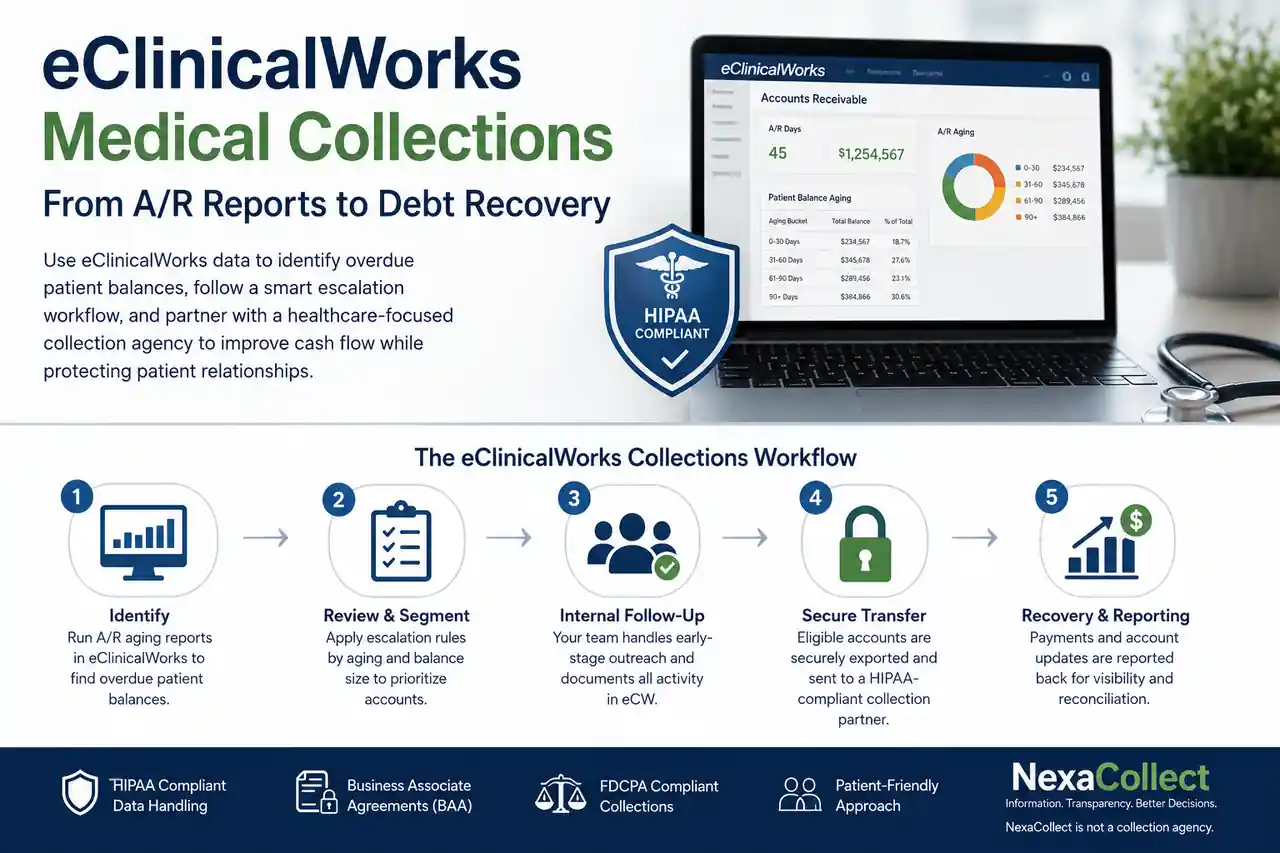
eClinicalWorks is strong EHR software. It’s not a collections department.
eClinicalWorks has grown into one of the largest ambulatory EHR and PM platforms in the U.S. Tens of thousands of providers rely on it every day for scheduling and clinical documentation, e-prescribing, labs, and imaging, charge capture and coding, and claims, posting, and reporting.
Many practices also use eCW RCM tools and services for eligibility and deductible checks, claim scrubbing and automated edits, ERA posting and denial queues, and dashboards and KPIs.
More recently, eCW has leaned heavily into AI-powered, “agentic” RCM to reduce manual work and speed up claim cycles.
All of that is valuable. But even with great software, most practices still face A/R days drifting into the 40s and 50s, 10-20% of A/R sitting in 90+ day aging, and denial rates in double digits, especially as payer rules change.
At some point, technology alone cannot force patients or payers to pay. You need clear policies, people, and a medical collections process built for patient balances around the system.
Need a Collection Agency? Contact us
What eClinicalWorks does well for revenue — and what it doesn’t do
It helps to draw a clean line.
eCW is great at:
- Capturing charges quickly and consistently
- Reducing obvious coding and format errors
- Submitting and tracking claims electronically
- Highlighting denials and underpayments
- Producing A/R and aging reports by payer, provider, and location
eCW does not:
- Call overdue patients and arrange payment plans for you
- Negotiate with stubborn self-pay accounts that are 120+ days old
- Skip-trace bad addresses or wrong phone numbers
- Litigate or pursue hard-to-collect balances
- Replace a licensed, compliant, third-party collection agency for bad-debt A/R
If you treat eClinicalWorks like a “set it and forget it” collections machine, you end up with a beautiful dashboard and a growing pile of unpaid balances.
Are your eClinicalWorks numbers actually healthy?
The first step is to stop guessing and look at your eCW reports like a CFO, not just a clinician. Key metrics to pull from eCW:
- Days in A/R (overall): Strong practices aim for roughly 30-40 days. When you’re consistently over 45-50 days, something is off.
- A/R aging buckets: Break out patient and insurance A/R into 0-30, 31-60, 61-90, 91-120, and 120+ days. A/R over 90 days should be a small slice, not a large chunk — when more than 10-15% of total A/R lives there, it’s a red flag.
- Insurance vs. patient responsibility: Look at how much A/R is payer balances, pure self-pay, or patient-due after insurance. With high deductibles and co-insurance, patient balances are rising, and these require a very different follow-up approach than payer A/R.
- Denial rate and top denial reasons: eCW already shows the percentage of claims denied on first pass and common denial codes. If denials are creeping up year over year, staff spend more time firefighting, and more balances drift into aged A/R.
Once you know your numbers, the question becomes: what happens to those 60-, 90-, and 120-day balances next?
Where balances slip through in eClinicalWorks workflows
Even well-run practices see money slipping through at a few critical points:
- Front-office gaps: Demographics, insurance information, or eligibility checks are incomplete, and patients are not clearly told how much they will owe or when.
- Back-office overload: Denial queues in eCW grow faster than staff can work them, and simple, low-dollar claims get ignored in favor of complex ones.
- Weak patient follow-up: Statements go out, but no structured reminder schedule exists, and staff make calls “when they have time,” which is never enough.
- No clear escalation rule: Some practices keep accounts forever in “patient A/R” because nobody wants to “send patients to collections,” resulting in high A/R, low cash, and a lot of quiet write-offs.
eClinicalWorks shows you the problem clearly on screen. But unless you turn those insights into rules and actions, nothing changes.
Using eClinicalWorks data to decide what goes to collections
A practical approach is to define simple, written placement rules based on your eCW reports. For example:
By aging:
- Patient balances 0-30 days: statements and soft reminders only.
- 31-60 days: reminder letter plus text/email and a phone attempt.
- 61-90 days: stronger reminder, offer a payment plan, final internal notice.
- 90+ days: if no progress or arrangement, eligible for third-party collections.
By balance size:
- Small balances (under $50-$100): one or two reminders, then internal write-off or batch placement depending on your policy.
- Mid-range balances ($100-$500): full internal workflow, then move to collections at 90+ days.
- Large balances ($500+ or $1,000+): earlier calls, more effort at 30-60 days — don’t let them quietly age into 6-12 months.
By payer / visit type:
- Chronic non-paying payers or plans: tighten pre-authorization and eligibility rules, and watch balances from those plans closely.
- Certain visit types (procedures, high-dollar imaging, elective care): stricter front-end collections such as deposits and signed estimates, with a faster escalation path if the patient balance is ignored.
You can set up most of these segments directly inside eCW using existing reports and filters. The missing piece is the policy and follow-through.
AI + humans: pairing eCW RCM with real-world collections
eClinicalWorks’ newer AI and automation features are ideal for scrubbing claims and catching coding issues, checking status with payers, pushing clean claims out faster, and flagging risky accounts before they age out.
What AI cannot do on its own: talk a scared patient through a bill they don’t understand, negotiate a realistic payment plan with someone juggling multiple debts, track down a moved patient with no forwarding address, or decide when it’s time to escalate to legal action.
That’s where professional medical collection agencies come in. The best ones understand HIPAA, FDCPA, and modern medical-debt rules, are comfortable working from eClinicalWorks exports and reports, use patient-friendly scripts and payment options, and provide feedback that helps you tweak your eCW workflows upstream.
Think of it as a layered system: eClinicalWorks and your staff prevent as much A/R and denial waste as possible, while a collection partner recovers what inevitably slips through, without abusing patients or damaging your reputation.
What a healthcare-focused collection agency should know about eClinicalWorks
If you’re on eCW, look for agencies that can speak your language. They should be ready to accept secure exports of aging reports, patient contact data, and balance details from eCW, work with your payer codes, rendering providers, and locations, respect your do-not-contact lists, charity-care policies, and state-specific rules, and report back recovery data in a format you can easily map to your eCW metrics.
Red flags: agencies that treat medical debt exactly like credit-card collections, show no understanding of the No Surprises Act, medical-debt credit reporting changes, or balance-billing limits, and have no process for protecting PHI or signing Business Associate Agreements.
You want a partner that understands both medical compliance and the reality of patient-pay balances in a high-deductible world, not just a generic call center.
How account data is handled
Every eClinicalWorks export Nexa receives is transferred through a secure, encrypted channel, never email attachments or unsecured file sharing. A signed Business Associate Agreement is in place before any protected health information is shared, consistent with HIPAA requirements. All patient contact and collection activity follows FDCPA guidelines alongside applicable state debt collection laws. This is a data-handling relationship, not a public data feed: your export stays within your account and is used only for the accounts you’ve placed.
Where Nexa fits in
To be direct about what this actually is: Nexa does not have a live, embedded software integration inside eClinicalWorks. What we offer is a secure export workflow — your practice pulls an aging or A/R report from eClinicalWorks using your own placement rules, and sends it to us through a secure, HIPAA-compliant channel. Nexa Collections is a full-service collection agency, not a referral service or an information hub. Once we receive that export, we take it from there.
What we do:
- Work your eClinicalWorks aging or A/R export directly, using the age, balance, and exception rules your practice sets.
- Contact patients directly across mail, phone, and email, inside FDCPA and HIPAA guidelines, using scripts built for patients already juggling multiple bills.
- Sign a Business Associate Agreement (BAA) before any PHI changes hands, and handle every account under that agreement.
- Handle payment plans, disputes, and negotiation so your billing staff isn’t stuck chasing 90-plus day balances between denial queues and new claims.
- Return recovered payments and account status updates so they map back into your eClinicalWorks metrics cleanly.
You’re not replacing eClinicalWorks or its RCM and AI-powered claim tools. You’re adding a dedicated recovery layer, connected by a secure export rather than a technical integration, for the accounts that have already aged past what statements, reminders, and internal follow-up can close. This same secure-export approach applies whether your practice runs on Compulink instead, on NextGen for ambulatory or dental practices, or on Eaglesoft for dental practices — the workflow and compliance standards stay the same. For exact rates, see the full breakdown of Nexa’s fixed-fee and contingency pricing.
FAQ
Does eClinicalWorks include a built-in collection agency?
No. eClinicalWorks offers powerful billing and RCM tools, and in some cases full-service RCM, but it is still software and services, not a contingency collection agency. It will not pursue old patient debts the way a licensed collection firm does.
What A/R days should a practice on eClinicalWorks aim for?
Many practices using eCW aim for 30-40 days in A/R with a relatively small slice of A/R over 90 days. If dashboards show 45-50+ days consistently, or a large chunk of A/R sitting 90+ days, the follow-up and collections process needs work.
How do I know which eCW accounts to send to collections?
Use eClinicalWorks aging reports to define clear rules by age, balance size, and visit type. A common pattern is: once a patient balance is 90+ days old with no response, it is a strong candidate for third-party collections.
Can I still use eClinicalWorks if I outsource collections?
Yes. Most practices continue to use eCW for charge capture, billing, and reporting, while sending specific sets of aged accounts to an external agency. The data starts and ends in the EHR/PM system; the collection agency works that data in between.
Will using a collection agency upset my patients?
Handled poorly, it can. Handled well, it doesn’t have to. A good medical-focused agency uses respectful language, offers payment plans, and knows when to back off. Often patients have already ignored multiple statements and calls before an account is placed.
Is this a live, technical integration with eClinicalWorks?
No. Nexa doesn’t have an embedded plug-in or API connection inside eClinicalWorks. The workflow is a secure export: your practice pulls an aging or A/R report using your own placement rules and sends it to Nexa through an encrypted channel.
Will Nexa sign a Business Associate Agreement (BAA)?
Yes. A BAA is signed before any protected health information is shared, and every account is handled under that agreement, consistent with HIPAA requirements.