Pharmacy Bill Recovery: Protecting Your 3% Margin
In independent pharmacy, the math has changed. With PBM reimbursements often dipping below acquisition cost (NADAC) and DIR fee disputes still squeezing cash flow on older claims, the days of “letting it slide” are over.
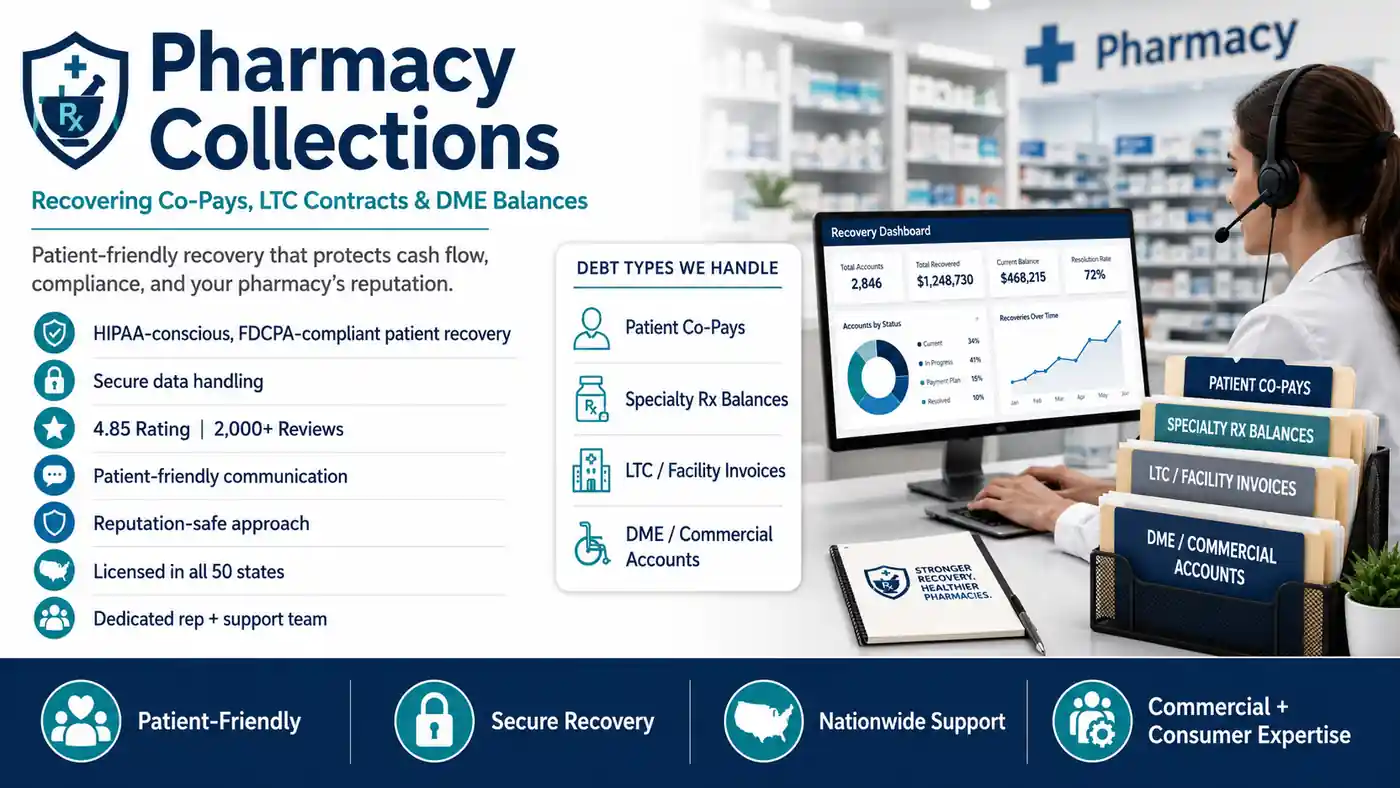
Quick Answer: Recovering Past-Due Pharmacy Balances
Pharmacy debt collection recovers unpaid co-pays, LTC facility house accounts, specialty medication deductibles, and unreturned DME rentals through HIPAA-compliant outreach that never discloses specific medication names, NDC codes, or treatment categories, only the balance owed. Nexa includes free skip tracing and PMS-compatible batch uploads, starting at a $15 fixed-fee letter for accounts under 120 days old.
The hard truth: If your net profit margin is hovering around 1.8% to 3%, you must fill approximately $2,700 worth of prescriptions just to offset a single $50 uncollected co-pay.
You cannot afford to be the community bank. Whether it’s uncollected patient deductibles for high-cost specialty meds or a nursing home that’s 90 days late on their “house account,” you need a recovery partner who understands the unique financial ecosystem of a pharmacy.
Nexa provides a reputation-safe approach, equipped with all 50-state collections license, offering free credit reporting, free litigious debtor check, free bankruptcy scrub, and zero onboarding fees. Secure – SOC 2 Type II & HIPAA compliant. Over 2,000 online reviews rate us 4.85 out of 5.
Need a Collection Agency? Contact us
The “PBM Audit” Shield: Why You Must Collect
Most owners view collections as “revenue recovery.” You must view it as audit defense.
PBM contracts and federal Anti-Kickback statutes generally prohibit the “routine waiver of co-pays.” If an auditor sees a pattern of uncollected balances on your books, they can accuse you of offering illegal inducements to patients.
- The Threat: The PBM can claw back the entire reimbursement (the full cost of the drug), not just the uncollected $20 co-pay. On a specialty Rheumatoid Arthritis medication, a waived co-pay could trigger a $3,000 recoupment.
- The Solution: Assigning these debts to a collection agency creates an irrefutable paper trail. It proves to the auditor that you made a “commercially reasonable effort” to collect, protecting your full reimbursement.
HIPAA: What Can and Can’t Be Said During Collections
Collecting a pharmacy balance means discussing money, not medicine. Every outreach stays limited to the account balance and payment options, never the specific drug name, NDC code, diagnosis, or treatment category behind the charge. A debtor’s family member or an answering machine hearing “you owe $340” is a normal collections call; the same message referencing a specific medication is a HIPAA exposure the practice, not just the collector, is accountable for.
The 4 Hidden Revenue Leaks in Pharmacy
Your “accounts receivable” likely hides four specific types of debt. A general medical collection agency treats them all the same, but a pharmacy specialist knows the difference.
1. The LTC & Facility Trap (B2B Debt)
If you service long-term care (LTC) facilities, group homes, or hospices, you likely bill them monthly on “net-30” terms.
- The Risk: When facility ownership changes or an administrator quits, your $15,000 monthly invoice often falls into a black hole.
- The Fix: This is commercial debt, not consumer debt. It requires an agency that knows how to pierce the corporate veil and demand payment from the facility’s CFO, not the patient.
2. Specialty Medication Deductibles
You dispensed a $4,000 Hepatitis C drug. The insurance covered $3,000. The patient owes a $1,000 deductible.
- The Scenario: You set up a compassionate payment plan. The patient pays the first installment and then stops answering calls.
- The Reality: You’ve already paid the wholesaler. That $1,000 loss wipes out the profit of your next 500 routine scripts. These high-balance accounts must be prioritized immediately.
3. DME (Durable Medical Equipment) Rentals
If you rent hospital beds, nebulizers, or crutches, you face a unique problem: the equipment is gone, and the payments stopped.
- The Fix: An agency can recover the fair market value of the unreturned equipment, ensuring you aren’t left with a depreciating asset and zero revenue.
4. PBM Clawback Residuals (The “DIR Hangover”)
A federal rule effective January 1, 2024 moved most Medicare Part D DIR fees to be assessed at the point of sale instead of retroactively, which has genuinely reduced new clawback exposure. But it hasn’t eliminated the problem: many pharmacies are still working through unresolved pre-2024 clawback disputes, and the reform only covers Medicare Part D specifically, not every commercial PBM contract. Broader federal PBM reform (capping fees, banning spread pricing) has stalled in Congress, even as individual states move faster on their own. The practical result: reconciling what a PBM actually paid against what your system expected is still an active, ongoing part of pharmacy AR, not a solved problem from 2024.
Compounding Pharmacies: The “Refill” Trap
Compounding pharmacies face a specific hazard: the custom med. Unlike a generic pill you can return to the shelf, a compounded cream is a sunk cost ($80–$150 in labor and materials) the moment it’s made.
- The Danger: Patients often order a refill before paying for the previous month. If you ship batch #2 without collecting on batch #1, you’re compounding your losses.
- The Strategy: Implement a strict “Collections Hold” policy. Let the agency chase the old debt while you require “Credit Card on File” for all future fills.
In-House Staff vs. Aggressive Collections vs. Nexa’s $15 Fixed-Fee
| Factor | In-House Staff | Aggressive/Generic Agency | Nexa Step 1 ($15 Fixed-Fee) |
|---|---|---|---|
| Cost | Staff time, no direct cash outlay | Often 30%+ contingency regardless of account age | $15 flat per account, you keep 100% recovered |
| HIPAA exposure | High, techs aren’t trained on minimum-necessary disclosure | Varies, generic scripts risk mentioning treatment details | Built around balance-only communication, no drug names or NDC codes |
| Patient retention | Depends entirely on staff tone under pressure | Low, aggressive scripts drive patients to competitors | Higher, diplomatic first-contact letter preserves the relationship |
| Recovery speed | Slow, competes with clinical workload | Fast but relationship-costly | Days to a few weeks for fresh accounts |
Pharmacies Want a Collection Agency That:
- Understands HIPAA is non-negotiable. A data breach is more expensive than the debt. Your agency must be SOC 2 Type II certified and understand exactly what “minimum necessary information” means when talking to a debtor.
- Can handle “soft” vs. “hard” collections. Soft: for the elderly patient who simply forgot her $30 bill, diplomatic reminders preserving the relationship. Hard: for the nursing home administrator ignoring a $12,000 invoice, legal demands, credit reporting, corporate pressure.
- Offers fixed-fee pre-collection. You shouldn’t pay 30% to collect a fresh debt. Look for agencies offering flat-fee letters (e.g., $15/account) for debts under 120 days old.
- Knows the “Part D” donut hole. Agents should be trained to explain why a patient owes money (e.g., “Mrs. Jones, you hit your coverage gap, which is why this bill is higher than usual”). Educated patients are more likely to pay.
- Integrates with modern PMS. Whether you use PioneerRx, McKesson, or Micro Merchant, the agency should accept digital file uploads to save your techs from manual data entry.
Stop Turning Techs Into Debt Collectors
Your technicians are trained to navigate insurance adjudications and fill prescriptions accurately. They are not trained to have conflict-heavy financial arguments.
Forcing your front-line staff to chase bad debt leads to two things: staff burnout (a morale killer, asking care-focused staff to play “bad cop”) and the “nice guy” write-off (techs naturally letting it slide to avoid awkwardness at the counter).
Outsourcing creates a healthy separation. Your staff remains the “healthcare heroes,” while the agency handles the uncomfortable financial enforcement.
Transparent, Pharmacy-Friendly Pricing
Accounting receivables don’t all look the same, so the fee model shouldn’t either.
Fixed-Fee Recovery ($15/account)
Best suited to early-stage receivables — invoices where the debtor relationship is still fresh and a firm, professional nudge is likely enough. Debtors pay 100% directly to you. There are no commissions taken from what’s recovered. Can be claimed as a business expense so this service can essentially be 100% free for you.
Contingency Service (20%–40%)
Built for older, disputed, or “ghosted” accounts that need sustained investigation, skip tracing, and negotiation. No Recovery, No Fee — Nexa is paid only when the account is successfully collected.

Frequently Asked Questions
Can a collection agency collect unpaid pharmacy bills without violating HIPAA?
Yes, when outreach is limited to what’s actually necessary to collect: the balance owed, the account, and payment options, never the specific medication, NDC code, or diagnosis behind the charge. A debtor’s household hearing “you owe $340” doesn’t reveal anything protected; the same call referencing a specific drug name would.
How do independent pharmacies collect past-due copays without losing local customers?
Through diplomatic, low-cost first contact rather than aggressive scripts. A soft, third-party reminder letter, typically far cheaper than a full contingency collection effort, resolves many balances from patients who simply forgot or fell behind, without the confrontation that turns a loyal customer into a lost one.
What is the best way to recover unpaid custom compounding medication costs?
Prevention plus fast escalation. Since a compounded medication is a sunk material and labor cost the moment it’s made, requiring a card on file for future fills stops new losses immediately, while the existing unpaid balance should move to collections quickly rather than waiting, since a refill shipped on top of an unpaid prior batch only compounds the loss.
How does Nexa handle LTC and nursing home pharmacy receivables?
As commercial debt, not consumer debt. A facility’s monthly house account is pursued at the corporate level, directed at the administrator or CFO who actually controls payment, rather than treated like an individual patient balance, which matters when facility ownership changes or an administrator leaves and the invoice risks falling into a black hole.
Can we deny refills if a patient is in collections?
This depends on state law and the type of medication. Generally, emergency or life-sustaining medication cannot be denied, but purely elective medications can be refused, or the patient can be converted to cash-on-delivery status until the balance is resolved.
What about unpaid “house accounts”?
The average independent pharmacy writes off roughly 1.5% of total revenue annually due to unpaid house accounts. If a long-standing customer hasn’t paid in 90 days, assigning the account to an agency lets the pharmacy stay the trusted local business while the collection conversation happens somewhere else.
Is it worth collecting a $40 co-pay?
On its own, maybe not. In aggregate, yes. A hundred unpaid $40 co-pays is $4,000 in pure profit lost, and most agencies allow small balances to be batched together for efficient, low-cost processing rather than chased one at a time. Secondly, you do not want to build your pharmacy’s reputation to be one which does nothing is co-pay is not paid, resulting in further more defaults.
Stop filling prescriptions for free.
Serving Pharmacies NationwideNeed a Collection Agency? Contact Us |