A Charlotte collection agency should recover overdue accounts without turning good customers into lost relationships. From professional firms in Uptown to contractors, healthcare providers, logistics companies and businesses along the I-85 corridor, slow-paying accounts can tie up cash flow and consume valuable staff time.
Nexa combines North Carolina-aware, reputation-safe recovery, secure data handling, and flexible fixed-fee or contingency options to help Charlotte businesses get paid while keeping customer relationships intact.
Collection Agency in Charlotte, NC — The Velvet Hammer Approach
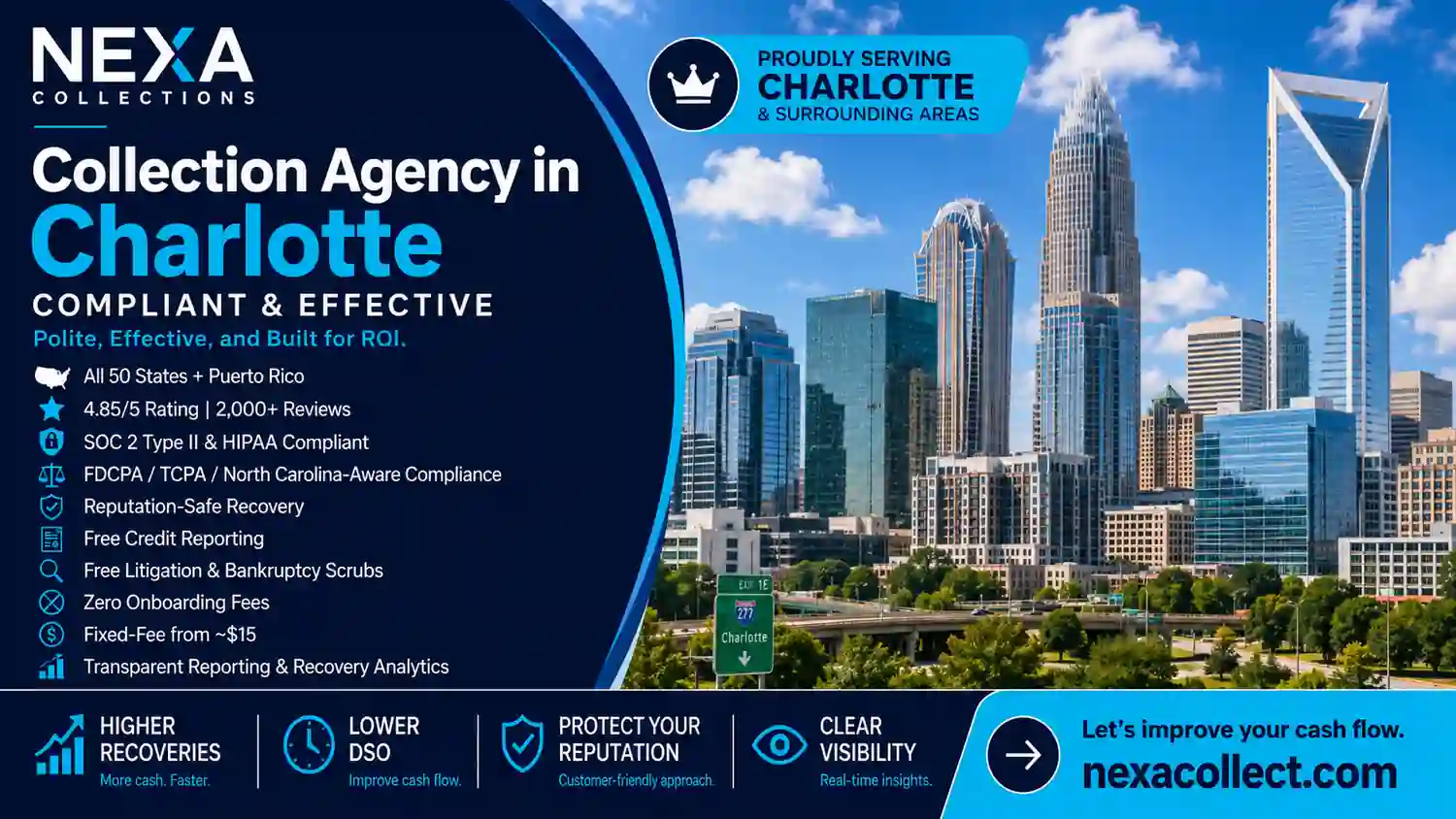
Nexa provides a reputation-safe approach, equipped with all 50-state collections license, offering free credit reporting, free litigious debtor check, free bankruptcy scrub, and zero onboarding fees. Secure – SOC 2 Type II & HIPAA compliant. Over 2,000 online reviews rate us 4.85 out of 5.
Need a Collection Agency? Contact us
Simple pricing (keep it predictable)
-
Fixed-fee: $15 — you keep 100% of what’s recovered (best for newer, straightforward accounts).
-
Contingency: 40% — no recovery, no fee (best when the debtor needs heavier follow-up).

When appropriate and permitted, we may also use email or text to speed up responses. Involvement of a collection agency significantly improves recovery rate—earlier you assign, better recovery results are delivered, especially with amicable strategies. Let your employees do the core work they were hired for (they don’t enjoy collections). Bilingual collections—Spanish collectors are also on board.
Money saver tip: Many clients can often treat the fixed-fee service as a business expense (after consulting their CPA).
Red-flag box: 3 Charlotte pitfalls that quietly kill recovery
-
“We’ll resend the invoice” loops: The debtor keeps you parked in email purgatory while paying louder vendors first.
-
Missing backup docs: A job was “approved verbally,” the PO is fuzzy, the scope changed—now the debtor claims confusion.
-
The wrong tone at the wrong time: One heated message can trigger a public complaint spiral (and suddenly your online reputation is on the line).
Why cooperative mediation wins more money than arguing
Most debtors don’t wake up planning to stiff you. They wake up prioritizing—rent, payroll, inventory, and the vendor who feels easiest to deal with today. When you argue, you create resistance. When you set clear options, you create motion.
That’s the Velvet Hammer: diplomatic, calm, persistent. Firm enough to secure payment, soft enough to protect your reputation. We work to make your invoice the one they want to close first—because it’s the simplest path to relief.
We also run a litigation scrub before we escalate, so you’re not pulled into messy, higher-risk situations that can cost more than the balance itself.
A quick note from the Account Reconciliation Team
We’re not here to “sound tough.” We’re here to get paid without turning your name into a complaint thread. We’ll ask for the missing piece, confirm the story, and offer a clean off-ramp: pay in full, pay on a short schedule, or put the account in a documented dispute lane. People cooperate when they feel respected—and they pay when the path is clear.
Two recent, reputation-safe recoveries (what actually happened)
Medical recovery (Charlotte): $4,860 patient balance
-
We confirmed demographics, ran USPS address checks, and validated the billing timeline.
-
We opened with a respectful call + follow-up letter, then used a structured “options” message: pay-in-full discount window vs. a two-payment plan.
-
The patient chose a plan; we monitored it and sent polite reminders. Paid in full within five weeks—no drama, no review-bomb risk.
Business recovery (nearby: Gastonia): $12,740 commercial invoice
-
We gathered the paperwork (work order, delivery confirmation, invoice history) and clarified what the debtor claimed was “still being reviewed.”
-
We offered a short cure period: confirm acceptance and pay, or provide a written dispute with supporting documents.
-
The debtor responded, admitted the service was accepted, and asked for staging. We secured 50% upfront and the remainder on a dated schedule. Closed in 27 days.
Industries we serve in the Queen City corridor
-
Healthcare & Medical: 100% HIPAA-compliant recovery for hospitals and specialty clinics—firm, discreet, documentation-first.
-
Colleges & Universities: Tuition, housing balances, bursar accounts—firm follow-up without torching student relationships.
-
Dental: Dental practices, orthodontics, implant cases—clear statements, calm communication, fast resolution.
-
Restoration / Pool / Contractors: Change orders, progress billing, “final invoice” disputes—scope clarity and payment plans that stick.
-
K-12 Private & Charter Schools: Enrollment fees, textbooks, program balances—sensitive outreach that protects community trust.
-
Accountants & CPA Firms: Professional fee recovery with net-30 awareness—polite but persistent mediation.
-
Banks & Credit Unions: Delinquent consumer loans, overdrawn accounts, deficiency balances—structured outreach and lawful escalation when permitted.
-
Construction & Trades: HVAC, electrical, general contractors—job documentation, milestone billing, dispute triage.
-
B2B Commercial / Restoration / Waste Management: Service-route billing, recurring contracts, backlogged AR—steady pressure, clean documentation.
Practical rules that matter (NY vs NC—quick clarity)
Short honesty note: New York is widely viewed as one of the toughest places to collect because requirements and restrictions can be intense. Many agencies avoid it, and doing collections internally can backfire if your documentation isn’t airtight—even for B2B. If you have NY accounts, make sure you have complete backup (contracts, authorizations, invoices, delivery/usage proof) before placing a file.
For North Carolina and federal rules generally, the practical guardrails include:
-
FDCPA + CFPB “Debt Collection Rule” (Regulation F): sets boundaries on communications and harassment; phone contact frequency is restricted.
-
State collection agency statutes/rules: recordkeeping and operational requirements apply in NC.
-
Verification tools: we use USPS address checks, skip tracing, and bankruptcy checks to reduce bad data and wasted outreach.
-
Credit reporting: available if you choose and if permitted for the account type and situation.
FAQ’s
1. Can a Charlotte collection agency recover a debt if the customer moved to Fort Mill or Rock Hill, South Carolina?
Yes. This is particularly relevant in Charlotte because the regional economy crosses state lines: the Charlotte Region includes Mecklenburg County in North Carolina as well as York, Lancaster, Chester and Chesterfield counties in South Carolina. A customer moving from Charlotte to Fort Mill or Rock Hill does not automatically make a valid debt uncollectible, but the collection strategy and legal requirements may change based on the debtor’s new state of residence.
For businesses serving customers throughout the Charlotte metro, using a collection agency with both North Carolina and South Carolina authority and nationwide coverage avoids having to change agencies simply because a debtor moved across the state line.
2. Can a Charlotte business garnish a customer’s wages after winning a debt collection judgment?
Usually not for ordinary consumer debts in North Carolina. The North Carolina Department of Labor states that North Carolina courts generally cannot order wage withholding for debts such as credit cards, automobile loans and other ordinary personal debts. Garnishment is available for certain categories such as taxes, student loans, child support and alimony.
That makes this an important Charlotte collection issue: winning a judgment does not automatically mean 25% of the debtor’s paycheck can be garnished, as might happen in some other states. Recovery may instead depend on voluntary resolution or other legally available post-judgment remedies.
3. How long does a Charlotte contractor have to protect mechanics lien rights on an unpaid project?
North Carolina deadlines can move much faster than ordinary debt litigation. A claim of lien on real property generally must be filed within 120 days after the claimant’s last furnishing of labor or materials, and an action to enforce that lien generally must begin within 180 days after the last furnishing.
For Charlotte contractors, electricians, plumbers, HVAC companies, roofers, remodelers and construction suppliers, this means an overdue construction invoice should not simply sit in accounts receivable for six months while routine reminders continue. Collection activity and lien-deadline review may need to happen in parallel.
4. How have North Carolina’s new medical debt policies changed collections for Charlotte hospitals?
This is a major current issue for Charlotte healthcare. Every eligible North Carolina acute-care hospital joined the state’s Medical Debt Relief Program. Participating hospitals implemented expanded charity-care policies, and beginning July 2025 they also agreed to measures including restrictions on selling lower-income patients’ medical debt, a 3% interest cap on covered medical debt, no negative credit reporting, and limitations on aggressive collection practices.
For Charlotte-area hospitals, that means patient accounts should be properly screened for charity care and program eligibility before ordinary collection activity proceeds. Importantly, the state program applies specifically to participating hospitals; NCDHHS notes that medical debt from physician groups, emergency groups and other non-hospital providers is not automatically covered by the same hospital program.
5. How long does a Charlotte business have to sue over an unpaid contract or invoice?
North Carolina has a three-year statute of limitations for many claims arising from contracts, obligations or liabilities created by contract.
That is an important difference from states that give creditors six or even ten years. A Charlotte business that allows an invoice to age for years while repeatedly promising itself that the customer will eventually pay can lose valuable legal options. The exact deadline depends on the facts and type of claim, so older accounts should be reviewed before assuming they remain enforceable.
6. Can a Charlotte business take an unpaid account to Mecklenburg County Small Claims Court?
Potentially. Mecklenburg County’s court information identifies small claims civil cases as claims under $10,000; North Carolina’s court system generally routes larger money claims up to $25,000 to District Court and claims above that level to Superior Court. Small claims must generally be filed in the county where at least one defendant resides.
This can make small claims a practical option for certain Charlotte unpaid invoices, service balances and other straightforward debts, particularly when documentation is strong. Mecklenburg County also operates on North Carolina’s eCourts system, with electronic filing required for attorneys.