Your Business Shouldn’t Feel Shaky Like the Narrows Bridge
In Tacoma, getting paid is often a documentation problem before it becomes a collection problem.
At the Port, a warehouse receipt can support lien rights. On a public project, a supplier’s notice deadline can determine whether a payment bond is available. In healthcare, charity-care screening comes before collection. At UW Tacoma, even the date a student withdraws can materially change the balance still owed.
That fits a city where healthcare, logistics, aerospace, technology and advanced manufacturing all intersect. Port of Tacoma activity and the South Harbor supported more than 41,000 jobs and nearly $10.8 billion in business output in the latest economic-impact analysis.
Nexa fits that environment with reputation-safe recovery, a $15 fixed-fee option for newer accounts, contingency recovery for tougher balances, 100% HIPAA-compliant healthcare workflows, and nationwide collection reach.
Before increasing pressure, understand the account. In Tacoma, the paperwork may be your strongest collection tool.
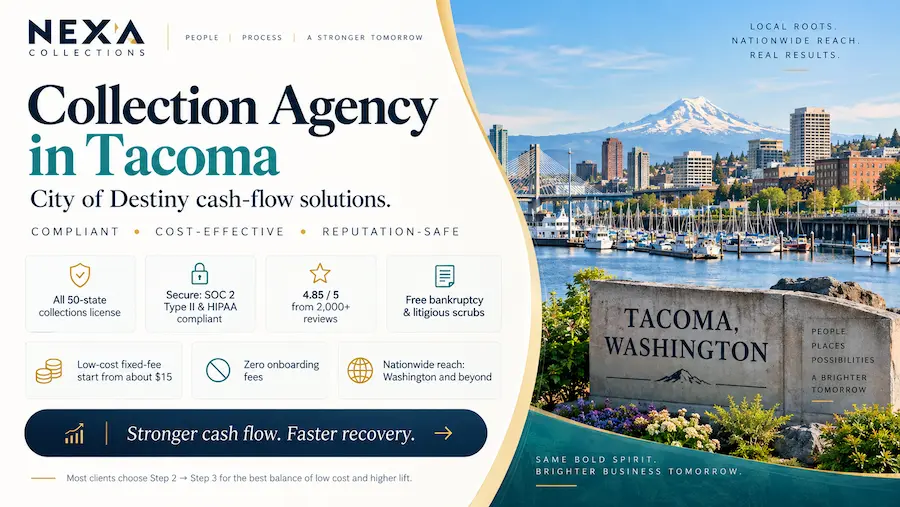
Nexa provides a reputation-safe approach, equipped with all 50-state collections license, offering free credit reporting, free litigious debtor check, free bankruptcy scrub, and zero onboarding fees. Secure – SOC 2 Type II & HIPAA compliant. Over 2,000 online reviews rate us 4.85 out of 5.
Need a Tacoma Collection Agency? Contact us
Quick Answer: Nexa connects Tacoma businesses, healthcare providers, and logistics operators with Washington-licensed, bonded collection agencies compliant with RCW 19.16. Offering both a $15 flat-fee program and contingency-based recovery, Nexa provides reputation-safe debt collection, SOC 2 Type II data security, HIPAA compliance, and free credit bureau reporting across Pierce County and the South Sound.
Simple Pricing
- Fixed-Fee: $15 per account — you keep 100% of what you recover.
- Contingency: 40% — no recovery, no fee.

When appropriate and permitted, we may also use email or text to speed up responses. Involvement of a collection agency significantly improves recovery rate — earlier you assign, better recovery results are delivered, using our most amicable strategies. Let your employees do the core work they were hired for, instead of chasing payments (which they obviously don’t enjoy). And yes — Spanish-speaking collectors are on board for bilingual outreach.
Money-saver tip: Many clients are able to “zero out” the cost of our fixed-fee service by treating it as a Business Expense for taxes (after checking with their CPA).
Industries We Serve in Tacoma
Healthcare & Medical: 100% HIPAA-compliant recovery for hospitals, physician groups, specialty clinics and outpatient providers. Healthcare is especially important locally; Tacoma’s planning data shows healthcare represents roughly 27% of covered employment in the city.
Port, Logistics & Warehousing: B2B recovery for freight forwarders, warehouses, distributors, transportation companies and port-related suppliers serving one of the strongest logistics networks on the West Coast.
Aerospace & Advanced Manufacturing: Recovery for aerospace suppliers, composite manufacturers, industrial companies and equipment vendors. Pierce County has deep Boeing-supply-chain and aerospace roots.
Dental & Orthodontics: Reputation-sensitive recovery for dental practices, orthodontists and specialty dental groups.
Colleges, Universities & Training Providers: Tuition, course fees, institutional receivables and other documented education balances, with an approach designed to preserve institutional reputation.
K-12 Private & Charter Schools: Diplomatic recovery of tuition, enrollment fees, device charges and other documented school balances.
CPA, Accounting & Professional Services: Recovery of accounting, engineering, consulting and professional-service invoices without unnecessarily damaging valuable client relationships.
Construction, Restoration & Trades: Recovery for general contractors, subcontractors, restoration firms, HVAC, electrical, roofing and specialty trades, including accounts where Washington lien or public-bond deadlines matter.
Banks & Credit Unions: Recovery of qualifying loan, overdraft and deficiency balances using strategies consistent with Washington’s exemptions and post-judgment rules.
Government Vendors & Utilities: Recovery support for companies supplying goods, equipment and services to municipal and other public-sector organizations.
Recent Recoveries
Industrial Packaging Supplier — Fixed Fee | 93% Recovered
A Pierce County supplier placed $9,600 in fresher B2B invoices. Fixed-fee follow-up recovered $8,928 — 93%.
Specialty Healthcare Staffing Firm — Contingency | 82% Recovered
A Tacoma-area healthcare vendor assigned $35,000 in aging facility invoices. Recovery produced $28,700 — 82%.
Fire & Security Contractor — Contingency | 71% Recovered
A South Sound contractor placed $24,000 in completed commercial installation balances. Recovery returned $17,040 — 71%.
Why Tacoma Businesses Partner With Us
-
Protect Your Brand on Ruston Way:We know that in a city the size of Tacoma, reputation is everything. Our diplomatic approach ensures you get paid without being labeled as “that” business.
-
Stop Being the Bank: Your job is to provide goods or services, not to offer interest-free loans to your customers. We reset the dynamic so you are taken seriously.
-
Free Safety Checks:We provide free bankruptcy and litigious debtor screenings. If a debtor has already filed Chapter 7, we will tell you immediately so you don’t waste time or money pursuing them.
Tacoma & Washington State FAQ
Can a Port of Tacoma warehouse hold cargo when storage, transportation or demurrage charges have not been paid?
Potentially, yes.
Washington law gives a warehouse a lien against qualifying goods in its possession for charges relating to storage, transportation, demurrage, terminal charges, insurance, labor and preservation of the goods. Depending on the storage agreement, the lien can also cover qualifying charges relating to other goods.
That has obvious local relevance: the Port of Tacoma and Northwest Seaport Alliance move containerized cargo, automobiles, breakbulk and bulk products through one of the West Coast’s largest logistics networks.
For collection, keep the warehouse receipt or storage agreement, inbound records, rate schedule, demurrage calculations, release instructions, invoices and communications concerning the goods together.
Commercial B2B Collection Services
If a UW Tacoma student withdraws after classes begin, does the tuition balance automatically disappear?
No. Timing matters considerably.
UW Tacoma’s current tuition-forfeiture schedule provides a full reduction during the earliest withdrawal period, but later withdrawal can leave 50% or eventually 100% of tuition owed. For Autumn 2026, withdrawal after the 21st calendar day generally results in 100% tuition forfeiture.
Past-due tuition can also trigger late charges and account holds, and an unpaid account may be referred to an outside collection agency with additional charges.
For education collections, preserve registration dates, withdrawal records, tuition calculations, financial-aid adjustments, housing charges and payment-plan history separately.
School & Education Collection Services
Can a Tacoma hospital send a patient to collections before checking whether the patient qualifies for charity care?
Washington law requires an initial determination of charity-care eligibility before collection efforts are directed at the patient. Hospitals must also provide notice of charity-care availability and maintain procedures for identifying potentially eligible patients.
The amount of assistance depends on the hospital category. Under Washington’s current framework, patients at qualifying larger hospital systems can receive a full write-off of the patient-responsibility portion at or below 300% of the federal poverty level, with partial discounts extending through 400%. Other hospitals follow a separate statutory schedule.
That makes pre-collection classification essential: insurance pending, financial-assistance eligible, disputed, payment-plan and verified self-pay balances should not all enter the same workflow.
A Tacoma supplier sold materials to a subcontractor on a public project. What payment-bond deadlines can affect recovery?
Washington’s public-works bond rules contain two particularly important notice points.
A supplier furnishing materials to a subcontractor generally must give the prime contractor written notice no later than 10 days after the first delivery if it wants to preserve the statutory bond remedy described in RCW 39.08.065.
After the public contract has been completed and formally accepted, qualifying laborers, subcontractors and material suppliers generally must file their written bond claim within 30 days after completion and acceptance.
For a Tacoma public-project receivable, preserve the project name, prime contractor, bond information, first-delivery date, invoices, delivery tickets, last-work date and acceptance date.
Contractor Collection Services
Can a Tacoma business open a new Tacoma Public Utilities account while an old utility balance is already in collections?
Tacoma Public Utilities currently says no: a customer cannot open a new account until the amount already in collections has been paid in full.
TPU bills are generally due 15 days after printing. Late accounts can incur a charge of $3 or 1% of the outstanding amount, whichever is greater, and unpaid balances can ultimately lead to service interruption and referral to the utility’s collection agency. Once the account is in collections, TPU directs the customer to resolve it with that agency rather than establishing another payment arrangement with TPU.
For commercial utility accounts, keep service dates, deposits, credits, payment arrangements, final bills and any disputed charges clearly separated.
Does sending a Tacoma contractor’s unpaid invoice to collections preserve its Washington mechanics lien?
No.
A qualifying Washington lien claimant generally must record the claim of lien within 90 days after it stops furnishing labor, professional services, materials or equipment. A copy of the recorded claim generally must then be provided to the owner or reputed owner within 14 days if the claimant wants to preserve certain attorney-fee and cost rights.
Recording the lien is not the end of the timeline. The lien generally expires eight calendar months after recording unless an enforcement action is filed within that period, with service on the owner generally required within 90 days after filing the action.
Collection activity can proceed alongside those remedies, but it does not stop the statutory clock.