Most collections content on Washington quietly understates how protective the state’s garnishment law actually is. Get that number wrong and a creditor either overestimates what a judgment will actually recover, or underestimates it and writes off an account that was worth pursuing. Getting the math right, not just the city name, is what separates a real Seattle-focused collections partner from a template with local neighborhoods swapped in.
Quick answer: Seattle collections require Washington-specific compliance, a 6-year statute of limitations for written contracts, an all-party consent requirement for recording calls, and a wage garnishment cap that’s more protective than commonly reported: only 20% of disposable earnings, not 25%, is actually reachable for ordinary consumer debt. Nexa recovers Seattle accounts starting at a $15 fixed fee per account, with contingency options for older balances, built around this specific legal framework and the region’s tech, medical, and aerospace-driven economy.
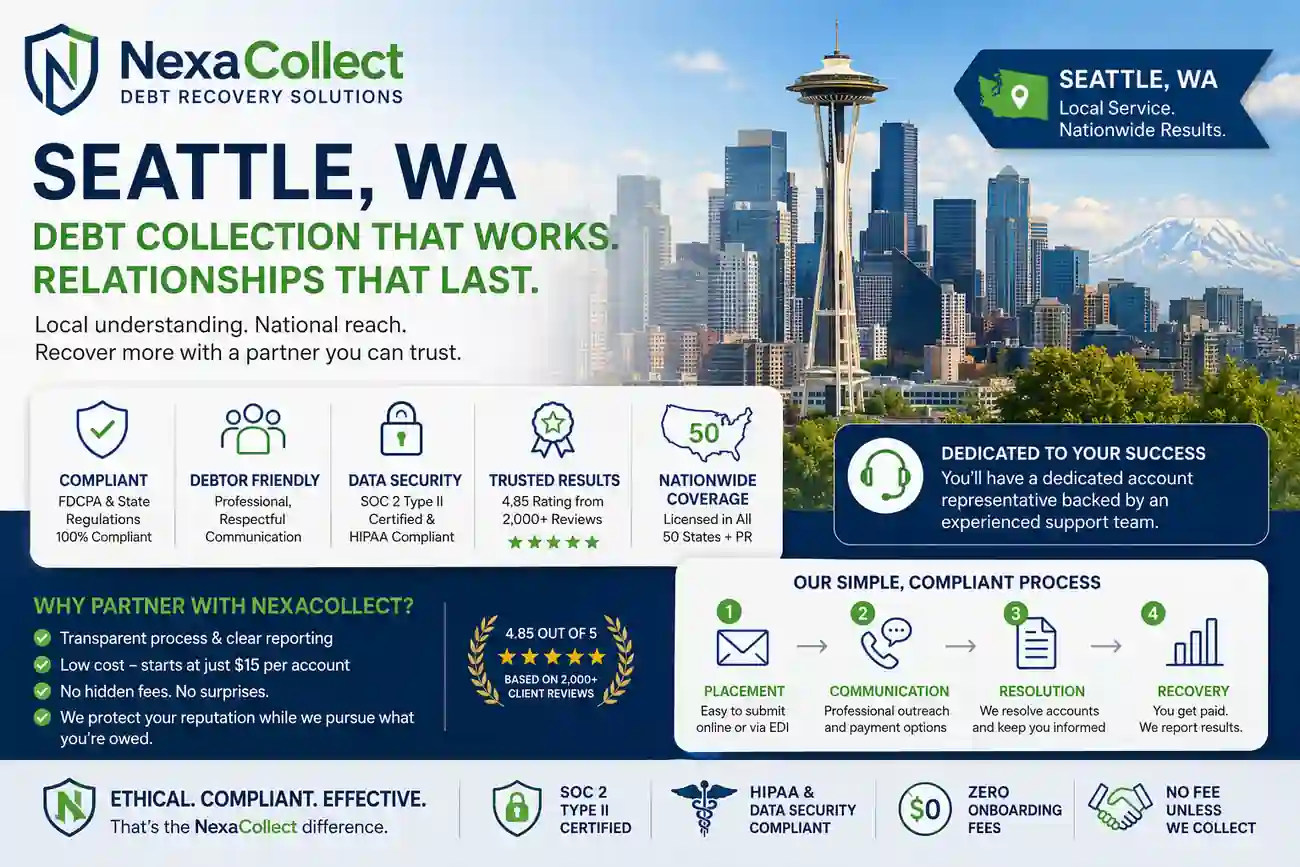
Nexa provides a reputation-safe approach, equipped with all 50-state collections license, offering free credit reporting, free litigious debtor check, free bankruptcy scrub, and zero onboarding fees. Secure – SOC 2 Type II & HIPAA compliant. Over 2,000 online reviews rate us 4.85 out of 5.
Need a Local Collection Agency in Seattle? Contact us
The Garnishment Number Most Sites Get Wrong
Washington is more protective than a flat 25% cap.
Under RCW 6.27.150, the exempt amount for an ordinary consumer-debt garnishment is the greater of 80% of disposable earnings, or 35 times the state minimum hourly wage, whichever leaves the debtor more. Run the math and that means a creditor can actually reach at most 20% of disposable earnings, not the 25% figure that circulates widely (often borrowed from the federal Title III floor, which Washington’s own statute exceeds in protectiveness). Assuming the higher, federal-level number when evaluating whether a judgment is worth pursuing means overestimating the realistic recovery on every wage-garnishment case in this state.
A narrower, genuinely Seattle-specific wrinkle.
The statute’s private student loan provision works differently from ordinary consumer debt: it uses “the highest minimum wage law in the state at the time the earnings are payable,” language that pulls in a city’s local minimum wage where it’s higher than the state’s. Seattle’s local minimum wage is elevated well above Washington’s state figure, so for student loan garnishment specifically, that protected floor rises accordingly for a Seattle-based debtor. Ordinary consumer debt doesn’t get this same local boost, it stays pegged to the flat state minimum wage regardless of where the debtor lives or works.
Recording a call here requires both sides’ consent.
Washington is an all-party consent state under RCW 9.73.030, meaning a call can’t be recorded without every participant’s consent, not just the collector’s. This isn’t a minor compliance footnote for an outreach-heavy collections operation, it directly shapes how calls have to be structured and documented from the very first contact.
The Washington Legal Landscape
| Statute of Limitations (written contracts) | 6 years — RCW 4.16.040 |
| Statute of Limitations (oral agreements) | 3 years — RCW 4.16.080 |
| Wage Garnishment (consumer debt) | Greater of 80% of disposable earnings exempt, or 35x state minimum wage — RCW 6.27.150 |
| Wage Garnishment (private student loan debt) | Greater of 85% exempt, or 50x the highest local minimum wage in the state — RCW 6.27.150 |
| Call Recording Consent | All-party (“two-party”) consent required — RCW 9.73.030 |
| Validation Notice | 30-day dispute window required before continued collection |
Medical and credit reporting standards run tighter here too, confirm current options before assuming a national default rule applies to a specific account.
What This Costs
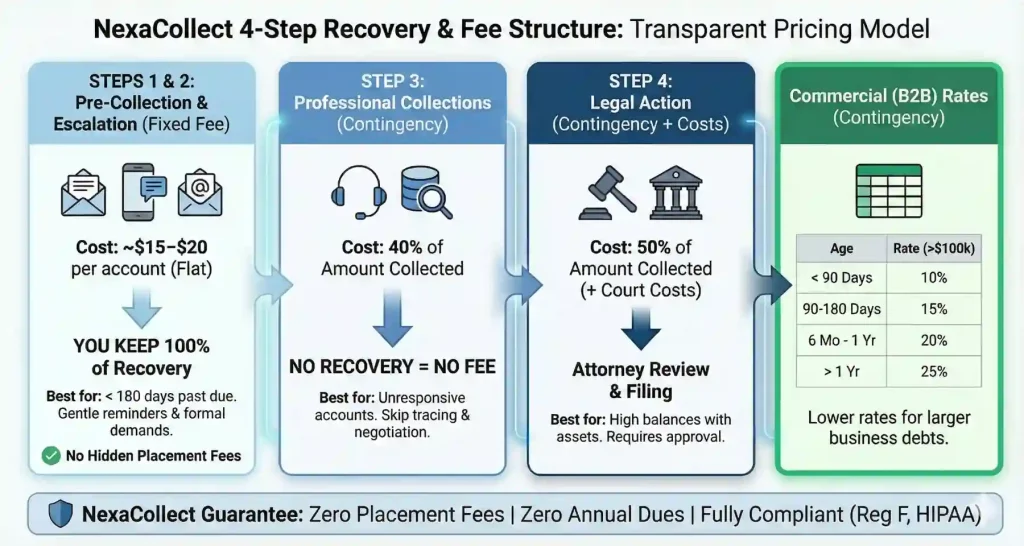
Step 1 & 2: Fixed-Fee Recovery (~$15/account). Five professional demand touches for accounts under roughly 60 days. Payments go directly to you. See the full pricing breakdown.
Step 3: Contingency Collection (~40%). For older or unresponsive accounts, no recovery, no fee.
Step 4: Legal Referral (client-approved, ~50%). Only where the balance and circumstances justify it, filing fees reimbursed from the first recovery.
Who We Collect For Across Seattle & the Sound
- Medical & Dental: HIPAA-compliant patient balance recovery for practices around First Hill, Capitol Hill, and the wider UW Medicine and Providence/Swedish network.
- Tech, Cloud & Aerospace: B2B and commercial receivables for the SaaS, cloud, and logistics companies concentrated in South Lake Union and SODO, sized for both established firms and fast-growing startups.
- Fitness & Membership Businesses: Recurring billing recovery for studios and gyms around Capitol Hill and South Lake Union.
- Schools & Education: Tuition and program fee recovery for the region’s private schools and training programs.
- Senior Living: Recovery for the region’s assisted living and skilled nursing communities.
- Utilities: Utility account recovery across the greater Puget Sound service territory.
Frequently Asked Questions
Is wage garnishment in Washington really capped at 25% of disposable earnings?
No, and this is a common misstatement. Under RCW 6.27.150, the exempt amount for ordinary consumer debt is the greater of 80% of disposable earnings or 35 times the state minimum wage, which means at most 20% of disposable earnings is actually reachable, not 25%. The 25% figure often gets borrowed from the less protective federal Title III floor, which Washington’s own law exceeds.
Does Seattle’s high local minimum wage affect how much can be garnished from a debtor’s wages?
It depends on the type of debt. For private student loan garnishment specifically, the statute uses the highest local minimum wage in the state, which pulls in Seattle’s elevated local rate and raises the protected floor accordingly. For ordinary consumer debt, garnishment, credit cards, medical bills, most commercial accounts, the calculation uses the flat state minimum wage regardless of where the debtor lives, so Seattle’s local wage doesn’t provide the same boost there.
Can a collection agency record calls with Seattle debtors without their knowledge?
No. Washington is an all-party consent state under RCW 9.73.030, meaning every participant on a call must consent to it being recorded, not just the party initiating the recording. This shapes how collection calls have to be structured and documented from the outset, not just a compliance detail addressed after the fact.
How long does a Seattle business have to collect on an unpaid account?
Generally six years for a claim based on a written contract under RCW 4.16.040, and three years for an oral agreement under RCW 4.16.080. Recovery odds decline well before either deadline arrives, so placing an account early gives meaningfully better odds than waiting until it nears the statutory limit.
Does Seattle’s tech and startup economy change how commercial collections should be approached?
Often yes. Alongside established anchors like Amazon, Microsoft, and Boeing, the city has a genuine startup ecosystem where companies sometimes wind down entirely rather than simply pay slowly. Distinguishing a dissolved company (requiring successor-liability and asset-tracing work) from a still-operating but slow-paying client changes the right collection strategy, and assuming every account fits the more conventional pattern can waste effort on accounts that need a different approach entirely.
Will pursuing an unpaid balance put a Seattle debtor’s home at risk?
Generally not through wage garnishment alone, and Washington maintains separate homestead-style protections apart from the garnishment framework described here. Given how protective Washington’s actual garnishment cap is, a negotiated payment arrangement is often more realistic and productive than assuming aggressive wage-based enforcement will recover much of a balance quickly.