The Business Case for Intraoral Scanners: ROI, Accuracy, and Practice Growth
For the modern dental practice owner, an intraoral scanner is no longer a luxury; it is the engine of a high-growth clinical and financial ecosystem. While the clinical benefits of “gag-free” impressions are well-documented, the true value lies in how these devices slash overhead, reduce lab remakes, and provide irrefutable documentation for both insurance claims and debt recovery.
The Financial Impact of Digital Precision
The most immediate ROI of a digital scanner is the elimination of the “Remake Leak.” Traditional PVS impressions have a 15% to 25% margin of error due to material distortion or tray shifts. Every remake costs a practice an average of $300 in lost chair time and additional lab fees. By moving to digital, accuracy improves to sub-micron levels, reducing remakes to less than 1%. Over a year, this can save a mid-sized practice upwards of $15,000 in pure overhead.
Typical Costs and Investment Tiers
Entering the digital workflow requires understanding the two-tier pricing model.
-
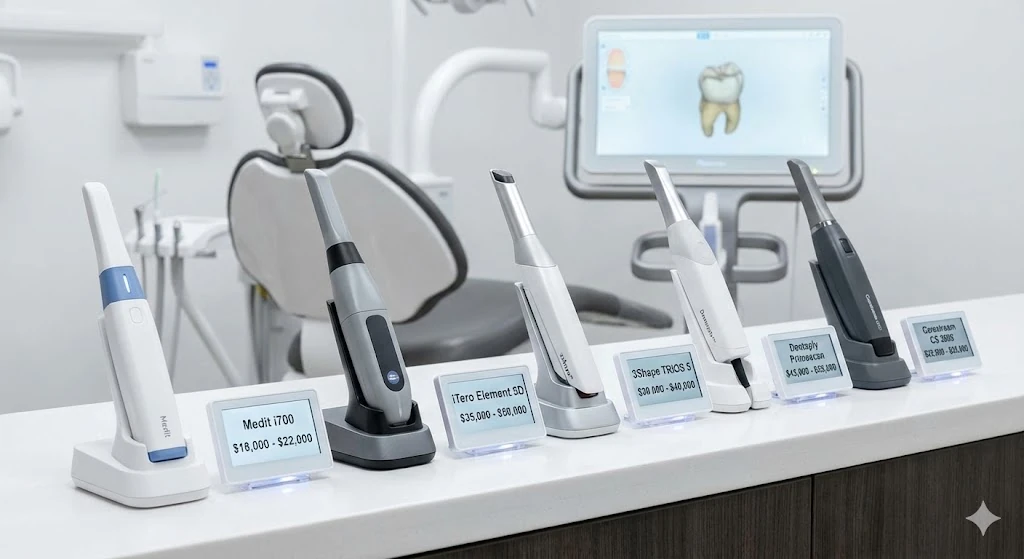
Entry-Level ($15,000 – $22,000): Brands like Medit offer high-speed scanning with no recurring monthly subscription fees. This is ideal for practices focused on basic restorative and crowns.
-
Premium Tier ($35,000 – $50,000+): Systems like iTero Element or Dentsply Sirona’s Primescan offer advanced AI, high-definition color, and deep integration with Invisalign or CAD/CAM milling units.
-
Hidden Costs: Factor in the “Subscription vs. Open System” debate. Some brands require a “laptop fee” or a monthly cloud storage subscription ranging from $200 to $400.
Top Brands Dominating the 2026 Market
-
3Shape TRIOS: Known for the best software ecosystem and wireless freedom.
-
iTero: The undisputed leader for orthodontic practices and Invisalign integration.
-
Medit: The “value disruptor” offering an open platform with powerful free apps for smile design.
-
Primescan: Celebrated for its sheer speed, scanning full arches in under 60 seconds.
2026 Intraoral Scanner Comparison: Top 5 Models
Choosing the right scanner depends on your specific practice needs—whether that is orthodontic integration, restorative speed, or overall value. Below is a comparison of the current industry leaders based on average market pricing and core functionality.
| Model | Average Price Range | Best For | Key Features | Subscription / Fees |
| Medit i700 | $18,000 – $22,000 | Best Value / ROI | Open system, high-speed, no-tip calibration, light-weight (245g). | $0 (No mandatory monthly fees) |
| iTero Element 5D | $35,000 – $50,000 | Ortho & Invisalign | NIRI technology (detects caries), Invisalign Outcome Simulator. | Monthly Service Fee ($300 – $450) |
| 3Shape TRIOS 5 | $30,000 – $40,000 | Ecosystem & Software | Wireless, “ScanAssist” AI, autoclavable tips, superior CAD integration. | Optional (Choice of subscription or limited free) |
| Dentsply Sirona Primescan | $45,000 – $55,000 | Speed & Large Labs | Massive field of view, 1-minute full arch scans, deep color depth. | Varies (Often bundled with DS Core) |
| Carestream CS 3800 | $22,000 – $28,000 | Ergonomics | Wireless, gesture-motion control, open STL/PLY/OBJ exports. | $0 (No mandatory monthly fees) |
Essential Features to Prioritize
Do not get distracted by flashy software. Focus on Scanning Speed—anything over 2 minutes for a full arch is too slow for 2026. AI Tissue Removal is vital; the software should automatically delete tongues and cheeks from the scan. Lastly, ensure it is an Open System (STL/PLY Export). This allows you to send files to any lab in the world, preventing “manufacturer lock-in.”
The “Integration Gap”: Workflow Training
The biggest failure point isn’t the technology; it’s the team. To realize the ROI, the scanner must be in the hands of the assistants, not just the doctor. A high-efficiency office uses the scanner during the New Patient Experience as a baseline record. This 5-minute task creates a “Digital Twin” of the patient, which serves as a benchmark for monitoring tooth wear, gum recession, and shifting over time—creating a reason for the patient to return for follow-up care.
Visual ROI and Case Acceptance
Patients are more likely to pay for treatment they can visualize. Using a scanner to show a 3D “Before and After” simulation is a powerful psychological sales tool. It shifts the conversation from a “cost” to an “investment.” Seeing their own crooked teeth move into a perfect 3D smile on a 20-inch monitor triggers a much higher “Yes” rate for high-ticket elective procedures than a flat X-ray ever could.
Are There Any Real Alternatives?
The only true alternative is the traditional PVS (Polyvinyl Siloxane) Manual Impression. While the material cost per tray is low (~$20), the indirect costs—shipping fees, storage space for physical models, and the risk of lost records—make it significantly more expensive over time. Some practices use Direct-to-Consumer (DTC) scan centers, but this removes clinical control and disrupts the patient’s “in-house” experience.
The Collections and Documentation Shield
In a billing dispute, a digital scan is your most powerful evidence. When a patient refuses to pay, claiming the work was “unnecessary” or “poorly fitted,” a time-stamped, high-resolution 3D scan provides objective proof. At NexaCollect, we find that cases backed by digital scans are resolved 40% faster because the debtor’s legal or insurance representatives cannot argue with raw 3D data.
Secure Your Dental Office Revenue
Contact Nexa Collection Agency Today