Raleigh’s economy runs on innovation—but unpaid accounts can still bring cash flow to a crawl. From biotech and technology companies tied to the Research Triangle to medical and dental practices, schools, contractors, property managers, professional firms, and growing businesses across Downtown Raleigh, North Hills, Cary, Apex, and Wake County, every overdue account represents revenue that should already be back in your business.
Nexa helps Raleigh organizations recover that money without burning bridges. We combine professional follow-up, payment negotiation, skip tracing, and appropriate escalation with a reputation-first approach tailored to the type of account—whether it belongs to a patient, customer, parent, tenant, or another business. Local knowledge matters because a biotech invoice, a healthcare balance, and a contractor receivable should never be handled with the same collection playbook.
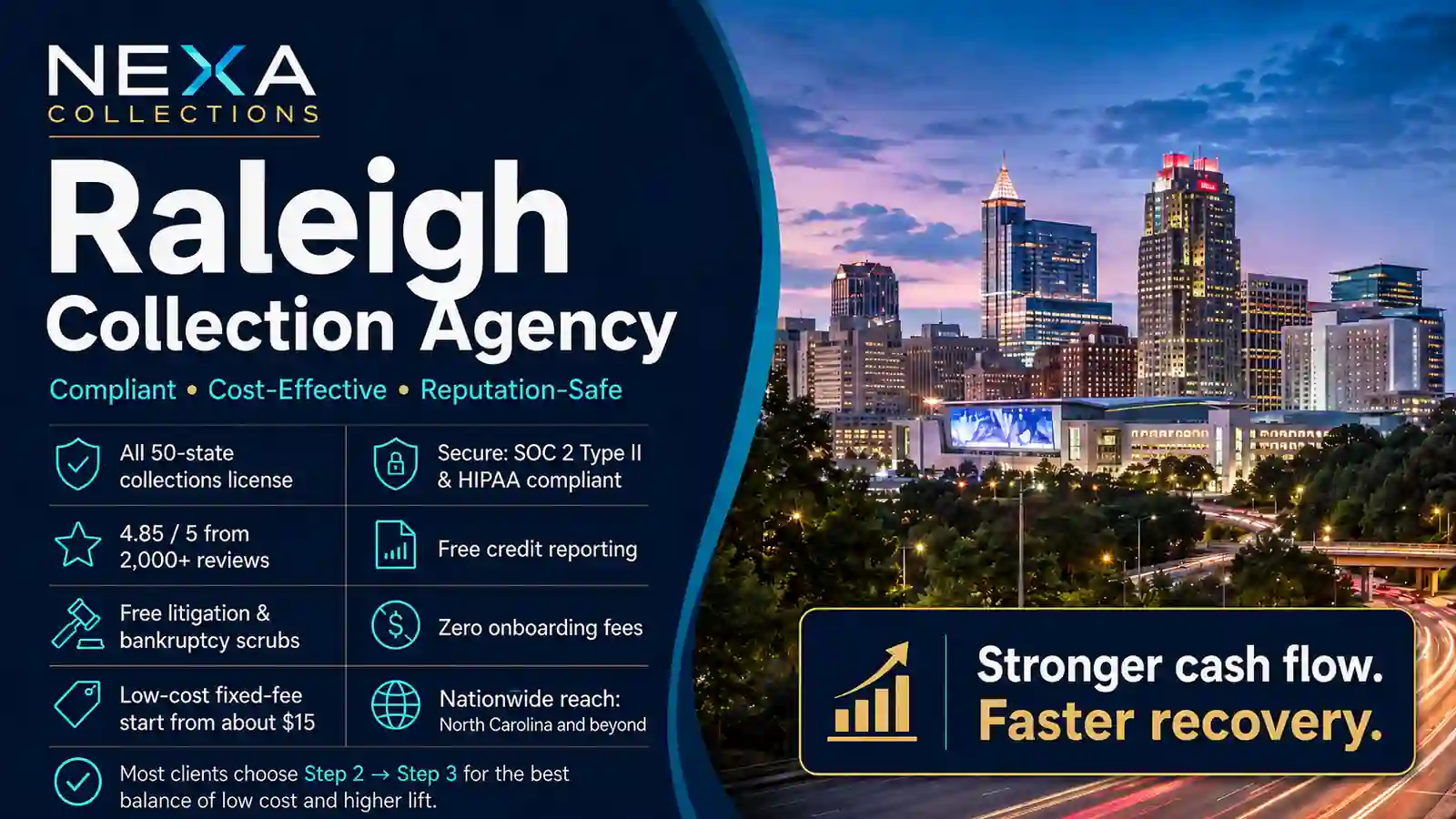
Nexa provides a reputation-safe approach, equipped with all 50-state collections license, offering free credit reporting, free litigious debtor check, free bankruptcy scrub, and zero onboarding fees. Secure – SOC 2 Type II & HIPAA compliant. Over 2,000 online reviews rate us 4.85 out of 5.
Need a Collection Agency in Raleigh? Contact us
Recent Recovery Results
Research Triangle Biotech Vendor — $62,800 Recovered at 80%.
A lab equipment and consumables supplier serving Research Triangle biotech clients carried $78,500 across 12 accounts tied to research contracts and equipment purchase orders. With full statement-of-work and delivery documentation reviewed at intake, 10 of 12 accounts resolved within 65 days, recovering $62,800 (80%) without litigation.
Multi-Specialty Medical Group — $34,900 Recovered at 71%.
A Raleigh medical group carrying $49,200 in self-pay balances across 97 accounts, correctly screened for Medical Debt Relief Program eligibility before placement, placed the remaining collectable accounts on a Step 1/Step 2 fixed-fee sequence. 63 accounts resolved within 50 days, with the remainder moving to contingency, bringing total recovery to $34,900 (71%) within 90 days.
Hospitals/Medical Debt:
Every acute care hospital in North Carolina, all 99 of them, opted into a program that has already relieved $6.5 billion in medical debt for over 2.5 million people. What most collections content skips is what that means operationally: for a meaningful share of patients, a hospital legally cannot sell the debt to a third party at all, and for everyone else, there’s a mandatory waiting period before it can. Placing a Raleigh medical account the way you would in most other states risks getting the sequencing wrong.
Quick answer: Raleigh hospital accounts run on North Carolina’s Medical Debt Relief Program, which every eligible hospital in the state joined: debt cannot be sold to a third-party collector at all for patients at or below 300% of the federal poverty level, and for other patients, hospitals must wait at least 120 days after the initial bill before a sale. Interest is capped at 3% while held by the hospital, or SOFR plus 1% if sold. Beyond hospitals, North Carolina generally prohibits wage garnishment for ordinary consumer debt, and sets a 3-year statute of limitations for general contracts, 4 years for UCC goods sales. Nexa recovers Raleigh accounts starting at a $15 fixed fee per account, with contingency options for older balances.
What Raleigh Creditors Need to Get Right
Hospital debt has real, current restrictions on when it can even be placed.
Every eligible acute care hospital in North Carolina joined the state’s Medical Debt Relief Program. For patients at or below 300% of the federal poverty level, participating hospitals generally cannot sell debt to a third-party collector at all. For patients above that threshold, hospitals must wait at least 120 days from the initial post-discharge bill before a sale can happen. Interest on debt still held by the hospital is capped at 3%; if sold, the cap shifts to SOFR plus 1%. A Raleigh hospital placing accounts needs this sequencing screened correctly before anything moves to collections, not discovered afterward.
North Carolina broadly doesn’t allow wage garnishment for ordinary debt.
Consistent with Texas and Pennsylvania, North Carolina courts generally cannot order wage garnishment for ordinary personal debts like credit cards or auto loans. Garnishment remains available for taxes, student loans, child support, and alimony, but a Raleigh creditor obtaining a judgment on an ordinary consumer debt shouldn’t assume garnishment is an available enforcement path; voluntary resolution and other post-judgment remedies matter more here.
The Research Triangle’s biotech density creates a genuinely specialized B2B account type.
With over 675 life-sciences companies in the region, Raleigh’s commercial receivables include lab services, research contracts, CRO agreements, and specialized equipment purchases that need statement-of-work and delivery documentation, not just a standard invoice, to resolve cleanly.
Construction accounts run on a tight, two-stage deadline.
A qualifying claim of lien on real property generally must be filed within 120 days of last furnishing labor or materials, with an enforcement action generally required to begin within 180 days of that same date. Waiting while re-sending the same invoice risks losing lien rights that were never actually used.
The North Carolina Legal Landscape
| Statute of Limitations (general contracts) | 3 years — N.C. Gen. Stat. § 1-52 |
| Statute of Limitations (UCC goods sales) | 4 years |
| Wage Garnishment | Generally unavailable for ordinary consumer debt (available for taxes, student loans, child support, alimony) |
| Medical Debt Sale Restriction (≤300% FPL) | Cannot be sold to a third party (unless to eliminate the debt) |
| Medical Debt Sale Waiting Period (>300% FPL) | 120 days from initial bill before sale |
| Medical Debt Interest Cap | 3% held by hospital; SOFR + 1% if sold |
| Construction Lien Filing | 120 days from last labor/materials furnished |
| Lien Enforcement Action | Must begin within 180 days |
| Security Deposit Accounting | 30 days (interim) / 60 days (final, if amount undetermined) |
What This Costs
Step 1 & 2: Fixed-Fee Recovery (~$15/account). Professional demand sequences with Medical Debt Relief Program eligibility screening built in for hospital accounts. Payments go directly to you. See the full pricing breakdown.
Step 3: Contingency Collection (~40%). For older or unresponsive accounts, no recovery, no fee.
Step 4: Legal Referral (client-approved, ~50%). Including construction lien deadline coordination, filing fees reimbursed from the first recovery.

Who We Collect For Across Raleigh
- Agriculture & Manufacturing: B2B and commercial receivables for the Research Triangle’s biotech, life-sciences, and advanced manufacturing suppliers, with statement-of-work and delivery documentation screening built into intake.
- Hospitals, Dental & Medical: HIPAA-compliant patient balance recovery with Medical Debt Relief Program eligibility screening for hospital accounts specifically.
- Colleges & Universities: Tuition and fee recovery for the region’s universities and colleges.
- K-12 Private & Charter Schools: Tuition and activity fee recovery handled diplomatically, alongside meal and fee recovery for public districts.
- Accountants & CPA Firms: Commercial receivables for the professional services firms supporting Raleigh’s biotech and corporate base.
- Banks & Credit Unions: Recovery for the region’s financial institutions and lending partners.
- Construction & Trades: B2B recovery with the 120/180-day lien and enforcement deadlines flagged at intake.
- B2B Commercial, Restoration & Waste Management: Commercial receivables for general B2B accounts, restoration contractors, and waste management service providers.
Frequently Asked Questions
Can a Raleigh hospital still send patient balances to collections given the Medical Debt Relief Program?
Yes, but with real restrictions on timing and eligibility. For patients at or below 300% of the federal poverty level, participating hospitals generally cannot sell debt to a third-party collector at all. For patients above that threshold, hospitals must wait at least 120 days from the initial bill before selling debt. Accounts should be screened against these criteria before placement, not assumed to be immediately collectable.
What interest rate applies to North Carolina medical debt?
Debt still held directly by a participating hospital is capped at 3%. If sold to a third-party collector, the cap shifts to the Secured Overnight Financing Rate (SOFR) plus 1%, both notably lower than rates that applied before the program took effect.
Can a Raleigh business garnish a customer’s wages after winning a judgment?
Usually not for ordinary personal debts. North Carolina courts generally cannot order wage garnishment for debts like credit cards or auto loans, though garnishment remains available for taxes, student loans, child support, and alimony. A judgment on ordinary consumer debt doesn’t automatically translate into a percentage of the debtor’s paycheck.
How long does a Raleigh business have to collect on an unpaid invoice?
It depends on what created the debt. North Carolina generally provides a 3-year statute of limitations for contractual claims under N.C. Gen. Stat. § 1-52, but contracts for the sale of goods under the UCC generally get 4 years, longer than the general period, the opposite pattern from most states.
How quickly does a Raleigh contractor need to act to preserve lien rights?
A qualifying claim of lien on real property generally must be filed within 120 days of last furnishing labor or materials, with an action to enforce that lien generally required to begin within 180 days of that same date. Collection efforts can proceed while lien deadlines are separately evaluated.
Does Raleigh’s Research Triangle location create different documentation needs for B2B accounts?
Often yes. With over 675 life-sciences companies in the region, accounts tied to lab services, research contracts, and specialized equipment purchases typically need the statement of work, purchase order, and delivery or acceptance records, not just a standard invoice, to resolve cleanly.
Talk to Us About Your Raleigh Receivables
Innovation in the Triangle is Moving Fast. Don’t Let Your Receivables Lag Behind.
Raleigh is no longer just a government town; it is one of the fastest-growing tech and biotech hubs in the nation. From the startups launching in the Warehouse District to the life science giants anchoring Research Triangle Park (RTP), business here is built on speed and innovation.
However, many Raleigh businesses are stuck using debt recovery strategies from the 1990s.
If you are waiting 120 days to address unpaid invoices because you fear upsetting a client or navigating North Carolina’s strict laws, you are putting your cash flow at risk.
Need a Collection Agency? Contact us
The “North Carolina Anomaly”: Why You Can’t Wait
North Carolina is unique. It is one of the few states that prohibits wage garnishment for most private debts (like medical bills, credit cards, or personal loans). This means if you wait until you have to sue, the court cannot simply order the debtor’s employer to pay you from their paycheck.
Because the “legal hammer” is softer here regarding wages, your pre-legal strategy must be twice as smart. You cannot rely on a judge to fix your bad debt later; you must motivate the debtor to pay now.
NexaCollect brings a data-driven, psychological approach to recovery that works within the specific constraints of NC law.
3 Strategic Reasons to Modernize Your Collections
In the Triangle, “hope” is not a strategy. You need leverage.
1. The “No-Garnishment” Reality Check
Since NC protects debtor wages, savvy debtors know they can drag out a lawsuit.
-
The Fix: We don’t rely on the threat of wage garnishment. We rely on Credit Leverage. By reporting debts to Equifax, Experian, and TransUnion (where applicable in Step 3), we threaten what modern consumers value most: their ability to buy a home in Raleigh’s hot real estate market or finance a car. This motivates payment far faster than a court order.
2. The 3-Year Statute of Limitations
North Carolina has a strict 3-year Statute of Limitations on contracts. The clock ticks faster here than in many other states.
-
The Risk: If you let an account sit for 36 months, it becomes legally uncollectible in court.
-
The Fix: Place accounts earlier. We see significantly higher success rates on accounts placed at Day 90 versus Day 180. Speed is your only defense against the 3-year cliff.
3. Protecting Your Brand in a Connected Hub
Raleigh is a “big small town.” Whether you are in North Hills or Brier Creek, reputation matters.
-
The Risk: Aggressive “junkyard” agencies generate complaints that spread quickly on local business forums.
-
The Fix: We are rated 4.85 out of 5.0 because we treat debtors with dignity. We act as professional mediators, preserving your brand while enforcing your payment terms.
Two Paths to Payment: A System That Fits Your Needs
We don’t believe in a “one size fits all” approach. We analyze the debt and apply the right pressure.
Path A: The “Flat-Fee” Professional Nudge (Step 1 & 2)
-
Best For: Medical practices (Dental, Chiropractic), Private Schools, and early-stage B2B invoices.
-
The Strategy: For just $15 per account, we send official third-party demand letters in our name. This signals that the account has been escalated to a professional firm, stripping away the “I forgot” excuse.
-
The Outcome: This “shock factor” often prompts immediate payment. You pay $15. You keep 100% of the recovered funds.
Path B: The “Contingency” Escalation (Step 3 & 4)
-
Best For: Construction (Mechanic’s Liens), Tech B2B, and stubborn refusals.
-
The Strategy: If letters fail, we move to intensive phone negotiations and skip-tracing. We charge 40%, but only if we succeed.
-
The Outcome: We use advanced data tools to locate assets that can be attached (like bank accounts) if legal action becomes necessary.
Local Intel: Success Stories in the 919
We are helping businesses across Wake County recover funds without burning bridges.
CASE BRIEF:
The RTP Tech Service Firm A managed IT services provider in Morrisville was owed $18,000 by a startup that had burned through its funding. The startup was ghosting them.
-
Our Action: We ran a Free Litigious Check and found the startup was still active but prioritizing other vendors. We deployed Step 2 (Flat-Fee) demands to the CFO directly.
-
The Result: The CFO, fearing a credit hit would impact their next funding round, released the payment immediately. The IT firm recovered 100% of the principal for a nominal flat fee.
CASE BRIEF:
The Dental Practice (North Raleigh) A busy family practice had $22,000 in aging patient copays. They were hesitant to use an agency due to fear of bad reviews.
-
Our Action: We used our patient-friendly diplomatic letter series.
-
The Result: We recovered $14,500 in the first 60 days. Patients appreciated the professional notice rather than a harassing phone call, and the practice maintained its 5-star Google rating.
FAQ: Collecting in North Carolina
Q: If you can’t garnish wages, how do you force payment legally?
A: While wages are protected, bank accounts are not. If we obtain a judgment (Step 4), we can levy the debtor’s bank account to seize the funds directly. We can also place liens on real property. However, our goal is to secure voluntary payment in Steps 1-3 so legal action isn’t needed.
Q: My debtor moved to South Carolina. Can you still help?
A: Yes. We are licensed in all 50 states.
If your debtor crosses state lines, our recovery process follows them seamlessly, and we adapt to the laws of their new location.
Q: When should I send an account to you?
A: The data is clear: Sooner is better. An account that is 90 days past due is 20% more collectible than one that is 180 days past due. Don’t wait for the “NC Anomaly” to limit your options.
Executive Summary: Your Next Move
Don’t let the “Triangle Boom” leave you behind. Every day an invoice sits unpaid, it loses value. Secure your revenue with a partner that offers:
-
National Reach: 50-State Licensing.
-
Proven Results: A 4.85/5.0 Client Satisfaction Rating.
-
Smart Pricing: Keep 100% of Step 1 & 2 recoveries.
Secure your bottom line today.