The era of “dialing for dollars” is hitting a wall. Gatekeepers are more protective, office phones are often bypassed for remote work, and direct mailers are increasingly viewed as clutter. If your sales team is still relying on a 2010 playbook, you aren’t just losing time—you’re losing market share to competitors who are already “socially surrounded” by your best prospects.
LinkedIn isn’t a social media site; for B2B services, it is a high-resolution database and a trust-building engine. Here is how to move from cold interruptions to high-intent conversions.
-
LinkedIn generates 80% of all B2B leads from social media, making it the dominant platform for professional growth.
-
The platform’s visitor-to-lead conversion rate is 2.74%, nearly triple that of Facebook and X.
-
Sales professionals who prioritize social selling are 51% more likely to reach their annual revenue quotas.
-
High-precision InMail campaigns deliver response rates 3x higher than standard cold emails or direct mailers.
1. The Math of Modern Outreach: Why “Old School” is Failing
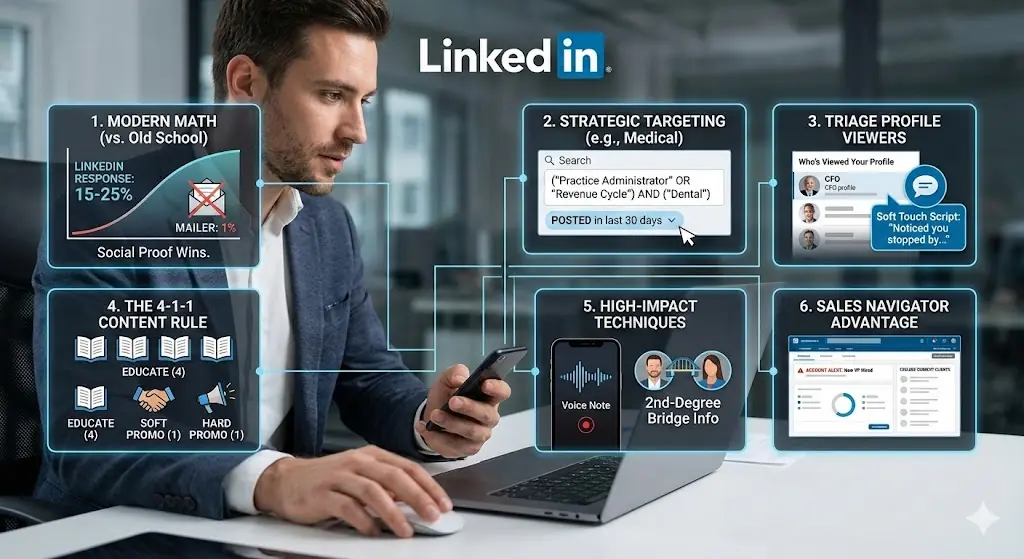
Traditional mailers have an average response rate of about 1%, and cold calls often require 18 or more attempts to even reach a decision-maker. Compare this to LinkedIn, where a well-optimized profile and a strategic message can see response rates of 15-25%.
The difference is Social Proof. When you call a prospect, you are a stranger. When you message them on LinkedIn, they immediately click your profile to see your “vitals”: Who do we know in common? Do they actually understand my industry? Are they an authority or just a salesperson?
2. Strategic Targeting: The “Collections” Niche Example
Let’s look at targeting the Medical and Dental billing sector—a high-value segment for collection agencies. Instead of a broad “Healthcare” search, use Boolean Search Logic in Sales Navigator to find the “hidden” influencers:
-
The Search String:
("Practice Administrator" OR "Office Manager" OR "Revenue Cycle") AND ("Dental" OR "Orthodontics") -
The Filter: Filter by “Groups.” Join groups like Medical Group Management Association (MGMA).
-
The Technique: Look for prospects who have “Posted on LinkedIn in the last 30 days.” This narrows your list from thousands of stagnant profiles to the active users who are actually listening.
3. The “Triage” Technique for Profile Viewers
One of the most underused features of LinkedIn Premium is the “Who’s Viewed Your Profile” list. Think of this as a digital “intent signal.” If a CFO of a manufacturing company views your profile, they didn’t get there by accident.
Don’t ignore them. Use this “Soft Touch” script:
“Hi [Name], I noticed you stopped by my profile recently. I’ve been doing a lot of work lately with [Industry] firms regarding their 90-day aging buckets. I’d be happy to share the recovery benchmark report we just finished for that sector if it’s helpful for your team.”
4. The 4-1-1 Content Rule
To be a magnet, you can’t just post “Hire us” every day. That’s the digital equivalent of a flyer. Instead, use the 4-1-1 rule:
-
4 pieces of educational content: (e.g., “3 ways to spot a high-risk credit applicant before you sign the contract”).
-
1 piece of “Soft” promotion: (e.g., A case study of a client who reduced bad debt by 22%).
-
1 piece of “Hard” promotion: (e.g., “We are opening 5 spots for free A/R audits this month”).
5. High-Impact Techniques (Beyond the Keyboard)
-
The Voice Note: Use the LinkedIn mobile app to send a 20-second voice message instead of a text InMail. It is personal, impossible to ignore, and proves you aren’t a bot.
Script: “Hey [Name], I was just reading your company’s latest update on the new clinic opening. Congrats on the expansion. I had a quick thought on how to keep the patient intake process lean during the transition—I’ll send a brief note over later.”
-
The “Second-Degree” Bridge: If you see a prospect you want to reach, look at your shared connections. Instead of asking for a formal intro (which can be awkward), ask your mutual friend: “Hey [Friend], I’m looking to reach out to [Prospect] about a B2B project. Do you guys work together closely, or is it just a casual connection?” This gives you “intelligence” before you reach out.
6. Sales Navigator: The “Deep Search” Advantage
While Business Premium is a great start, Sales Navigator Core is where the real scale happens. It allows you to:
-
Track Account Changes: Get alerted when a prospect company gets new funding or a new VP is hired. A new VP is often looking to “clean house” and bring in new, more efficient vendors (like a better collection agency).
-
Exclude Current Clients: You can upload your current client list so you don’t accidentally “prospect” people you already work with, keeping your brand looking professional.
The Bottom Line
If you are still sending mailers, you are paying for postage and a prayer. By moving that budget into a LinkedIn-first strategy, you are paying for data, access, and authority. You aren’t just finding leads; you’re building a network that works for you even when you aren’t logged in.