Most propane and heating oil dealers believe they’re bound by the same winter shutoff rules as the electric company. In most states, they generally aren’t. Cold-weather moratorium laws are built for regulated, pipeline-connected utilities, and multiple state regulators explicitly exclude delivered fuels like propane and heating oil from that protection. What most dealers treat as a compliance headache is, more often than not, a point of leverage they didn’t know they had.
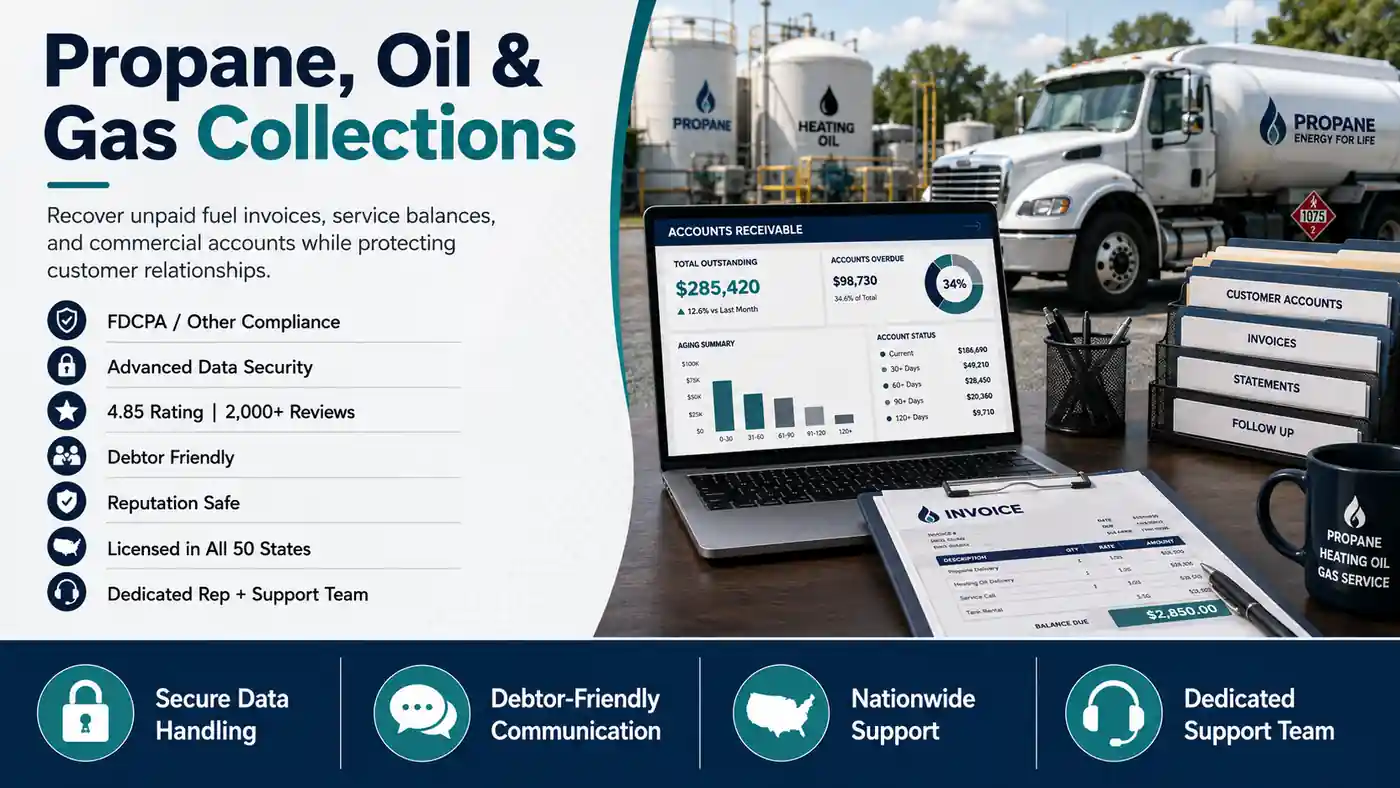
Quick Answer:Winter moratorium laws generally protect regulated gas and electric utilities, not propane and heating oil delivery, which means most dealers retain more collection leverage in cold months than they assume, though a handful of states extend narrower protections and it’s worth confirming your specific one. Nexa provides 50-state licensed, FDCPA-compliant collection starting at a $15 fixed fee per account, backed by SOC 2 data security, a dedicated account executive, and a 4.85/5 rating across 2,000+ reviews.
You Delivered the Gallons. They Burned the Fuel. Now You Need the Cash.
Fuel delivery is a high-stakes inventory game. Unlike a service business where you lose time if a client doesn’t pay, in the fuel business, you lose inventory. Every gallon of #2 heating oil or propane left in a debtor’s tank represents cash you already paid to the terminal. When wholesale prices spike, your “bad debt” line item doesn’t just double, it triples. You’re squeezed between the rack price and the customer’s wallet.
The “Winter Gap” Problem: the industry’s biggest killer is the “April drop-off.” Customers on budget plans pay faithfully through January, but as the weather warms, they stop paying the “true-up” balance. They ghost you in spring, leaving a $600 deficit that erodes the margin on every gallon delivered all winter.
Why fuel dealers switch to us:
- Rated 4.85/5 stars across 2,000+ verified reviews.
- Licensed in all 50 states, for delivery routes that cross state lines.
- Dedicated account executive, backed by a specialized support team, not a call center.
- SOC 2 Type II certified, 256-bit SSL encryption, FDCPA and Regulation F compliant.
- We know your industry: Most agencies treat a $400 fuel bill like a credit card debt. They don’t understand PUC regulations, cold weather rules (and where they genuinely don’t apply), or the intricacies of automatic delivery contracts. We do.
The 3 Leaks in Your Cash Flow Pipeline
1. The “Automatic Delivery” Trap
You fill a customer’s tank in February because your “degree day” software said they were low. Two weeks later, they move out. The new homeowner says, “I didn’t order this.” The old tenant is gone.
The Nexa fix: We specialize in tenant skip-tracing, using utility data and credit headers to find where your “pump and run” debtor moved, serving the demand letter at their new address before they unpack.
2. The Regulatory Reality (Cold Weather Rules, Corrected)
Here’s the misconception worth retiring: many dealers assume they’re legally barred from refusing delivery to a delinquent account during winter, the same restriction that binds the electric utility. In most states, that restriction doesn’t apply to delivered fuels at all. Winter moratoriums are written for regulated gas and electric service; propane and heating oil delivery is typically a competitive, unregulated business, and several state regulators say so explicitly. A minority of states do extend narrower protections to delivered fuels, or tie eligibility to LIHEAP/HEAP assistance programs, so this is worth confirming for your specific state before assuming either way, but the default assumption most dealers operate under is backwards more often than not.
The Nexa fix: We help you collect within whatever your actual state’s rules are, applying credit pressure and formal demand without guessing at a restriction that may not exist. The conversation moves from “you can’t shut me off” to a documented, professional demand that treats the balance seriously regardless of season.
3. The Tank Asset War
In propane, you often own the tank. If a customer defaults, you have a $1,500 steel asset sitting in their yard, and retrieving it costs money (crane, pump-out, labor). It’s also not as simple as driving over and taking it: reclaiming leased equipment from someone else’s property generally can’t involve a “breach of peace,” the same limitation that governs auto repossession.
The Nexa fix: We use the collection process as leverage to negotiate the voluntary surrender of the tank or a pump-out agreement, resolving it through the debtor’s cooperation rather than a contested legal action like replevin.
Serving Energy Industry NationwideNeed a Collection Agency? Contact UsDelivering High Recovery Rates |
In-House Tank Retrieval vs. Aggressive Collections vs. Nexa’s $15 Solution
| Factor | In-House Tank Retrieval | Aggressive/Generic Collections | Nexa’s $15 Answer |
|---|---|---|---|
| Upfront cost | Crane, pump-out, and labor costs, often exceeding the tank’s value | Often 35-50% contingency regardless of account age | $15 flat fee, you keep 100% of what’s recovered |
| Community & review risk | Low if handled quietly, high if it becomes a dispute | High, aggressive scripts risk local backlash in small communities | Low, framed as a professional demand, not a threat |
| Legal & moratorium compliance | Depends entirely on staff knowledge of what actually applies | Varies, generic scripts may assume the wrong rules apply statewide | Built around your specific state’s actual rules, not a blanket assumption |
| Account management | Whoever’s available that day | Often a standard call center | Dedicated account executive backed by a specialized team |
Q&A: Fueling Your Recovery Strategy
Can you collect on “budget plan” breakage?
Yes, and this is where Step 1 (fixed fee) shines. If a customer misses two budget payments in March or April, send them to us immediately. A polite but official reminder from a third party is often enough to get them back on the plan before the balance becomes insurmountable.
Dealing with commercial farms and greenhouses?
Agricultural accounts are notorious for harvest-based cash flow. When a large farm owes $25,000 for propane used in grain drying, standard letters don’t work. Our commercial division understands the agricultural cycle and negotiates payment plans secured by harvest proceeds.
Do you understand “degree day” disputes?
Absolutely. Customers often claim “you let me run out” or “you filled me when prices were high.” We act as a mediator, reviewing your delivery logs and contract terms to prove the delivery was authorized, neutralizing the dispute.
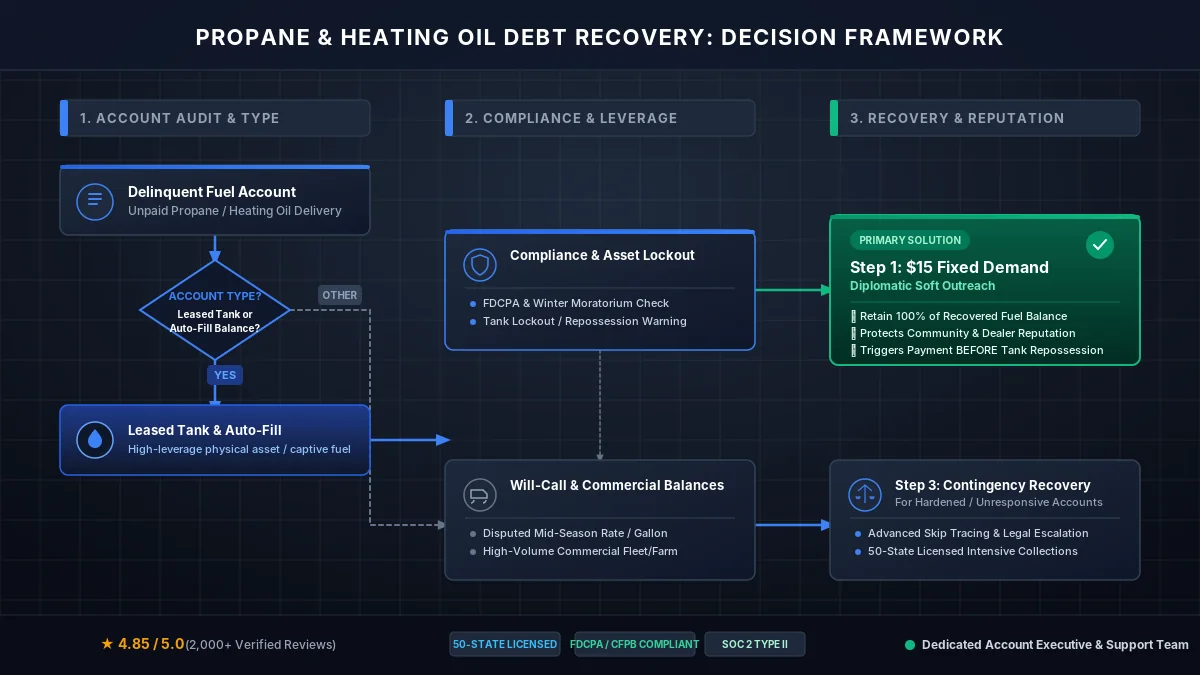
A Simple Decision tree diagram:
Pricing & Services: The “Gallon-for-Gallon” Recovery
We use a “Waterfall” system designed to protect your margins.

We use a waterfall system designed to protect your margins.
Step 1: Budget Plan Rehabilitation (Fixed Fee, ~$15/account)
Best for residential balances under $600 and budget plan “misses” (30-60 days late). Five diplomatic reminders sent in your name, it reads like a billing error notice, not a threat. Keeps the customer on your route; you recover 100% of the cash.
Step 2: The “Shut-Off” Warning (Fixed Fee, ~$15/account)
Best for accounts 90 days past due, or “will call” customers who ignored the bill. Formal demand sent in the agency name, signaling the account is flagged for credit reporting.
Step 3: Contingency Collections (Skips & Commercial, ~33-40%)
Best for tenants who’ve moved, tank recovery leverage, and balances over $1,000. No recovery, no fee. Deep skip-tracing, asset investigation, and compliant negotiation.
Step 4: Legal Action (~40-50% Contingency)
Best for large commercial or agricultural balances, or recovery of high-value tank assets.
Recent Results:
Heating Oil Supplier (New England) — The “Budget” Crash
A mid-sized dealer had 200 customers default on their budget caps at the end of a mild winter, owing an average of $350 each. A bulk Step 1 campaign in May recovered $52,000 in small balances. The dealer paid only the flat fee (~$3,000 total), keeping $49,000 to pre-buy fuel for next season.
Propane Distributor (Midwest) — The Agricultural Default
A large poultry farm owed $42,000 for propane used to heat chicken houses during a cold snap and claimed “poor yield” to refuse payment. Placed in Step 3 contingency, our team identified the farm’s active supply contracts with processors and negotiated a settlement where a portion of the farm’s next processing check was directed to the propane dealer. Full recovery in 4 months.
Regional Gas Utility (South) — Tenant Skips
High turnover in university rental housing led to $80,000 in unpaid “final bills” averaging $120. Automated placement into Step 2 combined with credit reporting resulted in 40% of students paying immediately upon seeing the collection notice hit their credit monitoring apps.
Frequently Asked Questions
How do you collect on unpaid winter heating bills without violating state moratorium laws?
The starting point is confirming whether a moratorium actually applies to your business at all, and for most propane and heating oil dealers, it doesn’t. Winter shutoff moratoriums are generally written for regulated, pipeline-connected gas and electric utilities; several states explicitly exclude delivered fuels like propane and heating oil from that protection. A minority of states extend narrower rules to delivered fuels, so we confirm your specific state’s actual requirement rather than assuming the broader utility rule applies, and build collection outreach around what’s genuinely required, not a blanket restriction that may not exist.
Can a $15 fixed-fee demand letter help me recover my leased propane tank, or just the money?
Primarily the money, though it often creates the leverage to resolve the tank too. A professional demand letter is generally the fastest way to prompt a debtor to either pay the balance or voluntarily agree to a tank pickup, since physically reclaiming leased equipment without the customer’s cooperation runs into the same “breach of peace” limits that govern auto repossession. Resolving the debt is usually what unlocks the tank, not a separate action.
How does Nexa protect my fuel business’s local reputation in small communities?
Step 1 outreach is deliberately built to look and read like a routine billing notice from your own company, not an aggressive third-party collector, specifically because fuel dealers often serve the same tight-knit communities for decades. The goal is resolving the balance quietly enough that it never becomes a local social media post or a conversation at the next town event.
Is Nexa licensed to collect if my delivery routes cross state lines?
Yes. We’re licensed to collect in all 50 states, which matters specifically for fuel dealers whose delivery territory doesn’t respect a state border, an account that moves from one state to a neighboring one doesn’t require switching agencies or losing continuity on the file.
Do I get a dedicated point of contact, or deal with an automated system?
A dedicated account executive, backed by a specialized support team, not an automated system or a rotating call queue. Your contact understands seasonal fuel billing specifically, budget plans, degree-day disputes, tank assets, rather than treating your account like a generic utility bill.
Stop Burning Profits
Your trucks are burning diesel to deliver product. Don’t burn money chasing the payment. Nexa Collections understands the unique squeeze of the energy market. Let us recover the funds so you can focus on the next delivery.