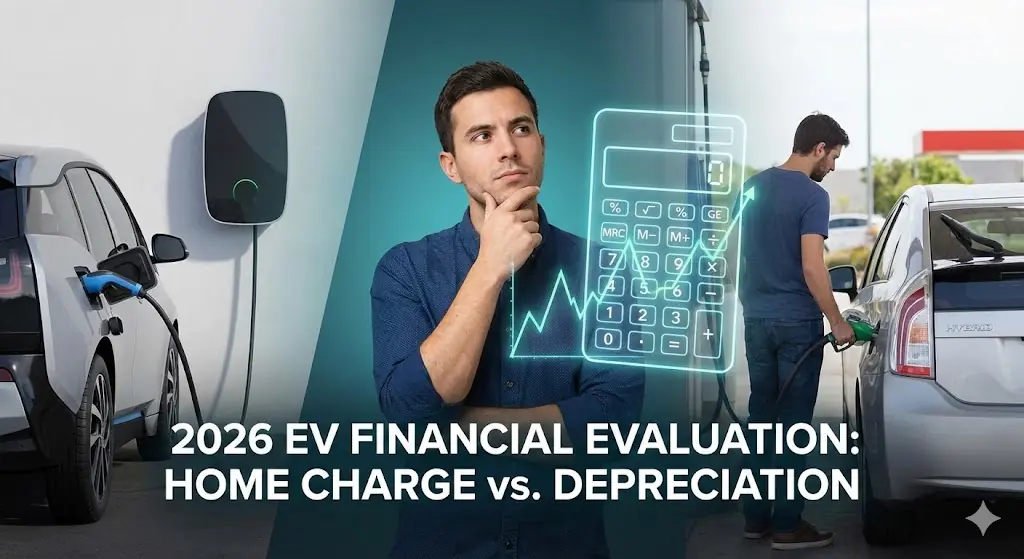
As we move through 2026, the American electric vehicle (EV) market has entered its “pragmatic era.” The era of easy $7,500 federal tax credits ended on September 30, 2025, stripping away the artificial price parity that once made EVs an effortless choice. In this post-subsidy landscape, the decision to go electric is no longer a broad “life hack”—it is a precise financial calculation based on geography, infrastructure, and asset management.
1. The Post-Subsidy Value Proposition
With the expiration of the federal new (30D) and used (25E) EV credits, along with the closure of the lease “loophole,” EVs must now win on their own merits. Without these incentives, the upfront cost premium of an EV (averaging $5,000 to $7,000 more than an equivalent ICE vehicle) must be recouped through operational savings.
Strategic Consideration: EVs are no longer subsidized social statements; they are standard capital assets. For a purchase to make sense in 2026, the “break-even” point—where fuel and maintenance savings cover the higher purchase price—has shifted from approximately three years to nearly six.
2. The Home Charging Divide
The most significant variable in EV economics is your primary “refueling” location. In 2026, electricity rates across the U.S. have diverged sharply. If you can charge at home on a standard Level 2 setup, you are likely paying between $0.04 and $0.06 per mile.
However, if you rely on public fast-charging networks, that cost often jumps to $0.12 or $0.15 per mile. In many regions, this is actually more expensive than driving a 40-MPG hybrid.
Strategic Consideration: An EV is a financial win for the homeowner with a garage. For the urban apartment dweller relying on commercial chargers, an EV is essentially a luxury vehicle that charges a premium for fuel and demands “time tax” for every session.
3. The Maintenance Paradox: Lower Upkeep, Higher Risk
EVs inherently require less routine maintenance—no oil changes, fewer fluids, and significantly less brake wear due to regenerative braking. Current data suggests routine maintenance costs are roughly 25% lower than internal combustion engines.
But there is a “tail risk.” When an EV breaks, it breaks expensively. A minor collision involving the battery’s protective casing or the complex sensor arrays required for modern ADAS (Advanced Driver Assistance Systems) can lead to repair bills that are 20-25% higher than those for gas cars.
Strategic Consideration: While you save on the “small stuff” monthly, you must be prepared for the “big stuff” occasionally. The financial benefit of an EV is often realized only by those who keep the vehicle for 5+ years, allowing the maintenance savings to accumulate and offset the risk of high-cost electronic repairs.
4. Depreciation and the “Silent” Financial Trap
In 2026, depreciation is the primary driver of EV financial loss. Rapid advancements in battery chemistry (like the shift to LFP or solid-state pilots) and charging speeds mean that a three-year-old EV can feel technologically obsolete. On average, EVs are losing 50-60% of their value within the first 36 months—a steeper curve than the 40-45% seen in hybrids.
Strategic Consideration: In a high-depreciation environment, the smartest financial move is often to buy a certified pre-owned (CPO) EV. Let the first owner absorb the initial $20,000 value drop. This allows you to enter the EV ecosystem at a price point that makes the fuel savings immediately profitable.
5. Brand Dynamics: Tesla vs. Rivian vs. Legacy
The brand you choose in 2026 heavily dictates your total cost of ownership:
-
Tesla (Model 3/Y): Still the efficiency king. With the universal adoption of the North American Charging Standard (NACS), Tesla’s Supercharger network is now open to most brands, but Tesla hardware still integrates most seamlessly, lowering “frustration costs.”
-
Rivian (R1S/R1T): High desirability and utility, but heavy. These vehicles weigh over 7,000 lbs, meaning they wear through expensive specialized tires significantly faster than a standard SUV.
-
Legacy Brands (Ford/VW): Brands like Ford have intentionally designed models like the F-150 Lightning to share parts with their gas counterparts, which has successfully kept insurance and repair costs lower than “EV-only” brands.
6. The Lifestyle “Non-Financial” Dividend
Not every EV benefit fits on a spreadsheet. The 2026 driving experience offers “intangible profits”:
-
The Zero-Stop Commute: Never visiting a gas station adds hours of reclaimed time back to your year.
-
Performance: The instant torque of an EV provides a luxury-tier driving experience that would cost $30,000 more to replicate in a performance gas vehicle.
7. The 2026 Financial Sanity Checklist
An EV is a profitable decision for you in 2026 if:
-
You can charge at home: This is the non-negotiable anchor of EV economics.
-
You drive 12,000+ miles per year: Lower mileage drivers will never save enough on fuel to offset the higher MSRP.
-
You are a long-term owner: Flipping an EV every 2-3 years in 2026 is a recipe for a massive depreciation hit.
-
You utilize business tax strategies: While consumer credits are gone, 100% bonus depreciation remains a powerful tool for business owners who use the vehicle for 50%+ professional use.
Summary:
If the math doesn’t align, do not force the purchase based on “fuel savings” alone. In the current market, a Hybrid or Plug-in Hybrid (PHEV) is often the most disciplined financial choice for the average American household.