The dentist owns the clinical outcome. The office manager owns everything that determines whether the practice survives to deliver it, the schedule, the insurance fights, the AR aging report, and increasingly, the practice’s exposure to a ransomware attack that could take the whole system offline for a week. That last one wasn’t on anyone’s job description five years ago. It is now.
Quick answer: A dental office manager runs the business side of the practice across ten core areas: scheduling, revenue cycle and AR, insurance advocacy, case acceptance, HR, overhead control, patient experience, compliance and cybersecurity, digital systems, and business reporting. The area most often neglected until it becomes a crisis is aged accounts receivable, balances over 90 days past due lose roughly 10% of their recoverable value every additional month, which is exactly the point at which a professional collection partner, not more internal follow-up calls, becomes the better financial decision.
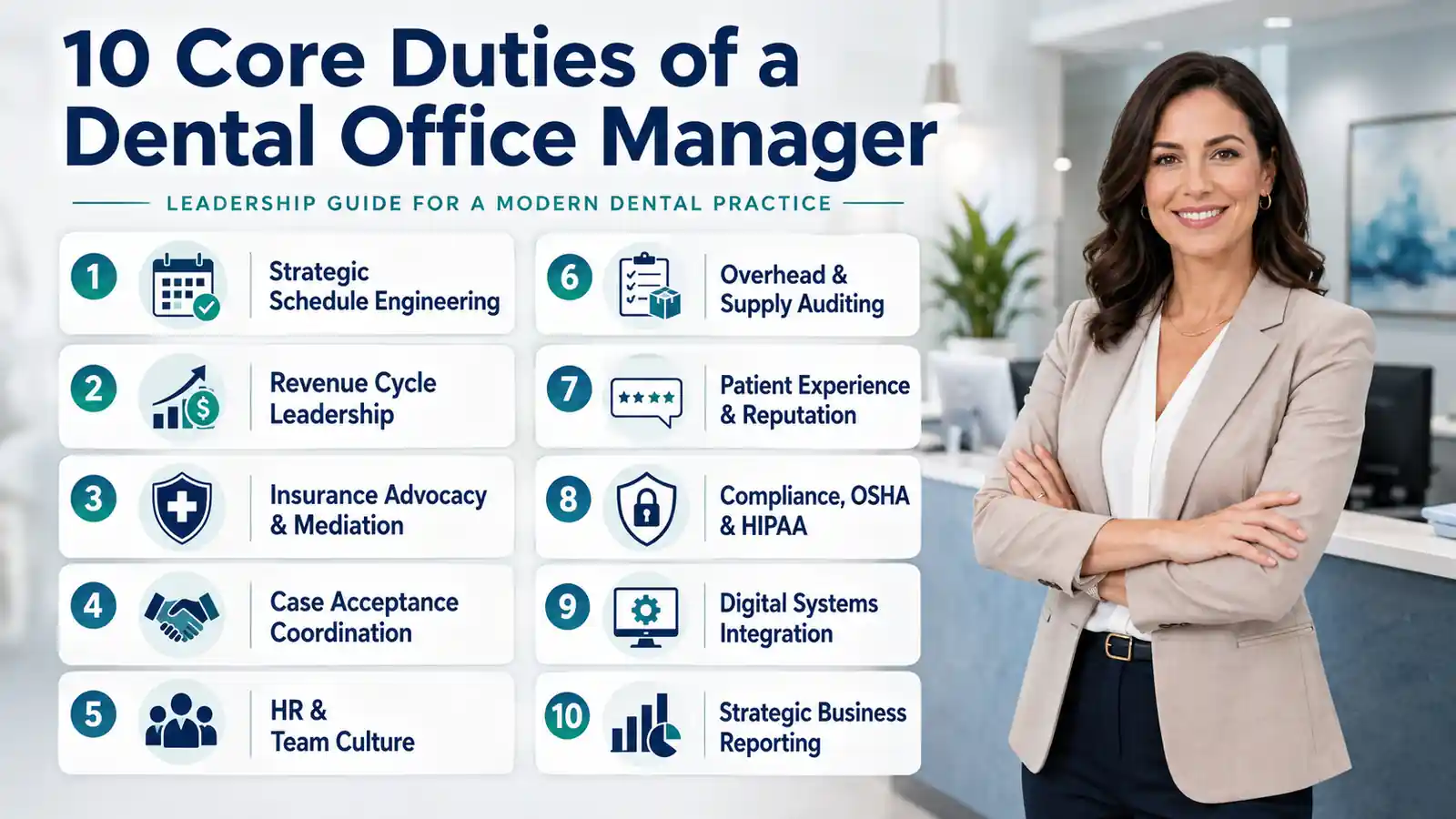
The Dental Office Manager is the “Chief Operating Officer” of the practice. Yes that’s a reality. To be a successful Dental Office Manager, you have to be part psychologist, part high-stakes negotiator, and part drill sergeant. While the Dentist is focused on the clinical work inside the patient’s mouth, you are responsible for the entire business behind it. If you want to move from being an “overworked employee” to an “indispensable partner,” you must master these 10 core pillars, several of which look different in 2026 than they did even a few years ago.
1. Strategic Schedule Engineering (The Tetris Master)
A static schedule is a recipe for a $0 day. You don’t just “fill slots”; you engineer the day for maximum production.
- The Reality: If a $2,500 crown cancels, you don’t fill it with a $150 cleaning. You maintain a “High-Value Priority List” of patients ready to move their major procedures up on short notice.
- The Goal: Minimize “dead air” where the Doctor is standing around with no one in the chair.
2. Revenue Cycle Leadership: Why AR Aging Is the Metric That Actually Determines Profitability
You ensure the practice’s “Production” actually turns into “Collections”, and this is the pillar where a manager’s attention (or inattention) shows up directly on the bottom line.
- The Reality: You oversee the handoff from the operatory to the front desk, ensuring every procedure performed is accurately coded and billed before the patient leaves the building. But billing correctly is only half the job. The other half is what happens to a balance that doesn’t get paid on the first statement.
- The Goal: Maintaining a net collection rate of at least 98%, and knowing exactly when internal follow-up stops being worth the staff hours it costs.
Why aging accounts need a different strategy than “call again.” A patient balance that’s 30 days past due still has strong recovery odds. By 90 days, that probability has dropped meaningfully, and it keeps declining roughly 10% for every additional month the account sits untouched. Most practices don’t lack a follow-up process, they lack a point at which the process changes. Sending the same reminder statement for the fifth time isn’t a strategy, it’s a habit, and it’s usually the reason a genuinely collectable balance quietly becomes a write-off.
This is exactly the gap a professional collection partner is built to close, not as a last resort after everything else has failed, but as a deliberate second stage once an account crosses roughly the 60–90 day mark. A well-run collections process doesn’t feel like a threat to the patient, it feels like a formal, respectful nudge that gets a meaningful share of stalled accounts moving again, without your front desk staff spending another hour on a call that goes to voicemail. Nexa’s dental collection services are built specifically around this handoff point, starting at a low fixed fee for fresher accounts, with contingency options for older balances. Practices that also bill through medical insurance for procedures like oral surgery may find Nexa’s medical collections services relevant for that side of the ledger too.
Talk to Us About Your Practice’s Aging AR
To ensure swift resolution and complete dispute-readiness, each placed dental account should include the patient’s signed financial policy agreement, an itemized treatment breakdown with ADA/CDT procedure codes and patient copays, insurance Explanation of Benefits (EOB) settlement records, and prior communication logs.
3. Insurance Advocacy & Mediation (The Fighter)
Insurance companies are designed to delay and deny. You are the barrier that prevents them from starving the practice.
- The Reality: You manage the “Insurance Aging Report,” personally calling adjusters to overturn “Radiograph missing” denials or “Not a covered benefit” excuses that should have been paid.
- The Goal: Getting claims paid within 14–21 days.
4. Case Acceptance Coordination (The Closer)
The Doctor diagnoses the need; you find the way to pay for it, and the financing landscape has genuinely changed.
- The Reality: You sit down with patients in a private “Consult Room” to break down complex treatment plans into manageable monthly payments. Beyond traditional in-house plans, most practices now offer point-of-sale financing through platforms like CareCredit, Sunbit, or Cherry, letting a patient walk out with financing approved in minutes rather than leaving to “think about it” and never coming back.
- The Goal: Turning “I’ll think about it” into a scheduled appointment before they walk out the door.
5. Human Resources & Cultural Chemistry (The Glue)
High staff turnover is the #1 “hidden” cost in dentistry. You manage the team so the Doctor doesn’t have to.
- The Reality: You handle the hiring, the difficult “performance reviews,” and the mediation of the inevitable friction between back-office assistants and front-office staff.
- The Goal: Creating a “no-drama” environment that patients can actually feel when they walk in.
6. Overhead & Supply Chain Auditing (The Watchdog)
Dental supplies can easily eat 10% of your gross revenue if not monitored.
- The Reality: You don’t just let the assistants order whatever they want. You negotiate with dental reps, compare prices on “gray market” vs. authorized dealers, and keep inventory tight.
- The Goal: Keeping dental supplies under 5–6% of total revenue.
7. Patient Experience & Reputation Management (The Face)
In the age of Google Reviews, one bad experience is a permanent stain.
- The Reality: You are the one who “saves” the patient relationship when a procedure goes wrong or a billing mistake happens. You respond to every review and ensure the “lobby vibe” is welcoming, not clinical.
- The Goal: A consistent 4.8-star rating and a high internal referral rate.
8. Compliance & Cybersecurity: The Threat That’s Bigger Than the Old Checklist
One audit, breach, or ransomware incident can end a practice, and the risk profile here has shifted significantly in the last two years.
- The Reality (still true): You are the designated Compliance Officer. You ensure the sterilization logs are signed, the SDS sheets are updated, and that no one is leaving patient charts open on the computer screen.
- The Reality (new, and larger): Healthcare ransomware attacks rose 58% in 2025, and dental and other secondary providers accounted for roughly 26% of those incidents. Attackers specifically target smaller practices because they assume, often correctly, that a five-chair office has weaker defenses than a hospital system. The average dental ransomware incident in 2025 cost around $85,000 once IT recovery, breach notification, legal fees, and lost production days were added up, and this isn’t hypothetical: named practices including Pecan Tree Dental in Grand Prairie, TX (roughly 13,300 records, January 2026) and 32 Pearls in Washington (roughly 23,000 records, May 2025) were hit directly. Delayed breach notification carries its own legal exposure separate from the attack itself, Westend Dental in Indiana paid a $350,000 settlement specifically for notifying patients late.
- The Goal: A “bulletproof” office ready for both a surprise OSHA inspection and a phishing email that a tired front-desk employee almost clicks on a Friday afternoon. Baseline defenses that matter most: endpoint detection software on every workstation (not just antivirus), tested offsite backups, multi-factor authentication on every remote login, and current software patching, since exploited, unpatched vulnerabilities were the leading root cause of healthcare ransomware incidents in 2025.
9. Advanced Digital Systems Integration (The Modernizer)
If you are still doing everything manually, you are wasting the practice’s money, and “digital” now means more than online scheduling.
- The Reality: You vet and implement software for automated appointment reminders, digital intake forms, online scheduling, and increasingly, AI-assisted real-time insurance eligibility verification that checks a patient’s coverage before they even sit down, instead of your front desk discovering a lapsed policy mid-appointment.
- The Goal: Automating 80% of administrative busywork.
10. Strategic Business Reporting (The Partner)
At the end of the month, you don’t just show the Doctor a bank balance; you show them a roadmap.
- The Reality: You track Key Performance Indicators (KPIs) like New Patient Flow, Case Acceptance %, No-Show Rates, and AR aging by bucket (30/60/90+ days). You present these numbers to the Doctor with a plan on how to improve them.
- The Goal: Giving the Dentist the “Financial Peace of Mind” they need to focus solely on clinical work.
Ultimately, the most successful Dental Office Managers are those who stop viewing themselves as administrators and start acting as the practice’s Chief Operating Officer, the person who turns the dentist’s clinical vision into a sustainable, high-growth business. Managing practice cash flow well, not just production numbers, is often what separates a practice that feels chronically strapped from one that genuinely isn’t.

Frequently Asked Questions
At what point does an aging patient balance stop being worth internal follow-up?
Generally once it’s been through two or three internal statement and phone attempts without resolution, typically around 60–90 days past due. Beyond that point, recovery odds decline roughly 10% for every additional month, and the staff time spent on repeated internal calls usually costs more than the fee for a professional recovery service that has a genuinely different structure for getting a stalled account moving.
How much does dental collections actually cost, and does it make sense for small balances?
A fixed-fee service typically runs a low flat rate per account (around $15 with Nexa) for fresher balances, with the practice keeping 100% of what’s recovered, or a contingency percentage for older, harder-to-reach accounts where no recovery means no fee. Even small balances are usually worth placing on a fixed-fee model, since the cost per account is low enough that recovering even a modest patient balance nets more than the internal staff time it would have taken to keep chasing it manually.
Is a dental practice actually a realistic ransomware target, or is that overstated for a small office?
It’s not overstated. Healthcare ransomware attacks rose 58% in 2025, and dental and other secondary healthcare providers accounted for roughly 26% of incidents. Attackers specifically favor smaller practices because they’re statistically likely to have weaker defenses than a hospital system, size doesn’t offer protection, it makes a practice an easier target, not a less interesting one.
What’s the real financial exposure if a dental practice is hit by ransomware?
The average dental ransomware incident in 2025 cost around $85,000 when IT recovery, breach notification, legal fees, and lost production days are combined, and that figure doesn’t include potential HIPAA penalties for delayed breach notification specifically, which has led to real settlements in the six figures for practices that didn’t notify patients promptly.
Do modern patient financing platforms like CareCredit or Sunbit actually improve case acceptance?
They generally do, because they remove the “let me think about it” moment that happens when a patient hears a large out-of-pocket number. Point-of-sale financing that approves in minutes lets the office manager close the treatment plan in the same visit, rather than hoping the patient calls back after doing their own math at home, where a meaningful share of “I’ll think about it” cases quietly become no-shows.
What’s the difference between a compliance officer’s HIPAA duties and a practice’s cybersecurity posture?
HIPAA compliance covers policies, training, and breach-notification procedures, largely administrative and documentation-based. Cybersecurity posture is the actual technical defense, endpoint detection, backups, multi-factor authentication, patching, that determines whether an attack succeeds in the first place. A practice can have a technically compliant HIPAA policy on paper and still be highly vulnerable if the underlying technical defenses haven’t kept pace, which is exactly the gap that’s caused real breaches at practices that assumed a signed policy was enough.
How does a strong AR process protect the patient relationship instead of damaging it?
Handled well, it does the opposite of what people fear. A structured, professional follow-up process, one that escalates predictably rather than through a series of increasingly awkward personal calls from front-desk staff, actually removes tension from the practice-patient relationship. The office manager and hygienist stay the “friendly face” of the practice, while a separate, respectful process handles the money conversation, which is generally the arrangement patients themselves prefer once a balance has genuinely gone unaddressed.
What KPIs should an office manager actually be tracking for accounts receivable specifically?
At minimum: AR aging broken into 30/60/90+ day buckets (not just a single total), net collection rate (collections divided by net production, with 98%+ as a reasonable benchmark), days in AR (average time from service to payment), and the percentage of total AR sitting past 90 days, which is the single number that best predicts how much revenue is at genuine risk of becoming uncollectable if nothing changes.
Need help with your practice’s accounts receivable? Contact us