Nexa Collections helps Chicago businesses, medical practices, and schools recover past-due balances within Illinois’s rules — including a 10-year statute of limitations on written contracts and the state’s own medical-debt credit-reporting ban. The process is easy to use, backed by responsive support and a secure client portal, with nationwide 50-state licensing behind it. Accounts are typically worked at a flat $15 fixed fee or 40% contingency, with no fee unless funds are recovered.
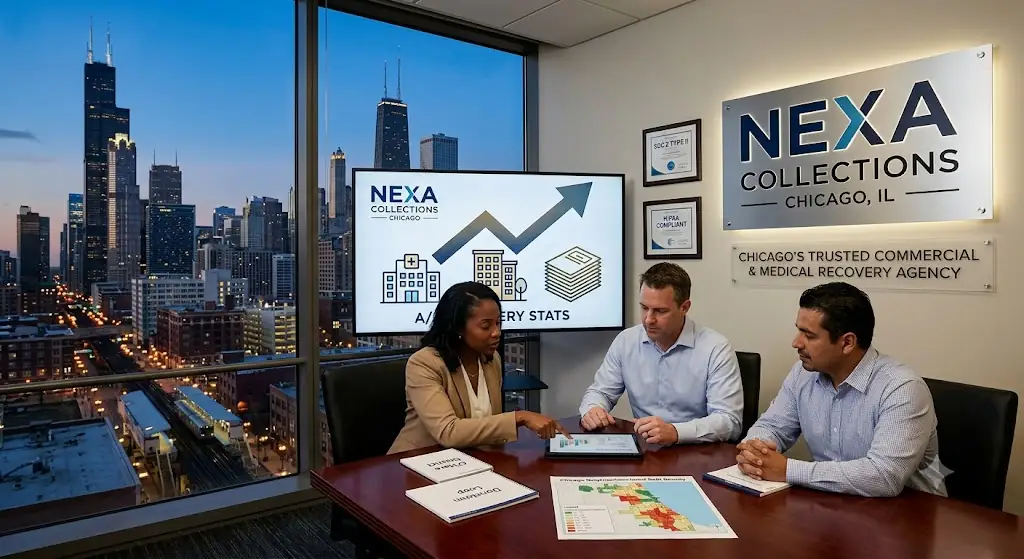
Chicago & Illinois’s 2026 Compliance Landscape: What Creditors Need to Know
Illinois runs longer on the statute-of-limitations clock than almost anywhere else, and shorter on the interest rate for most consumer-debt judgments than the headline figure suggests. Recovering revenue in Chicago works better when the approach accounts for both of those specifics rather than a single blanket rule.
The 10-Year Written Contract Window — One of the Longest in the Country
Illinois gives creditors ten years to sue on a written contract, promissory note, or other written evidence of indebtedness (735 ILCS 5/13-206) — one of the longest windows in the country, compared to the 4-to-6-year range common elsewhere. Oral agreements and open accounts carry a five-year window instead (735 ILCS 5/13-205). That gap matters: an account that would already be time-barred in most states can still have years of runway left in Illinois, provided the paperwork actually qualifies as “written.”
Illinois’s Own Medical-Debt Credit-Reporting Ban
Since January 1, 2025, Illinois has prohibited consumer reporting agencies from including medical debt on a credit report (Public Act 103-0648, 815 ILCS 505/2EEEE). The debt itself isn’t erased — providers and their collection partners can still pursue it — but credit-reporting leverage is off the table. Illinois is one of roughly 15 states with a law like this; its long-term durability is currently being tested in federal court on Fair Credit Reporting Act preemption grounds, though it remains the operative law in Illinois today.
Judgment Interest: 9% for Commercial, 5% for Consumer Debt
Illinois judgment interest isn’t a flat rate. Most judgments accrue at 9% per year (735 ILCS 5/2-1303), but consumer debt judgments of $25,000 or less — which covers the large majority of individual patient or membership balances — accrue at only 5% per year. Assuming the higher rate applies to a patient-debt judgment overstates what interest will actually add to the balance.
Illustrative Example: When “Written” Isn’t as Simple as a Signature
Consider a composite scenario grounded in a real 2026 Illinois appellate decision: a creditor assumes an account qualifies for the 10-year written-contract window because a signed application exists, but a court later has to determine whether disclosure documents created after signing — and never physically re-signed — still count as part of the “written” agreement. Illinois courts have found that properly incorporated follow-on documents can count, but it depends on the specifics. Confirming which documents actually qualify before assuming a 10-year window applies is worth doing early, not after a dispute is already underway.
Medical & Dental Practices: Recovering Revenue Under Illinois’s Reporting Ban
What Public Act 103-0648 Actually Changes
The law removes credit reporting as a tool for medical debt — it doesn’t touch a practice’s ability to bill, follow up, or place an account with a collection partner. Practices that built patient-communication scripts around a credit-reporting threat need those scripts rewritten, not just softened.
HIPAA-Aligned Recovery Across Chicago’s Hospital and Practice Networks
Whether the balance comes from a North Side specialty practice or a system-affiliated clinic, patient billing records carry protected health information regardless of size, and recovery is handled under HIPAA-aligned procedures throughout.
Illustrative Example: A North Side Practice Adjusting Its Approach
Picture a multi-provider practice that, into early 2025, was still sending patient letters referencing potential credit-reporting consequences — language that Public Act 103-0648 made inaccurate to use. Correcting that language and shifting toward direct communication and structured payment plans tends to resolve balances just as effectively without the compliance exposure of an outdated threat.
Schools & Higher Education in Chicago
Tuition and Fee Balances Without Losing Re-Enrollment
Private K-12 schools and higher-education programs across Chicagoland face the same tension found in other major metros: an unpaid tuition or fee balance needs resolving, but the same family may be expected back next term. A one-size-fits-all collections approach tends to cost more in lost re-enrollment than it recovers in cash.
Illustrative Example: A Private School Balance Resolved Before Fall Term
In a composite scenario typical of the Chicago private-school market, a family carries a spring balance into summer with fall re-enrollment paperwork pending. Offering a structured payment plan ahead of the re-enrollment deadline, rather than after, tends to resolve the balance without forcing a choice between collecting it and keeping the student enrolled.
B2B & Commercial Accounts Across Chicagoland
Small Claims for Smaller Balances
Illinois small claims court handles disputes up to $10,000 — a faster, lower-cost option for smaller B2B balances that don’t justify full civil litigation.
Wage Garnishment: Illinois’s Unusual “Gross Wages” Formula
Illinois calculates wage garnishment differently than most states: the cap is the lesser of 15% of gross wages (not disposable earnings) or the amount by which disposable earnings exceed 45 times the applicable minimum wage — currently $675/week at Illinois’s $15.00/hour minimum wage (735 ILCS 5/12-803). Debtors who qualify as head of family and earn under $1,750/month net may be fully exempt. Screening for this before litigation tends to be more useful than assuming a judgment will produce a predictable monthly amount.
Illustrative Example: A West Loop Vendor Invoice and the Head-of-Family Exemption
Consider a composite scenario: a West Loop consulting firm obtains a judgment against an individual client, only to find the debtor qualifies for Illinois’s head-of-family exemption due to dependent support obligations, making wage garnishment unavailable. Screening for likely exemptions before committing to litigation — rather than after winning a judgment that produces nothing — tends to be the more useful sequence.
Why Chicago Businesses Choose Nexa
Easy to Use, Start to Finish
Placing an account moves through a straightforward intake — balances, documentation, and account details — with a secure portal for tracking status afterward.
Backed by Responsive Customer Support
Questions about a specific account or the process in general get answered by a real point of contact rather than a support queue that goes quiet after onboarding.
Licensed Nationwide, Compliant Locally
Nexa operates with 50-state collection licensing, applied here with Illinois- and Chicago-specific rules layered on top rather than a one-size-fits-all national script.
Reputation-Conscious Recovery Across Chicagoland
From the Loop to the suburbs, a debtor today can be a referral source or repeat client tomorrow — recovery is handled with that relationship in mind, not just the balance owed.
Chicago Success Stories
The scenarios below are illustrative composites drawn from the kinds of situations that come up repeatedly across Chicago receivables, not verified individual case results, but they reflect the actual mechanics of how each type of recovery tends to get resolved.
The North Side Practice Correcting Its Patient Letters
Problem: A multi-specialty clinic’s patient correspondence still referenced credit-reporting consequences for unpaid balances, months after Public Act 103-0648 made that language inaccurate.
Approach: Nexa corrected the compliance gap and shifted to structured, documented payment plans and direct outreach instead.
Outcome: A meaningful share of the aging balance was resolved within a couple of months, with the practice’s patient communications brought back into compliance.
The West Loop Fitness Studio and Its Chargeback Problem
Problem: A West Loop fitness studio was losing revenue to membership chargebacks and card-on-file churn, on top of standard unpaid dues.
Approach: A policy review alongside the standard collection sequence identified where cancellation and billing communication was creating disputes in the first place.
Outcome: Chargebacks declined meaningfully alongside the recovered balances, addressing the underlying pattern rather than just the immediate accounts.
The Suburban IT Firm’s B2B Invoice Dispute
Problem: A suburban Chicago IT services firm was owed a substantial balance on a service agreement the client disputed as incomplete.
Approach: A documentation review clarified which deliverables had actually been completed, and an amicable outreach sequence backed by that documentation was used before any legal step.
Outcome: The balance was substantially resolved within a few months without litigation.
Industries We Serve in Chicago
Chicago’s economy runs on finance and professional services in the Loop, healthcare systems spanning the city and suburbs, and manufacturing and logistics tied to its position as a national transportation hub, and the approach that works for a Loop law firm doesn’t work for a North Side dental practice.
Medical & Dental
Practices navigating Illinois’s medical-debt reporting ban need recovery built around documented, HIPAA-aligned communication rather than credit-reporting leverage that’s no longer legally usable.
Schools & Higher Education
Tuition, fees, and housing balances recovered with an eye toward re-enrollment, not just the balance owed today.
Finance & Professional Services
B2B recovery for the Loop’s financial and professional-services firms, where the 10-year written-contract window and the 5%/9% judgment-interest split both matter for how a balance gets valued.
Logistics & Manufacturing
Commercial account recovery for businesses tied to Chicago’s rail, trucking, and manufacturing base, where documentation discipline matters as much as outreach.
Senior Living
Family and estate-representative recovery for Chicagoland’s senior living facilities, handled with a measured, dignity-first approach.
Fitness & Membership-Based Businesses
Recovery for membership and card-on-file balances, paired with a look at where cancellation or billing policy gaps are creating avoidable disputes in the first place.
Trust, Security & Compliance
HIPAA & BAA Coverage for Medical and Dental Accounts
Patient billing records carry protected health information regardless of Illinois’s credit-reporting rules. Nexa maintains HIPAA-aligned handling procedures for medical and dental accounts and executes a Business Associate Agreement (BAA) with practices that require one.
FDCPA & Illinois Consumer Fraud Act Alignment
Every account is worked in alignment with the federal Fair Debt Collection Practices Act, alongside Illinois’s Consumer Fraud and Deceptive Business Practices Act — the same statute that now governs medical-debt credit reporting in the state.
SOC 2 Type II & PCI-DSS Data Security
Data handling is SOC 2 Type II certified — meaning security and privacy controls have been independently audited, not self-reported — and payment processing runs at PCI-DSS Level 1, a high tier of card data encryption.
Secure Client Portal for Documentation & Account Tracking
Patient ledgers, tuition records, invoices, and correspondence are exactly the kind of sensitive documentation that shouldn’t move through email. A secure client portal lets you upload that documentation, track account status, and monitor recovery progress without exposing patient, student, or client data to unnecessary risk.
Transparent Pricing for Chicago Accounts
Fixed-Fee Recovery ($15/account)
Ideal for early-stage receivables. Debtors pay 100% directly to you. No commissions.
Contingency Service (40%)
Performance-based recovery. No Recovery, No Fee.

See the full breakdown on the collection agency fee schedule page.
Frequently Asked Questions
What’s the statute of limitations on a debt in Chicago?
Ten years for written contracts (735 ILCS 5/13-206) and five years for oral agreements or open accounts (735 ILCS 5/13-205) — one of the longer written-contract windows in the country.
Can medical debt still be reported to credit bureaus in Illinois?
No. Since January 1, 2025, Public Act 103-0648 prohibits consumer reporting agencies from including medical debt on a credit report. The debt itself is still collectible; only the credit-reporting option is off the table.
Can you garnish wages in Illinois, and how much?
Yes, but Illinois caps it at the lesser of 15% of gross wages or the amount by which disposable earnings exceed 45 times the applicable minimum wage — currently $675/week. Debtors who qualify as head of family with net income under $1,750/month may be fully exempt.
Illinois generally limits wage deductions to the lesser of 15% of gross weekly wages or the amount by which disposable earnings exceed 45 times the applicable federal or Illinois minimum wage, whichever is greater. Additional exemptions or limitations may apply depending on the debtor and debt type.
What interest applies to a Chicago judgment?
It depends on the debt type: 9% per year for most judgments, but only 5% per year for consumer debt judgments of $25,000 or less, which covers most individual patient or membership balances.
How much does a Chicago collection agency cost?
Early-stage accounts run on a flat $15-per-account fixed fee, with debtors paying you directly and no commission taken. Older or harder-to-reach accounts move to a 40% contingency fee, charged only on what’s recovered.
Is patient billing data handled under HIPAA?
Yes. Medical and dental accounts are processed under HIPAA-aligned procedures, with a Business Associate Agreement executed where the engagement requires one.
Start Recovering in Chicago
Illinois’s rules reward getting the specifics right — a 10-year window that depends on what counts as “written,” and a judgment interest rate that depends on what counts as “consumer.” Let Nexa handle recovery within the current rules so your business, practice, or school isn’t the one finding out the hard way.