In Chesapeake, one unpaid invoice may be tied to freight sitting in a warehouse, another to a hospital payment plan, and another to a contractor waiting on retainage. Calling all three “past due” does not make them the same collection problem.
That distinction matters in a city built around logistics and supply chain, defense and security technology, advanced manufacturing, professional services, and healthcare. Chesapeake’s location near Hampton Roads also means many businesses work across ports, warehouses, military-adjacent industries and regional supply chains.
Secure Your Revenue: A Smart Collection Strategy for Chesapeake Businesses
Nexa gives Chesapeake creditors a reputation-safe way to match the recovery strategy to the receivable. Fresher balances can start with the $15 fixed-fee program; harder accounts can move to 40% contingency recovery; healthcare accounts use HIPAA-conscious workflows; and commercial disputes are worked from the contracts, delivery records and account history behind the invoice.
The goal is not to chase every debtor harder. It is to understand what leverage already exists—and use the least disruptive path that can still get the account paid.
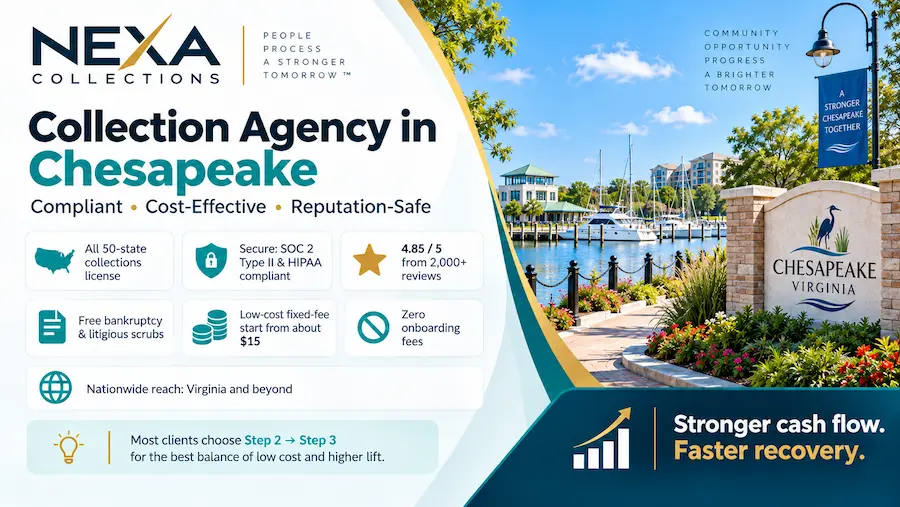
Nexa provides a reputation-safe approach, equipped with all 50-state collections license, offering free credit reporting, free litigious debtor check, free bankruptcy scrub, and zero onboarding fees. Secure – SOC 2 Type II & HIPAA compliant. Over 2,000 online reviews rate us 4.85 out of 5.
Need a Chesapeake Collection Agency? Contact us
The Chesapeake Risk Profile: Why You Need Protection
Every city has a unique economic pulse. In Chesapeake, the mix of healthcare providers, heavy industry, and service businesses creates specific payment risks.
-
High Turnover: With a transient military population near Hampton Roads, debtors often relocate quickly. If you wait 90 days to collect, they might already be in another state.
-
The “write-off” Trap: Local businesses often write off small debts ($200-$1,000) because traditional agencies charge 50% fees, making recovery pointless. We fixed this math.
We offer a different path: A hybrid model that combines low flat fees with high-powered contingency.
How We Recover Funds (Without the High Costs)
We don’t believe in charging you 40% on a debt that could have been solved with a simple, authoritative letter. Our system is built to filter out easy collections cheaply.

Phase 1: The “Flat-Fee Firewall” (Steps 1 & 2)
Before we start taking a percentage of your money, we use a fixed-cost approach to wake up dormant accounts.
-
The Strategy: We send a series of official demands.
-
The Cost: Less than the price of a lunch per account (approx. $15).
-
The Benefit: This phase usually resolves roughly 40-50% of unpaid bills. The best part? You keep 100% of the recovered funds. No commissions.
Phase 2: Intensive Recovery (Step 3)
If the flat-fee demands don’t work, we instantly shift gears.
-
The Strategy: Our team begins targeted phone calls, skip-tracing (locating debtors who moved), and negotiation.
-
The Cost: 40% contingency.
-
The Benefit: Zero risk. If we don’t collect at this stage, you don’t pay a dime.
Phase 3: Litigation Support (Step 4)
-
The Strategy: For high-balance refusals, we have a network of attorneys ready to file suit in Chesapeake courts.
-
The Cost: 50% contingency.
Recent Recoveries
Marine Equipment Distributor — Fixed-Fee | 92% Recovered
A Hampton Roads supplier placed $9,500 in fresher commercial balances. Fixed-fee follow-up recovered $8,740 — 92%.
Commercial Collection Services
Healthcare Staffing Company — Contingency | 84% Recovered
A regional staffing provider assigned $31,000 in older facility invoices after internal AP follow-up stalled. Documentation-led recovery returned $26,040 — 84%.
Security & Access-Control Contractor — Contingency | 71% Recovered
A Chesapeake-area provider placed $22,800 in installation and monitoring balances. Contract-focused recovery produced $16,188 — 71%.
Security Alarm Collection Services
Why Chesapeake CFOs and Managers Choose Us
1. We Are “Google Review” Safe : A bad collection agency can ruin your online rating faster than a bad product. We prioritize a diplomatic approach that preserves the debtor’s dignity—and your 4.8-star rating.
2. Free Due Diligence: Before we suggest legal action, we run free bankruptcy and litigious checks. We won’t let you throw good money after bad if a debtor has already filed Chapter 7.
3. Local Compliance Mastery : Virginia isn’t the Wild West. We adhere strictly to the FDCPA and Virginia-specific statutes regarding statute of limitations (generally 3 years for open accounts, 5 for written contracts in VA). We insulate you from liability.
Sector Spotlight: Who We Help
Medical & Dental, Hospitals (HIPAA Compliant), Schools, Small Businesses, CPA & Professional Services, Commercial B2B, Contractors, Restoration, Property Management, Security & Alarm, Utilities, Government, Gyms & Fitness, Hospitality, Logistics & Manufacturing.
Common Questions (FAQ)
Can a Chesapeake warehouse or carrier hold goods when storage, freight or demurrage charges are unpaid?
Potentially, yes.
Virginia’s commercial code gives a qualifying warehouseman a lien on goods in its possession for charges including storage, transportation, insurance, labor and certain related expenses. A carrier can likewise have a lien on goods covered by a bill of lading for transportation, storage, demurrage, terminal charges and qualifying preservation expenses.
Those rights can be powerful, but they depend on possession, the governing documents and statutory procedures. For example, a carrier generally loses its lien when it voluntarily delivers the goods. A warehouse enforcing its lien must also follow Virginia’s notice and commercially reasonable sale requirements.
For a Chesapeake logistics or distribution account, keep the warehouse receipt, storage agreement, bill of lading, rate confirmation, demurrage records, release instructions, invoices and payment history together before deciding whether ordinary collection, lien enforcement or another approach makes sense.
Commercial B2B Collection Services
A Chesapeake subcontractor has finished the work, but the GC says, “We haven’t been paid yet.” Can payment simply be withheld?
Virginia has significantly limited the old “pay-if-paid” approach in construction contracts.
For qualifying private construction contracts, owners generally must pay a general contractor within 60 days after receiving an invoice following satisfactory completion of the invoiced work. If the owner intends to withhold payment, written notice generally must be provided within 45 days, identifying the contractual reason and amount withheld. Contractors generally have parallel obligations to their subcontractors, including payment within 60 days and written notice of withheld amounts within 50 days.
Virginia law also says payment by the owner generally cannot be made a condition precedent to paying the subcontractor, except in limited circumstances such as the upstream party’s insolvency or bankruptcy.
For collection, save the subcontract, approved change orders, schedule of values, pay applications, completion records, punch-list status and any written withholding notices.
Contractor Collection Services
What must a Chesapeake hospital do before treating an uninsured patient balance like an ordinary collection account?
Virginia requires general hospitals to do more than simply issue a bill.
A general hospital must make reasonable efforts to screen every uninsured patient for eligibility for Virginia medical assistance or the hospital’s own financial-assistance policy. If an uninsured patient qualifies for financial assistance, the hospital must inform the patient of the option to enter into a payment plan.
Those payment plans must be based on the patient’s ability to pay, cannot include payment-plan fees, allow early payment without penalty and can be renegotiated. Hospitals must also disclose charity-care and payment-plan information.
For a Chesapeake medical provider, that makes account classification critical: insurance pending, financial assistance, active payment plan and verified patient responsibility should not be treated as the same bucket.
A Chesapeake company supplied goods or services to a city or other Virginia locality. How long can the public agency take to pay?
Virginia’s Prompt Payment rules give vendors a useful benchmark.
A local government agency generally must pay for completed goods or services by the date stated in the contract. If the contract does not establish a payment date, payment generally must be made no later than 45 days after the goods or services are received or 45 days after the invoice is rendered, whichever is later.
If the agency believes there is a defect or other problem preventing payment, it generally must notify the supplier within 20 days after receiving the invoice or goods/services. Unless the contract says otherwise, qualifying late payments can also carry finance charges of up to 1% per month.
For government-facing receivables, preserve the purchase order, procurement contract, proof of delivery, invoice date, acceptance documentation and any written notice identifying a payment defect.
Government Collection Services
Chesapeake Public Schools has many schools with free meals. Can unpaid meal balances still be treated like ordinary school debt?
Not all Chesapeake schools operate under the same meal-payment structure.
Chesapeake Public Schools currently lists 31 schools participating in the Community Eligibility Provision, allowing enrolled students at those schools to receive breakfast and lunch without charge.
At schools where charges apply, CPS says students may charge a complete breakfast or lunch when they lack sufficient funds, but they cannot charge à la carte or incomplete meals. The district attempts to contact parents or guardians regarding negative balances and specifically states that it will not file a lawsuit against a student or parent because of school-meal debt. Collectible delinquent meal debt remains on the student account while the student is enrolled.
That is very different from documented private-school tuition, extended-care fees, damaged devices, transportation charges or other contractual education receivables.
If a Chesapeake creditor wins a judgment, can 25% of the debtor’s paycheck always be garnished?
No. Twenty-five percent is a ceiling, not an automatic entitlement.
For an ordinary Virginia debt, garnishment is generally limited to the lesser of 25% of disposable earnings or the amount by which disposable weekly earnings exceed 40 times the higher applicable federal or Virginia minimum hourly wage.
If weekly disposable earnings do not exceed the protected threshold, there may be nothing available for ordinary wage garnishment. Different rules can apply to support, taxes, bankruptcy orders and other specially treated obligations.
That makes it useful to evaluate collectability before spending heavily on litigation rather than assuming every judgment will produce a predictable wage deduction.
Don’t let your hard-earned revenue sit in someone else’s bank account.
Click here to Get a Quote & Start Collecting